Love, Freedom, Solitude & Consequence

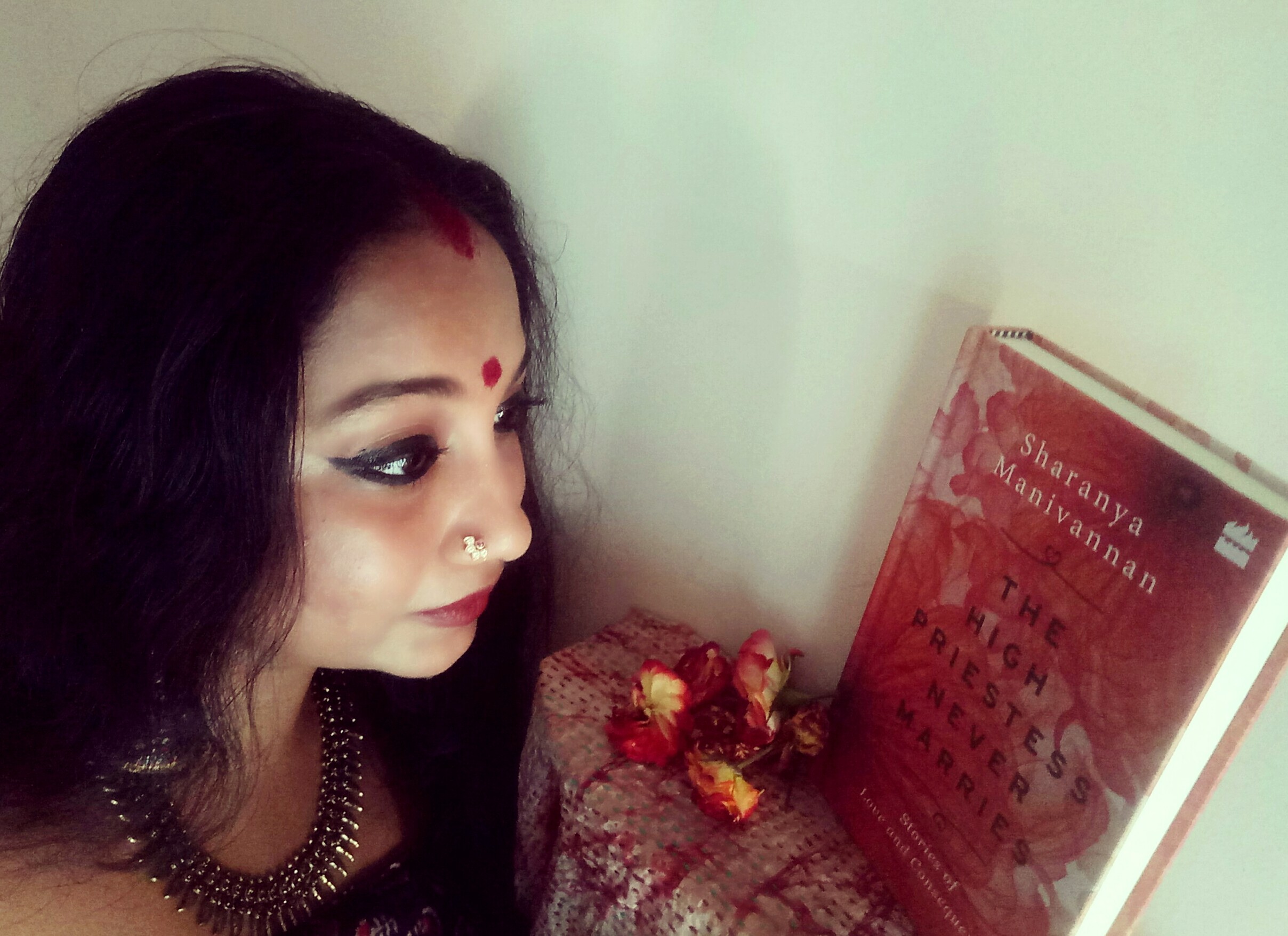
When negotiating the delicate balance between aloneness and isolation, these lines from Jane Hirshfield’s poem “Vinegar and Oil” waft back to me – “Wrong solitude vinegars the soul,/ right solitude oils it. // How fragile we are, between the few good moments.” There are ways to reject the institution of marriage without having to deny the emotional impact of giving up social legitimacy, protection and – indeed – companionship. That’s the reason why my new book of short stories, The High Priestess Never Marries, is subtitled as follows: Stories of Love and Consequence.

There are consequences to loving, there are consequences to pretending to be in love, there are consequences to leaving, there are consequences to pretending to not want love. No matter who you are, you must negotiate these.

These are the consequences that the intelligent, and often very brave, women in my book of stories confront. They are women who, if you asked them, would say “bachelorette” is an andro-centric diminutive; reclaiming “spinster” is a stronger statement. They are widows. They are adulterers. They are lovers, they are losers, they are leavers, they are seekers.

The institution of marriage is profoundly problematic, deeply patriarchal in nature. To be a feminist is to necessarily challenge it. In India, for instance, we know that statistically speaking, women are leaving the workforce at an unprecedented rate (participation stands at just 27%, even compared to 37% a decade ago) – which means that a woman’s passions and ambitions, no matter her achievements or education level, are simply sublimated into the system. We know that only 5% of marriages are inter-caste, which means that even in so-called “love marriages”, the fundamental function of the institution as a means to perpetuate hierarchical systems remains virtually intact. We know that marital rape is not recognised by law, incontrovertible proof of the idea that a woman, and by extension her body, become the property of the household into which she marries. These are not uniquely Indian problems. It is not a coincidence that the English word “husband” is of agricultural origin: a wife was among the possessions he managed on his property.

It must be possible to challenge the system from within it, and some of the characters in my book try to, through transgressions and interrogations. But to not be within it affords its own agency, even as it strips a woman of privileges as varied as not being regarded as morally bankrupt to the literal, physical security of a companion to walk dark streets with (a companion who, if questioned by the equally patriarchal law enforcement system, can validate the relationship where a woman’s word alone has no currency). And it’s those women – the loners and non-conformists, who largely fill the pages of this book.

Autonomy may be stained with fear, but it is pervaded by freedom. It is in this freedom that the characters in The High Priestess Never Marries play, pray, push the envelope and prise their own hearts open continuously. They dive into the myths. They trek into the mountains. They dip their paintbrushes into the palettes of their lives. They serve their hearts on a platter, seasoned to perfection. They weep into the sea. They have lovers’ tiffs with the moon. They copulate with trees and devote themselves to deities. They keep very still. They sing. They sigh. They say No, they say Never, they say Not Now – they say Yes Yes Yes O Yes.

They fall. But how they fly.

(An edited version appeared on Bonobology.com)
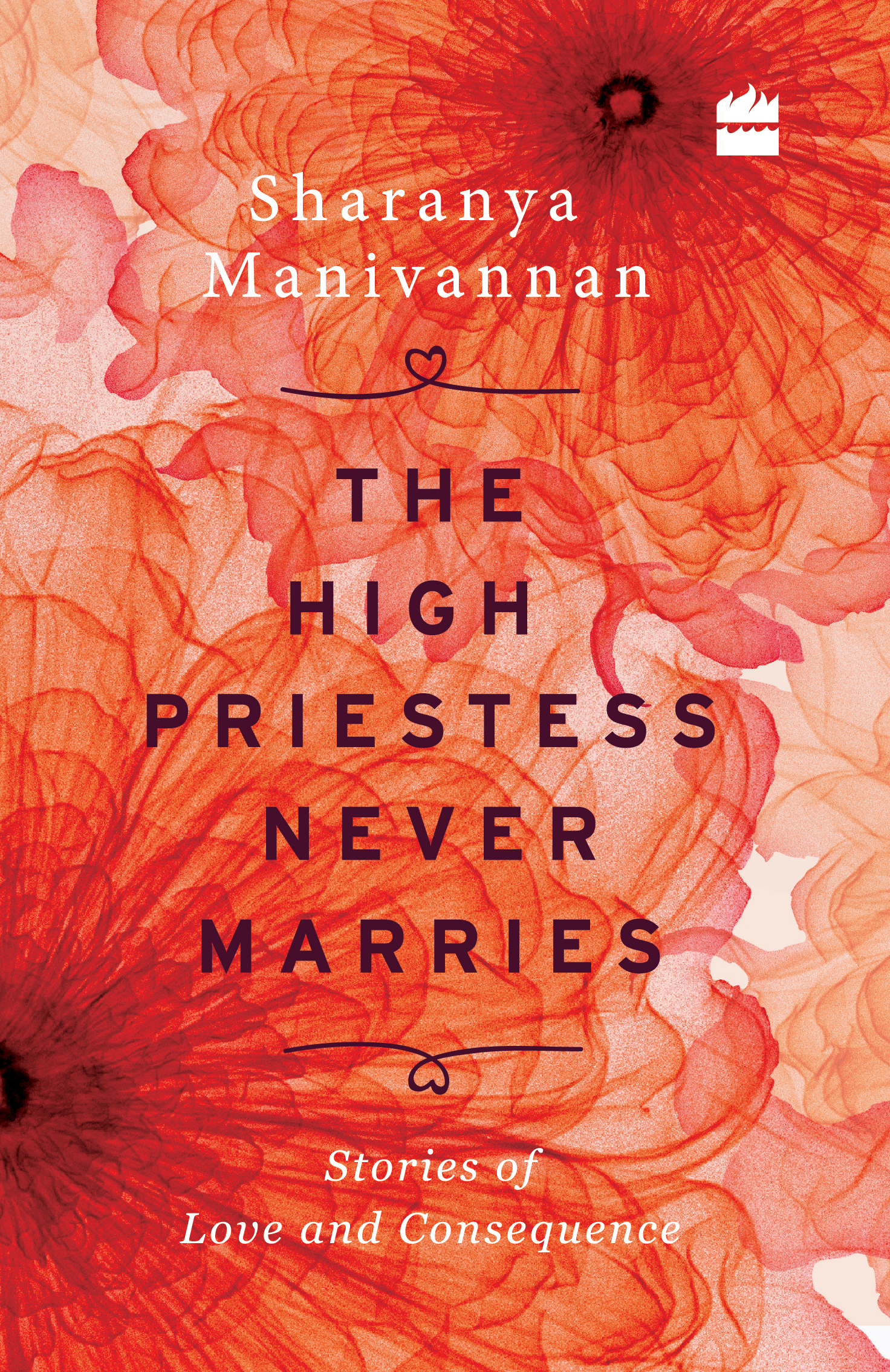
~ THE HIGH PRIESTESS NEVER MARRIES ~

The High Priestess Never Marries

A Sri Lankan mermaid laments the Arthurian Fisher King; a woman treks to a cliff in the Nilgiris with honey gatherers of the Irula tribe; a painter fears she will lose her sanity if she leaves her marriage and lose her art if she stays faithful within it; one woman marries her goddess; another, sitting in a bar, says to herself, ‘I like my fights dirty, my vodka neat and my romance anachronistic.’The women in this collection are choice makers, consequence facers, solitude seekers. They are lovers, vixens, wives to themselves. And their stories are just how that woman in the bar likes it – dirty, neat and sexy as smoke.

Selected reviews, interviews & articles

“A formidable debut” – Aditya Mani Jha, The Hindu Business Line

“Manivannan’s language has desire written into its very bones, from its simplest forms to a more complex reenactment of the power play between men and women. Sensuality judders through each story and each encounter is rendered erotic through its sharp intensity and temporariness. Hers is a liquid prose that flows from one vignette to the next. The words are limpid pools of passion and pain filled with portents of despair, palli doshams and other untranslatable astral signs. It is the perfect tongue for these high priestesses, poetesses, goddesses, and the vixen who love and live according to their own terms.” – Diya Kohli, Open Magazine

The High Priestess Never Marries is a tour de force of language, desire, and ancestral heartbeats.” – Richa Kaul Padte, The Establishment

“This collection of short stories by Sharanya Manivannan claims to set forth stories of love and consequence. To agree with her would be unfair, for her stories are so much more. They are my secrets and desires in written form, picked unknowingly from my body and mind, given back to me in a manner so exquisite that is almost painful to contemplate.” – Anusha Srinivasan, amuse-douche (republished in The Madras Mag)

The sheer power and beauty of The High Priestess Never Marries will leave you breathless…” – Baisali Chatterjee Dutt, Bonobology.com

“[An] anachronistic romance to me isn’t one that is boxed into a particular life, but one that gently touches that kind of certainty now and then, an act of belonging.” – Helter Skelter Magazine (with Niharika Mallimaguda)

“But it is only a particular beloved who cannot receive [love]. The world at large, with its wounded wings, its gaping craw, can.” – Scroll.in (with Urvashi Bahuguna)

“[W]hat calls out to me is the secret resilience of women, not the sexist assumption of their strength ” – THread (with Tishani Doshi)

“I love Sharanya Manivannan’s women. They did not demand my sympathy. They did not offer condescension either. They were beautifully vulnerable, incredibly human.” – Deepika Ramesh, Worn Corners

“Deep oceans, old legends, star-filled skies, turmeric, vermilion – all the environments and embellishments of this book – I felt, in the end, come together to explore and disclose a certain feminine mystique – ancient and eternal, brimming with desire, flawed, fertile, heartbroken. Most of all, irrepressible.” – Tulika B., On Art & Aesthetics

“The book started on a fun note: misadventures in love. It gradually grew into what it means to build alone, without the scaffolding of the social legitimacy of marriage. What does one do with her heart when it is chronically broken, but when she refuses to bend her will alongside it? That’s what the stories in this collection attempt to answer.” – SheThePeople.TV (with Sukanya Sharma)

“Manivannan, a well-regarded poet, brings her penchant for deft encapsulations to her fiction.” – Pooja Pillai, The Indian Express

Purchase online

Amazon.in

Amazon.com

Infibeam

sharanya-navaratri

Save

Save

Save

Save

~ THE AMMUCHI PUCHI ~

the-ammuchi-puchi

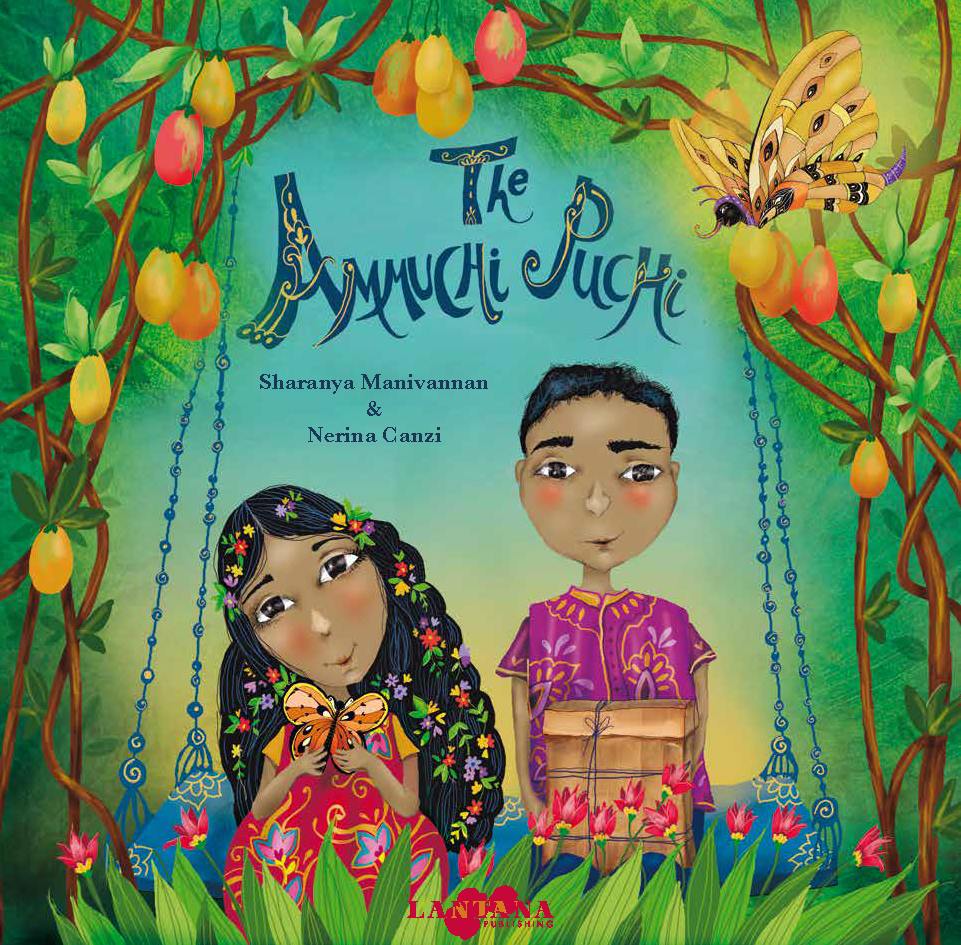
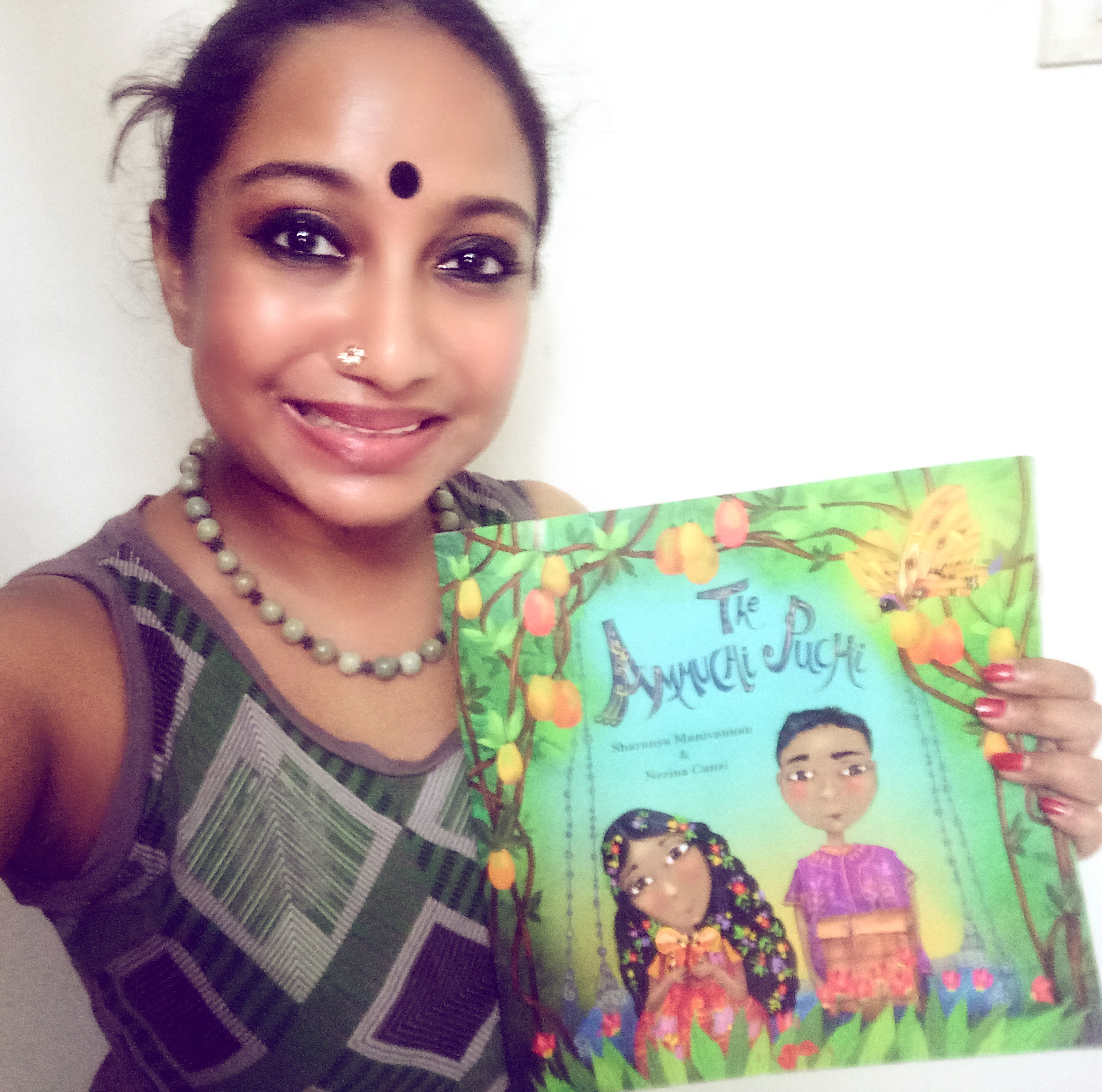
When Anjali and I were really little, we were sort of afraid of our grandmother, Ammuchi…

Aditya and Anjali love listening to their grandmother’s stories, particularly the scary one about the ghost in the tree. But the night their grandmother passes away, all her stories seem to lose their meaning. Then something happens that is more mysterious and magical than any story. Could their grandmother still be with them after all? A poignant and moving story about bereavement and healing, stunningly illustrated and told in gorgeous poetic prose.


Selected reviews & interviews

‘Sharanya Manivannan’s beautiful story will help sensitive children from the world over make friends with loss, and Nerina Canzi’s colour-drenched, jewel-like illustrations bring this tale of grandmothers, families and a very special butterfly to radiant life. The Ammuchi Puchi will take children, and adults, of all ages, on an unforgettable, sweet-sad journey from grey back into a world of glorious colour.’ – Nilanjana Roy, award-winning author of The Wildings

‘Stunning, vibrant illustrations bring this book to life… Not only is this a poignant story, handling the issue of bereavement with tact and understanding, it also shows children that grief is a universal emotion, shared by all cultures and peoples. Simply beautiful!’ – North Somerset Teachers’ Book Awards blog

‘This is just a beautiful book, about love and loss and magic and subjective truth, the hugest of subjects delicately handled for the smallest of people.’ – Preeta Samarasan, award-winning author of Evening is the Whole Day

‘I was genuinely very emotional by the end of this book. I loved these children and their grandmother so much, it’s a very important relationship exemplified with emotion and heart…. The story itself is artfully done, we learn about a strong, sparky, joyful and creative female role model in Ammuchi, who adores her grandchildren, inspires them and ignites their imaginations! … A traditional story feel, bursting with bright colours and emotion set to the backdrop of beautiful India. One for every bookshelf and library.’ – Alexis Filby, Book Monsters

‘The essence of Ammuchi Puchi is of universal appeal and relevance. It’s a beautiful picture book, both for sharing and, with its satisfyingly substantial text, for an older child to read alone. It is a moving, thought-provoking story that doesn’t offer any answers, but only asks of its readers that they have an open mind – and is all the richer because of it.’ – Marjorie CoughlanWindows, Mirrors, Doors

On Magical Butterflies And The Special Love Of Grandmothers” – Interview on the Lantana Publishing blog


Purchase online

Lantana Publishing

Amazon.in

Book Depository


sharanyamanivannanammuchipuchi


The Ammuchi Puchi ~ written by Sharanya Manivannan and illustrated by Nerina Canzi ~ Lantana Publishing, UK, October 2016

Save

The Venus Flytrap: Even The High Priestess Has To Hustle

In the classic Sex And The City episode, “A Woman’s Right To Shoes”, Carrie – a successful, single writer – attends a birthday party for the child of an old friend. She is requested to remove her shoes at the door. When she goes to retrieve them as she leaves, she finds that someone with the same size and very little impulse control has strutted off in them. Specifically, in $485 Manolo Blahnik heels.

After a few days, Carrie sheepishly goes back to check if the shoes may have turned up. Her friend offers to pay for them, balks at their cost, tells Carrie she finds it ridiculous and gives her less than half instead. She thoroughly shames her for what she calls her “extravagant lifestyle” and compares it unfavourably against her choices: kids, houses and the like.

Carries leaves, feeling awful, and eventually comes to her senses: if she has spent large sums of money on gifts for this friend at all the “milestones” of her life (most recently, her child’s party), why does her friend begrudge the achievements of hers, just because they don’t involve matrimony and mortgages? She finds an ingenious way to prove her point that plays right into her friend’s bourgeois worldview.

I recently watched this episode again after many years and found myself quite emotionally invested in it. I identified with Carrie’s shame and indignation, and wished for myself her audacity in fixing the situation. Instead of stewing in a pot of polite resentment, as I’ve been doing.

In October, I had not one but two new books published: The High Priestess Never Marries and The Ammuchi Puchi. My social media feeds right now alternate between the evocative red of the first’s cover and the vibrant jewel tones of the second’s pages. But each time I talk or share about my books, I feel guilty and apologetic.

Because you see, ultimately, devotion to art is not seen as legitimate in the eyes of most of society. It’s the thing you do because you’re selfish. It’s the thing you do because you snub approved goalposts. It’s the thing you do because a girl like you with so much time on her hands needs a hobby.

I don’t believe any of that. But I’m affected by it. What a catch-22: if I didn’t care, I wouldn’t have made the labours of love that I have made.

Why should I feel like I’m hustling when all I’m doing is showing you my heart? And my heart isn’t composed of hashtags, it isn’t crowdsourced attention, it isn’t app-friendly. My heart isn’t the hubris of overnight success, it isn’t borrowed or bought.

Not your baby’s first poop, but my baby’s first reader. Not my selfie of the day, but my selfhood, woven in words. Not a smile plastered on in hungover honeymoon photos, but the tears I wasn’t afraid to let anyone see. Not a posh new address on Papa’s money, but the sanctuary I am building with my own hands and the gifts and curses life gave me.

I cheer on the choices you make. Why can’t you cheer on the chances I take?

An edited version appeared in The New Indian Express on November 10th. “The Venus Flytrap” appears on Thursdays in Chennai’s City Express supplement.

The Venus Flytrap: A Postcard From Bundjalung Country

I write this to you by hand from a wildlife sanctuary in Brisbane. My companions have gone to an animal show, while I have chosen to catch my breath and reflect. I am surrounded by bird calls (I promised you this a few weeks ago) and the quick footsteps of excited children. I still have white sand in my shoes from a beach I stole away to on my last morning in Byron Bay. This brings to mind the first time that I travelled to this land, when I’d lain on my back under regal trees and it was Singapore by the time I washed Larrakia country out of my hair.

But that was Darwin, in the North, and it is Bundjalung country I have been in this time.  On one of three rainy days, the writer Jeffery Renard Allen and I were having coffee when a woman came up to us and asked if we wanted to meet one of the Elders. That woman was Dale Simone Roberts, and as Jeff leant to be introduced to the seated Elder, Aunty Dorrie Gordon, Dale turned to look me in the face and said “Bless your journey. I can see a little bit. You’ve been fighting for the women.”

I burst into tears.

I don’t know what it was: the history and trauma embodied by Aboriginal people like Aunty and Dale, and the ordeal and fresh wounding embodied by Jeff, as an African-American man in the world today; or the fact that while I was contemplating the everyday resilience of others, someone had seen right into mine. Aunty blessed me in her way, and I touched her feet first, as we do in mine.

Immediately after, a precious conversation with Helen Burns, a local writer with whom I’d forged an instant bond upon discovering that we are both writing fiction projects on Andal. She told me how sometimes she sees a person in Tamil Nadu, on a bus perhaps, and could swear that they were Aboriginal. In Pitjanjara (one of many indigenous languages), she said, the word for ‘parrot’ is ‘kili’. I fished into my handbag for my notebook to write this down, and it fell open to an image of Andal I hadn’t realised I had carried to this distant continent.

How many countries are within each nation? How many countries are within each individual?

Among my panels was one on multicultural influence. My passport declares one thing, my heart and tongue claim another, and my history sprawls though acres of a third.

But an Australia-India Council grant has brought Rosalyn D’Mello, Salma and I here to promote our feminist anthology, Walking Towards Ourselves, and over and over again we found ourselves simultaneously adding nuance to popular narratives and expounding on the dire condition of women in India. One journalist told us that a national Year 12 exam asks students to write essays on the same. On us.

 And when she asked about India itself, I told her a list of things I was afraid to speak about, and in this way I named them – the many countries within a nation that only on some days do I call mine.

An edited version appeared in The New Indian Express on August 11th. “The Venus Flytrap” appears on Thursdays in Chennai’s City Express supplement.

The Venus Flytrap: Calling To A World That Isn’t Listening

Deeply disheartened, I stood before a lit lamp and tried to find a reason to raise my voice in a world made deaf by its own silences. A line flickered to mind, and I recognised it as the title of a book I’d wanted to read, but had never purchased. That line was: “finding beauty in a broken world”. The environmentalist Terry Tempest Williams wrote a collection of essays by that name, on seeking a way of being that integrates all the fragments shattered by human brutality. I yearned for the book suddenly. I have buried myself in language for as long as I can remember. It salves me. It puts me, too, back together.

I sought an excerpt online, the way another person might view a movie trailer. In the first page, Williams writes – “…I faced the ocean. ‘Give me one wild word’. It was all I asked of the sea.”

That was how I had felt, at my altar – and that page led me to this page you read now.

All libraries carry the memories of trees, and sometimes it is to the source that we must go. The summer streets are carpeted with the yellow flowers of rusty shield-bearer trees. I recall the closing lines of Adam Zagajewki’s poem: “Praise the mutilated world/ and the gray feather a thrush lost,/ and the gentle light that strays and vanishes/and returns.” This is what I try to do, in the evidence of the lines that precede them: “You’ve seen the refugees going nowhere,/ you’ve heard the executioners sing joyfully./ You should praise the mutilated world.”

As I write this, my voice hurts – both spiritually and physically. For the latter, I drink a kashayam, and for the former I seek the balsam of words. And as I do, I remember something: not too long ago, I was a part of a panel on women’s issues. After the event, one of the other participants asked me, “So, did you never fight with your parents as a teenager?” Of course I had, I said lightly. “Oh really? How is it fighting when you have a voice as soft as yours? Not possible.” The indignation I felt was at once blunt and sharp, like a pair of precise surgical scissors. But in the interest of politeness, I said nothing. I looked her in the eye and allowed a tactful bystander to laugh the situation off with a “that’s just her voice!” How little the person who had insulted me knew of war, I thought, to not be able to tell a fire from a blown fuse.

Tonight, through my bedroom window and yours, the first full moon of the Tamil year will blaze. Perhaps you’ll see it, awoken by mosquitoes or misery (or just the stealth of moonbrightness). And if you do, remind yourself. To sleep well is an act of self-care, and those of us accused of caring too much frequently forget to tender ourselves the same. A mercenary measures steps in blood, a soldier in miles, and a warrior in how gently one’s footfalls shape the earth. Were we only so gentle with ourselves, too.

An edited version appeared in The New Indian Express on April 21st. “The Venus Flytrap” appears on Thursdays in Chennai’s City Express supplement.

Book Review: Matchbox by Ashapurna Debi

The title page of this new volume of selected stories by Ashapurna Debi carries this evocative credit: “Translated into a Bengali English by Prasenjit Gupta”. It’s a small homage both to the many sub-languages that we speak, write and think in, as well as to the oft-forgotten translator, whose burden it is to prove an author’s entire reputation to a foreign audience.

In Ashapurna Debi’s case, that reputation is complicated. She began to publish her work as a teenager, in 1936, and by the time of her death in 1995 had penned a staggering 242 novels and novellas, 62 books for children and over 3000 short stories. Although widely-read, her work was also largely derided for its tendency toward the domestic and quotidian. The author did not command respect, only recognition.

This is surprising, especially if one skips the excerpt from Jhumpa Lahiri’s master’s thesis that serves as the book’s introduction, and returns to it later. Lahiri writes at some length about the author’s critical reception, offering the observation: “[A] complaint issued by critics is the author’s supposed conservatism, especially with regards to women’s lives.”

Only 21 of the aforementioned 3000 stories are collected in The Matchbox, and while the extent of the author’s palette remains out of the grasp non-Bengali readers, what is represented here contradicts, or at the very least complicates, her reputation as a non-feminist writer.

Ashapurna Debi’s feminism is extraordinarily subtle. She does not forget men: their rage, their worries, their susceptibility to being manipulated. In “Brahma’s Weapon”, Oshima seeks employment at a former flame’s company, to her husband’s jealousy. In “Glass Beads Diamonds”, Shomita shows up unannounced to a wedding in her ex-in-laws household, while her current husband waits in the car.  In the disturbing “Shadowsun”, sisters Mollika and Ghentu are pitted against each other since childhood, one deemed feminine and the other inferior. In “Earth Sky”, Rojoni is temporarily swayed by a warm welcome on a visit home but ultimately chooses to keep working at the tea plantation: the subtext is the pain of those at home, who cannot experience that freedom to choose. Her characters do not challenge the milieu that causes them this grief. They lie to themselves and to others: little Monoroma in “A Covering Of Leaves” learns from watching her deeply-bonded parents that love is the only true wealth but a pretense of success will spare the providers’ pain; in “Grief”, Shoktipoda decides to delay telling his wife Protibha her mother has died, and she in turn feigns not having seen the postcard with the news so as to fully express her anguish only when he comes home. They are not progressive in any way. The author, however, in her close rendering of their lives, lays bare the suffering within.

Only in the title story, “Matchbox”, does her concern for the status quo of a patriarchal worldview – take an explicit turn. “This is precisely why I compare women to matchboxes. Even when they have the means within themselves to set off many raging fires, they never flare up and burn away the mask of men’s high-mindedness, their large-heartedness. They don’t burn up their own colourful shells. They won’t burn them – and the men know this too. That’s why they leave them scattered so carelessly in the kitchen, in the pantry, in the bedroom, here, there, anywhere. And quite without fear, they put them in their pockets.” In one reading, this is a statement of restraint. In another, it is a statement of sheer power.

Here, the introduction sheds light again, quoting from the scholar Manisha Roy’s 1972 critique: “Ashapurna Debi’s novels, which emphasize the glory of love in a conjugal setting, are frequently given to brides as wedding presents. They have attractive jackets, often with illustrations of a demure wife touching the feet of her husband to show respect.” On the one hand, her books were seen as light romantic reading. On the other, they told the truth about mundane oppression within marital contexts. This bifocality of her work is what explains its popularity: it was subversive literature about life within ordinary households, welcomed in those same households through a non-threatening guise.

In terms of language, that Bengali English brought to life by Prasenjit Gupta is well- rendered. The languages are interwoven effortlessly, without the awkwardness of italics. Onomatopoeic touches are maintained: a cat purrs pirring-pirring, and a drawing is made at khosh-khosh speed. A glossary at the back of the book needs little consultation – not because of a pan-Indian familiarity but due to the smoothness of the translation and the universality of the spaces in which the stories occur. There is something to be said for understanding through osmosis: in any fine translation, such ease is a characteristic most notable when it goes unnoticed. For instance, when Keshob Rai in “The Scheme Of Things” is full of vitriol for a child described as “that cold-in-the-nose, enlarged-spleen-in-the-abdomen, amulet-on-the-arm, tiger’s-claw-around-the-neck, rickets-stricken boy”, we need no explanation for the meanings of this odd string of invectives.

Reading these stories, one senses what its original audiences – those whose lives most closely mirrored those of the characters – must have felt. For lack of a better word, they must have felt understood. Even the distant reader, at times bored by the domesticity of squabbling in-laws or long-suffering spouses, sees the genius it takes to stir such clarity of recognition.

An edited version appeared in The Hindu Business Line’s BLink.

Walking Towards Ourselves: Indian Women Tell Their Stories

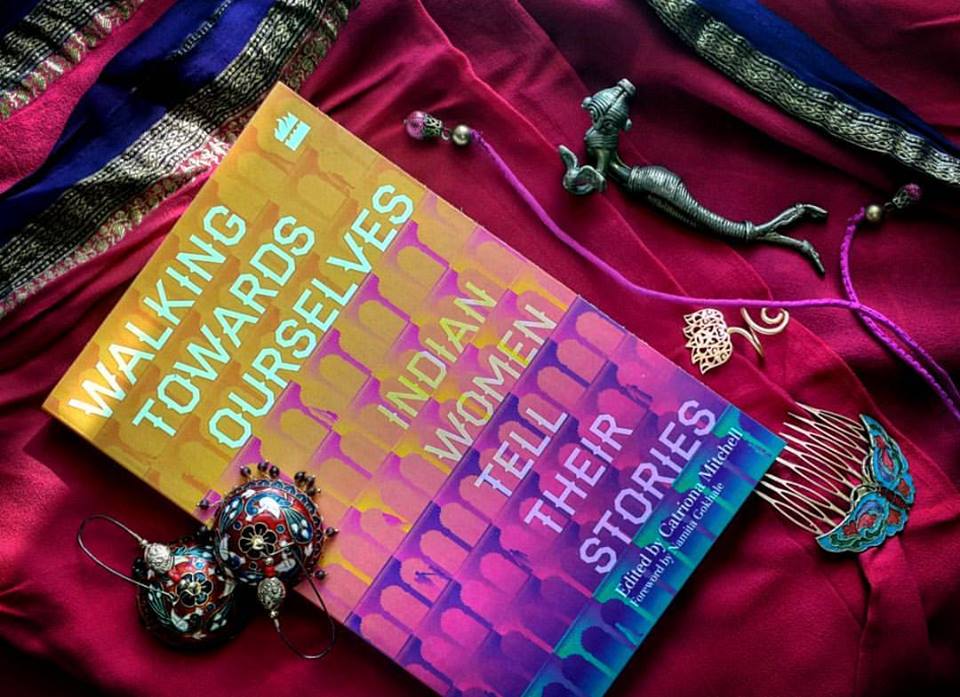
In “Karaikal Ammaiyar And Her Closet Of Adornments”, I write about personal style as a mode of self-expression, and self-concealment. I write about the pleasure of the perfect drape, the passion of red lipstick, and the heartache of living in a time when beauty and power cannot always co-exist. This essay is in the new anthology Walking Towards Ourselves: Indian Women Tell Their Stories, edited by Catriona Mitchell. The book is out now from HarperCollins in India, and Hardie Grant in Australia/the UK shortly.

karaikalammaiyaradornments


In Femina Magazine, Dec 18 2015 Issue

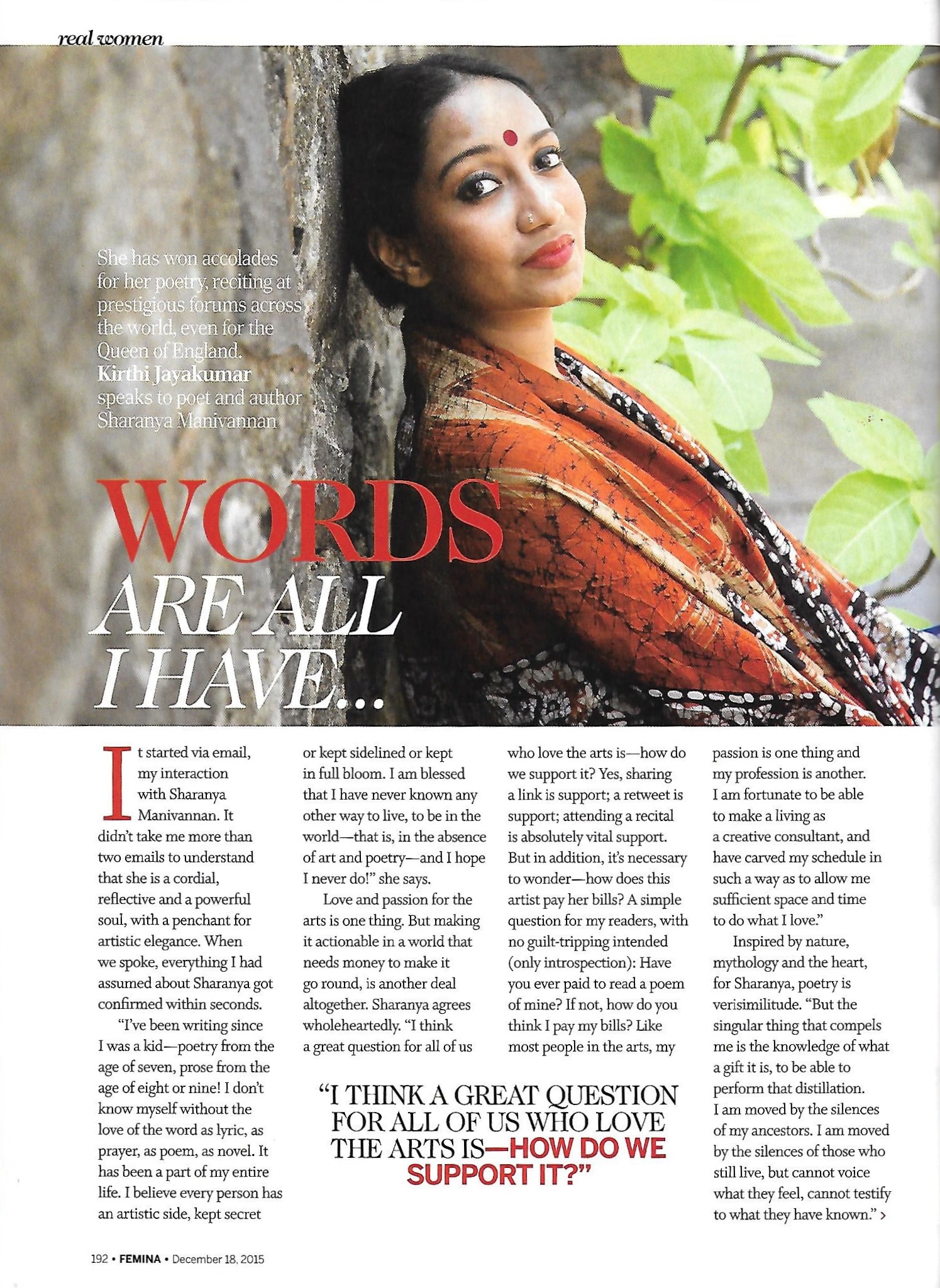
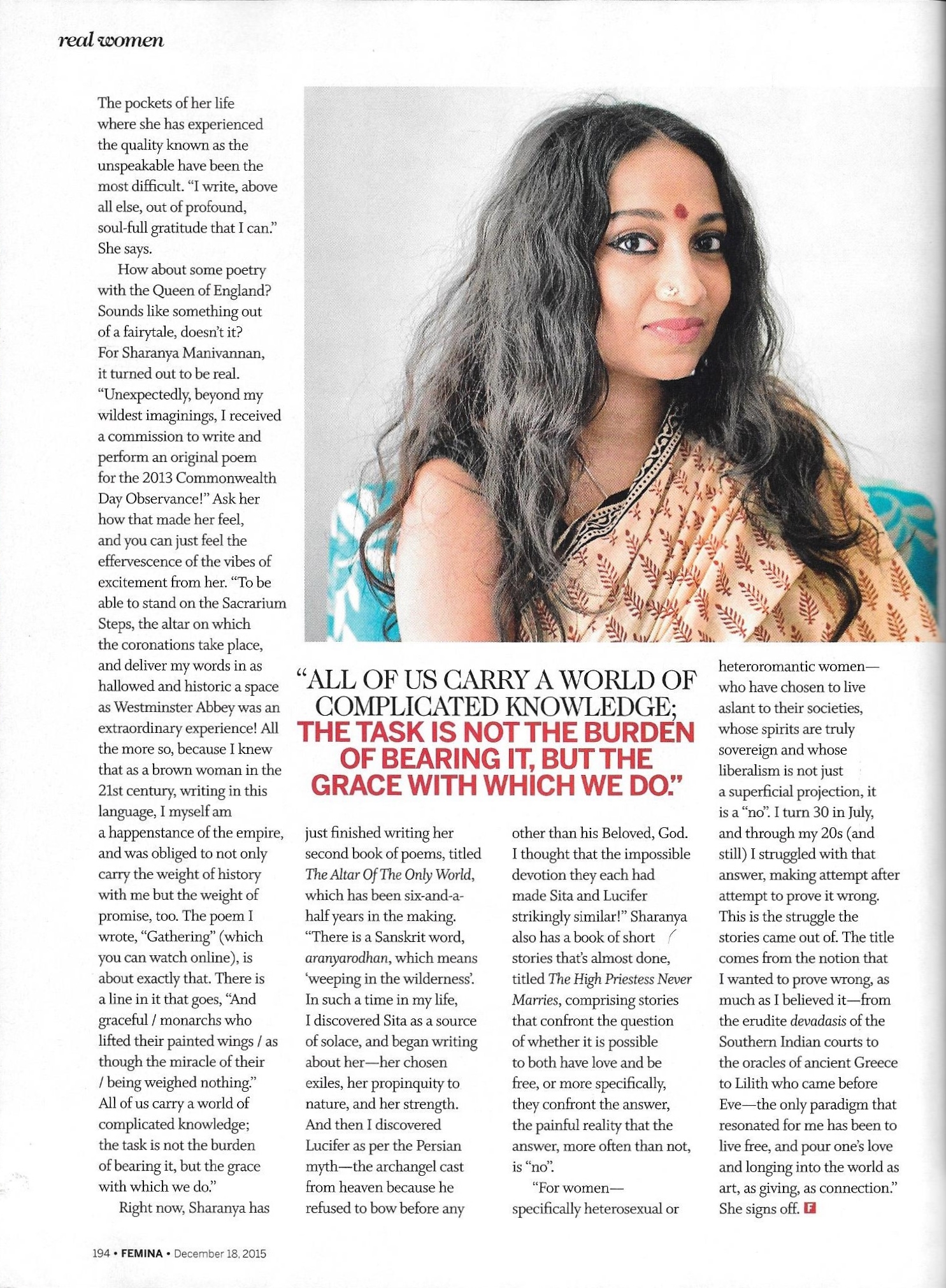
I was very thoughtfully interviewed by Kirthi Jayakumar earlier in 2015 for Femina. The piece appeared in the Dec 18 2015 issue of the magazine.

Please keep your eyes and hearts open and your loving wishes sent in the general directions of The High Priestess Never Marries (HarperCollins India, 2016) and The Altar Of The Only World (HarperCollins India, 2017). And me, if you have more love to spare. Because I do, and I’ll try to make more books from it :) Happy new year! xo

Sharanya Manivannan Femina 1Sharanya Manivannan Femina 2

Book Review:The Sleepwalker’s Guide To Dancing By Mira Jacob

When a successful brain surgeon begins to sit on his porch and speak to his long-deceased mother, his daughter is summoned to her childhood home in New Mexico to try to make sense of what is happening. Kamala Eapen and her husband, Thomas, have maintained no more than a cordial engagement for decades. Their marriage has been savaged by enough trauma: a rift sown by a fateful 1979 holiday to his own childhood home in India, the subsequent loss of that entire wing of relatives, and then their own son Akhil’s tragic death as a teenager. So Amina Eapen – a gifted former photojournalist who has chosen to hide in the more banal world of wedding photography in order to cope with her varied melancholies – is only one among the many who return to her father. His memories, regrets, and more than several of his dead loved ones have too. Amina’s task is not so much as to find out why, but to find a way toward an elusive peace – for all of them, and all of their ghosts.

Mira Jacob’s debut novel, The Sleepwalker’s Guide To Dancing, is a brilliant accomplishment. It takes a familiar premise – that of a crisis in the family forcing someone in the younger generation to confront the past and thus facilitate healing – and spins it into something original, fresh and often funny.

The book brims with the honesty of its setting and its characterisations: it is unlike the vast majority of diasporic fiction in that neither it nor its protagonists’ lives pivot on the fact of immigration. India is not romanticised; the only losses that count are those of people and relationships. True to life, in the circumstance of immediate grief, there is neither room nor reason to indulge grandiose imaginaries.

But certain things are definitely not imaginary, even as they find rational explanatory parallels. Medical science explains Thomas’ visitations from the dead, but not Amina’s own enigmatic experiences. With an astonishing lightness of hand, Jacob weaves the realms of spirit and doubt in a way that resounds with the truth of most human experience.

At a substantial 500 pages, a length at which any novel might risk tedium, The Sleepwalker’s Guide To Dancing nonetheless glides by. Jacob has succeeded in creating that rare thing in this age of the fragmented attention span: a big book so gripping and so charming that it truly can be read in a day, its many pages flying by effortlessly.

The heart of this novel is not suffering, but the ways in which faith and love can suffuse pain with a quality that makes it somehow less irredeemable. In Albuquerque, the Eapens belong to a motley new family composed of other Indian immigrants. They are so close that Amina’s best friend Dimple, who like her lives in Seattle as an adult, is introduced to people as her cousin. It is this patchwork family who rally around through Thomas’ medical diagnosis, just as they had in all difficulties past. In caring for her father, Amina finds in them her own safe harbour – and with it the courage to end her own self-sabotages and step into the potential others see in her, as an artist, a partner and a daughter.

Among the novel’s outstanding points is its beautiful structure. Moving between Seattle and Albuquerque past and present (with a brief prelude in Salem, Tamil Nadu, where the Eapens’ ties to India are permanently severed), the author maintains the story through a talent for the graceful cliffhanger, convincing dialogue and a palpable compassion – we know what binds the characters is not their grief.

Thus, despite its sadness, this is above all an uplifting, reaffirming book. The Sleepwalker’s Guide To Dancing is a moving paean to human existence: forever poised between the facts of the mundane yet also waltzing with the mysterious in experiences too esoteric to bring into the open, except by way of that great intangible – love.

An edited version appeared in The Sunday Guardian.

Review Of One Part Woman by Perumal Murugan

Distance allows us to be dismissive of the lives of other people, to filter their narratives down to a few essential keynotes and tragedies. In One Part Woman, translated into English three years after its Tamil original garnered widespread acclaim, Perumal Murugan turns an intimate, crystalline gaze on a married couple in interior Tamil Nadu. It is a gaze that lays bare the intricacies of their story, culminating in a heart-wrenching denouement that allows no room for apathy.

Kali and Ponna, land-owning farmers in Thiruchengode, enjoy a completely happy marriage on all counts but one. Despite over a dozen years together, they are yet to have children. Theirs is a sexually-charged and mutually fulfilling relationship; it is neither for lack of effort nor of intent that they are unable to conceive. The couple perform countless acts of penance, entreating various deities – among them the half-male, half-female god on the hill attended by a Brahmin priest and the tribal goddess Pavatha of the same hill, to whom blood sacrifices are made. Ponna weeps at the onset of every menstrual period. Neither love nor their thriving land is enough to keep at bay the despair of being without offspring in their community. They are constantly on the receiving end of disparagement from the people around them: Kali’s sexual potency is the subject of sly and open taunts, while every slip or argument Ponna has with another is turned on her using her childlessness as an indication of her character or capabilities.

The disparagement arrives in wounded, less unkind guises too – particularly from their mothers, who tell stories of hereditary curses that could explain their misfortune and sing dirges lamenting the couple’s barrenness. Eventually, the two women decide that there may be only one way. Every year, on the fourteenth day of the chariot festival to the androgynous deity on the hill, the rules of all marital contracts are relaxed. Any man is allowed to lie with any woman – a tradition acknowledged as being a socially and divinely sanctioned method of conceiving should a husband be sterile. Ponna’s mother and mother-in-law, in the hope that it is Kali who is the cause of their infertility, suggest the solution of sending her to participate. The resulting anxieties and attendant manipulations challenge the marriage, and alter its course.

One Part Woman is a powerful rendering of an entire milieu which is certainly still in existence, which it engages with insightfully. The author handles myriad complexities with an enviable sophistication, creating an evocative, even haunting, work.

The novel is also acutely sensitive in its approach toward gender and sexuality and humane in its treatment of longing. While fundamentally an emotional work, driven by personal desires and losses, it also unsettles the reader with what it frankly reveals about simplistic ideas about progressiveness. The society in which the book is set in is permissive in ways that the urban middle-class in the same state at large is not, even though known markers of suppression, such as caste laws, hold sway. But, here as elsewhere, the true hindrances to happiness and progress come in much more personal forms.

Murugan’s writing is taut and suspenseful, particularly as the book progresses towards its climax. At a slim 230 pages, the novel moves quickly, but with such a finely-wrought intensity that tension remains high right up to the final paragraph. Aniruddhan Vasudevan’s translation deserves mention – the language is crisp, retaining local flavour without jarring, and often lyrical. Highly recommended.

An edited version appeared in The Hindu Business Line.