Ameen Merchant’s The Silent Raga

Anything that combines the powerhouses that are the Madras Book Club (supposed to have a membership of 800) and the Prakriti FoundatioAmeen Merchant & Sharanya Manivannann equals, at the very least, fantastic turnout. I calculated between 150-200 people at the Taj Connemara last night, at the launch of Ameen Merchant’s The Silent Raga. Reading from the novel were Madras Players’ Yamuna and Deesh Mariwala, classical singer Subhashri Ramachandran and yours truly, as well as the author of course.

The Silent Raga was shortlisted for the Commonwealth Writers’ Prize, and is published in Canada by Douglas & MacIntyre and in paperback (Rs 395) in India by HarperCollins. A couple of interviews with the author are here and here.

With Ameen at the post-launch gathering at Amethyst

The Shaming of Scarlett Keeling

(Cross-posted at Ultraviolet)

That violence against women rarely grabs any attention except for in the presence of gruesomeness, sensationalism, drama and tragedy is already known. But more disturbing by far than the fact that the murder of a teenage tourist in Goa last month has been making headlines precisely due its cocktail of all the above elements is the level of moral sanctimony that accompanies the media coverage, the ensuing debates, and even what are ostensibly the responses of those who knew Scarlett Keeling and her family.

On February 18, the body of 15-year old Scarlett Keeling, a British national, was found on a Goan beach. Police initially chalked up her death to drowning after consuming too much alcohol, despite evidence of severe bruising and rape. But investigations and post-mortem investigations revealed contradictory facts, as did eyewitness accounts by people who had seen the girl during her final hours. Scarlett had been in India with her mother Fiona MacKeown, MacKeown’s boyfriend, and her siblings. They were frequent visitors, and on this instance were on a six-month-long trip.

Allegations were quickly leveled against MacKeown for her negligence of Scarlett. The moral higher ground was quickly swamped by those chastising her for her irresponsible behaviour. One whiff of scandal led to another, and details about MacKeown’s private life were dug up. Scarlett’s diary entries were exposed in the media. The bottomline message was that somehow, by choosing to lead lifestyles that included partying, sex and substances, they had asked for the tragedy that befell them. Terms like “alleged murder” were popular, as though it could have been anything else, until today’s gruesome revelation: Scarlett was murdered by having her head held underwater for between five and ten minutes. She asphyxiated to death.

It is alarming to watch the cruelty of the media – from possibly every newspaper in the country to even NDTV’s usually fairly progressive We The People to the blogosphere – and what can be gauged of common opinion by it. Despite the horrifying brutality inflicted on a person who by Indian standards was still a child, and the overwhelming confusion and despair her loved ones are no doubt experiencing, the attacks made against the victim and the family censure them with only superficial demonstrations of sympathy. Political officials in Goa are calling for the revoking of MacKeown’s visa and a ban on her entering the country again, blaming her for maligning the image of the state. She has since gone into hiding, fearing for her life from both the drug mafia and state officials whom she has linked to them.

Scarlett’s boyfriend, an Indian citizen named Julio Lobo, has been taken for medical tests to see if he is “sexually active”. A DNA test of substances found on or in the victim’s body would not be unreasonable, but pray tell, what does his being or not being sexually active reveal about the horrific tragedy? Is it necessary, given that in her diary, Scarlett had written not only that she had sex with him, but that she felt he used her for it? Is there a test that proves sexual activity in males? Or is this like one of those repressed, backward ideas about broken hymens and being able to pee in a straight line? That this person’s private life is being pried into in a manner that is unlikely to shed any light on the senselessness of the incident is nothing more than one of the many ways in which the blame is being pinned on “the wanton Western way”. The boyfriend, we are to assume, has sinned by his affinity to this lifestyle of debauchery, which – we are also to assume – is imported to India by the likes of the Keeling family. But even that doesn’t quite crack it: Lobo is being tested not because of his character – but because of what the conclusiveness of science is meant to tell us about hers.

Lobo, in turn, has retaliated by attacking MacKeown because she had been aware of Scarlett’s lifestyle (but she says Scarlett was neither a binge drinker not drug abuser, to her knowledge). This, too, is reprehensible. At 25 years old, a decade older than Scarlett, his relationship with her could amount to statutory rape. Clearly, prior to the murder, MacKeown’s liberal parenting style benefited him. His attempt to deflect attention from his actual law-breaking by ganging up against the bereaved mother with the rest of the patriarchy squad is sickening.

In other words, the condemning of the murdered girl, her family, her friends, their lifestyles and their choices is a typical misogynist response – the wicked woman gets her dues. And this time, there are not one but two “wicked women”: Fiona MacKeown, mother of not just the victim, but of several more children of “varying paternity”, and Scarlett herself. That the women in question happen to be from the West (that corrupter of our chaste and virtuous ways of life!) is icing on the cake.

Rape, murder, the works – apparently, under the right (or wrong) circumstances, they can all be justified.

Make no mistake. What we see in the media today is not an enquiry into a crime. It is slut-shaming, plain and simple. The nation is not in shock because a 15 year old has been so brutally treated. Those are not the sounds of protest and outrage; they are the sounds of many hands rubbing in glee, so thrilled to be vindicated of their position that women who break the rules deserve what’s coming to them, and what’s coming to them is exactly what happened to Scarlett Keeling.

But what happened to Scarlett Keeling has nothing to do with if she had sex, if she did drugs, if she drank. What happened to Scarlett Keeling has nothing to do with why her mother so frequently chose to travel to India or lived a bohemian, unconventional lifestyle. What happened to Scarlett Keeling has only one reason: some places in the world are not safe for women, not because of culture or tradition, but because of an absence of respect for them as individuals. India is one of them. India killed Scarlett Keeling – and every day, kills many less sensationalized individuals. That Fiona MacKeown has seen this is not delusion on her part.

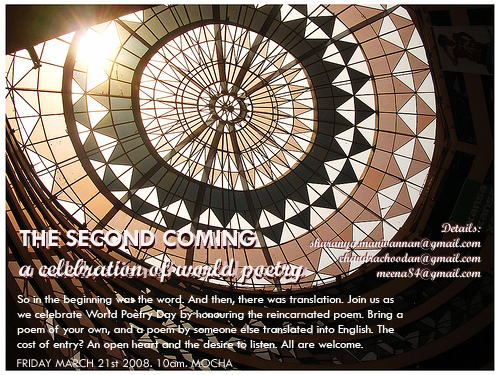
“The Second Coming”: The Reincarnated Poem Open Mic

After the success of the reading at Thalankuppam just over a week ago, we decided to hold something a little more mainstream, just to spread the word that poetry, open-mic style, has come to Chennai.

“The Second Coming” (all puns and cleverness intended) is going to be a mix of two formats. Original poetry, and poetry in translation. The idea is to not only encourage people to get a feel of performing their own writing, but to also hone poetry appreciation and performance poetry in itself, by sharing some of the best verses through the ages. Because March 21 is World Poetry Day we celebrate translation in particular, the gift it gives to the world at large. Basically, in addition to any poetry of your own, bring along a poem that was not originally in English. Think Octavio Paz, Rabindranath Tagore, Anna Akhmatova (for examples) and you’ll see what we’re trying to do.

Friday is a public holiday, and Mocha in the mornings is a lovely setting. This reading will be held on the upper floor, with special permission from the management. All are welcome.

Please click on the flyer below for details. It’s a little cluttered but they’re there. Really. ;)

mocha-copy.jpg


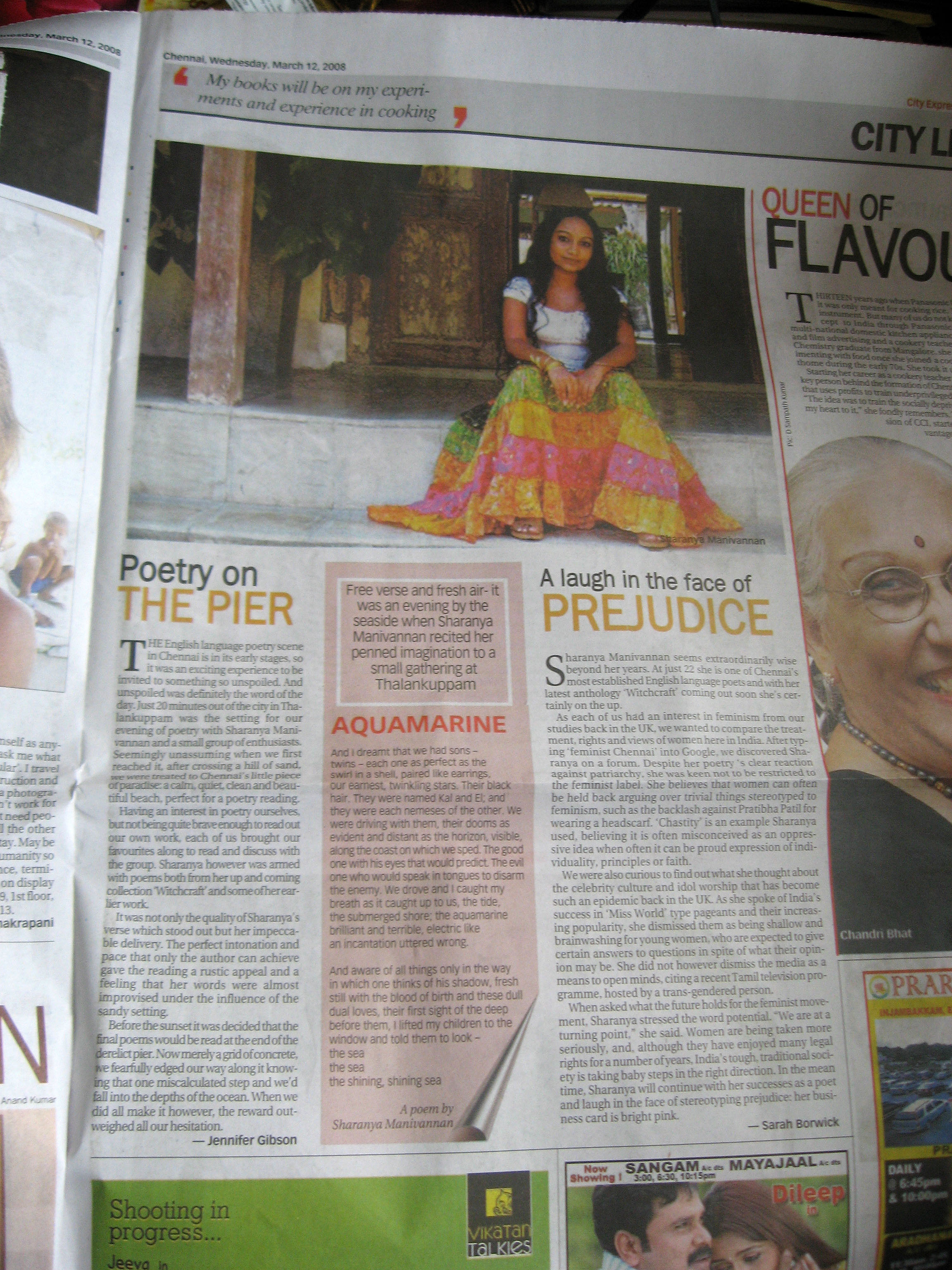
In Today’s The New Indian Express

untitled-5.jpg

I don’t have a scanner, and I apologise for the clunky thing above. Please click on the image to take you to the file’s page, then click on the image again. Then, zoom in to read. Sorry!

For a change, am pleased with this print article that appeared in today’s The New Indian Express, in the City Express (Chennai) supplement. There’s a write-up on Poetry on the Pier, an interview focused on my feminism, and one of my poems.

At Thalankuppam

jump

Some very friendly boys and their dog, on Thalankuppam beach. All photos above are by me. Larger sizes and black and white versions are on my Flickr page.

Chandrachoodan Gopalakrishnan and I came up with the idea of holding a poetry reading at Thalankuppam, north of the city of Chennai, while talking about coasts. Like many artists, we are both obsessed with them to some extent. When I told him about my own favourite beach, which is widely regarded as a crappy excuse for one but stirs me still, he told me about Thalankuppam. He had discovered it by accident, while riding without any particular destination in mind, leaving the city behind. By this time, we and a few others had been having a lot of discussions about the necessity and opportunity present to create a community, one which not just writes and reveres the written word, but takes joy in the spoken.

Thalankuppam made sense on several levels — gorgeous yet discreet, it has an interesting story which few know. We wanted a small event, something in the indie spirit. No sponsors, no pish-poshness. We also wanted something that had the ethos of the city in it — an ethos which we hope to shape, in our own small ways. As I have written and said elsewhere before, I feel blessed to be at this point again for the second time in my life. The right place at the right time, just as I was six or seven years ago in KL. Chennai is pulsing with something which, if harnessed, will set the city alight. Trust me on this one. I’ve seen it once and am certain I’m about to witness it again. Or the city will, in any case, with or without me.

On the afternoon of March 9th, a small group set forth from Madras University, hugging the beach northwards for under an hour until we reached the area of Thalankuppam. We entered a settlement area, and the further into it we drove the more I realised that truly, this was the kind of beach that could only be stumbled upon. When we finally parked to walk, near a delta, we were confronted by a small hill of sand. Human-made, from sediment that clogged the factory-bordered river otherwise.

Beyond this hill was the beach. And jutting from this beach was the abandoned pier. Chandroo’s camera will say things best, so please go ahead and harass him to post his photos up.

We settled on the beach to start the reading, which was pleasantly delayed by the far from camera-shy boys above. Matthew played sacrificial lamb, reading a poem which Sivakami, who had had to leave once we reached Thalankuppam, had left with him. He delivered her homage to the masculine and feminine properties of the sea beautifully. Chandroo read three poems, one of which was a translation of Subramania Bharathy. Katia, Matilda, Sarah and Jenny — the unsuspecting newspaper interns we whisked off to this deserted, untouristy part of greater Chennai — most impressively shared some of their favourite poems by others from memory. Katia read some musings from her journal. I read a few pieces, including one about a dream I had about a sea that was startlingly similar to the view mid-way on the pier. Julian did not read, but lent his quiet support.

We had held off from actually getting on the pier and walking to its end because Chandroo, whose 25th or thereabouts trip this was, had recommended we wait until closer to sundown, when the colours of our surroundings would take on different properties. He was right — it was worth it.

Walking the pier itself was probably the most incredible experience of an altogether brilliant evening. The good kind of scary, like a rollercoaster, only more dangerous, because the only safety devices we had were each others’ sweaty hands and our own intrepid footsteps. You can’t tell from the picture we used on the flyer, but that is no bridge. It’s like a horizontal ladder. Lose your step and you plummet into the water.

It was like walking on waves, the ocean surging around us. Absolutely stunning.

At the end of the pier was a wonderful little sheltered platform. I tried to imagine watching a thunderstorm from there, the terrible thrill it must be like. We were joined by two latecomers, who hadn’t carpooled and had gotten lost hence. Here, I read two more poems before we headed back, beating the dusk.

Thank you all — who were interested but could not make it, who came, who will come to future events. We had a wonderful time and will keep you posted about the next event. Suggestions, ideas — let us know. Sivakami Velliangiri left a poem responding to the event in the comments section of the announcement post; do check it out.

Quick Hit

Yesterday’s “Poetry on the Pier” was a wonderful experience. Photos and more soon.

Elections

Okay. I can’t blog and have nothing constructive to say and it’s no longer my business. But I am refreshing that website every few minutes like millions of others. And I am really really really excited.

Poetry On The Pier

Pier-flyer
For more on the location, please see here. We’ll coordinate a meet-up point in the city from which to head out to the beach. Please get in touch so we have some idea of how many people to expect. And feel free to forward!
This is a small, indie event, open-mic style (but without a mic). This is not a workshop or a slam. Bring poems, and an open mind and open heart.
Update: Please click on the flyer for date and time details! Thought this was obvious, but I guess it wasn’t. :)

“The Lovechild of Anaïs Nin and Johnny Cash. Pure Sin on Amphetamines.”*

(Or, Contrary to popular belief, I am not in love with the sound of my own voice.)

But I enjoy using it, especially in artistic expression. And there is some evidence (occasionally culled from speaking to distracted drivers from the backseat…) that shows that there are folks out there who kinda like it too.

No hidden brag posts here, just a nice dose of the shameless usual. I resurrected my Myspace account as a musician one, so as to upload spoken word recordings. You can find me here. Two poems are up now: Karna Considers Yuanfen and And If You Still Must Leave, both recorded by Kieran Kuek at 2am studios, Kuala Lumpur, last year. The latter poem is up in two versions — the violent rendering, in which I usually perform it, and a colder, more controlled one, which Kieran encouraged me to explore as an alternative method of delivery.

To be honest I wouldn’t say that it’s these two poems that should introduce people to my work, but those are the ones I have good recordings of.

I’ve found that I don’t enjoy recording in studios, or for the sake only of recording, very much at all. I slip up more. I feel less in my element. There is an absence of a certain haphazardness, which gets lost in multiple takes. I remember something I read in a magazine maybe a dozen years ago, when I certainly could not relate but was intrigued enough to keep it in mind — the singer Jewel in her pre-sellout days likening recording in a studio to faking an orgasm.

Nonetheless, there are more recordings in the works. The final cut of Poem, which I did with Kieran and also in a different persona, hasn’t grown on me enough for me to upload it. I did some recordings for the Australian Broadcasting Corporation last month, and if any of that is workable, will definitely upload.

I recommend using headphones, and listening to them loud.

Find me. Add me. Listen. If you like.

* That would be a quote. The subject line is because I think Jerome’s line, “poor man’s Kylie in shorts” is way cool. My friend the actor and credit card abuser Branavan Aruljothi offered me the above for a “sounds like…” comparison. It is not nearly as cool. But neither am I.

Flash Fiction: The Woman Who Feared The Sea

I wrote this a few days ago, and today being Tell A Fairytale Day, thought it appropriate to post now.

The Woman Who Feared The Sea

The woman who feared the sea loved the sea. She loved it so much she saw its ugliness. Its deep, dark deep-dark. Her love, unlike most loves, was honest. Prying. In her love, all objects paled, their shadows turned into truths. She expected the worst, and in this way, could subvert its hold.

This is how she discovered that she feared it. She was sitting by the sea with the man who would become her husband. It was 3.30 in the afternoon, thirty years ago, thirty miles or thirty thousand from where you first hear this story. There weren’t that many people around. The shore was prettied with the pawprints of dogs. The man asked her to remove the hairclip she was wearing. It had a pink synthetic flower on it. She obliged. She left it in the sand, next to her thigh.

It was the second time she was meeting this man. Already, her future had rolled itself out in front of her. She could look into the sunlit blue of the horizon confidently. When he took her hand in his and squeezed it, she suddenly felt like she should leave a token to the sea. Like a ticket to a concert. Or a votive to the Virgin.

The waves flirted near her toes. A little nearer, a little further. She was thinking about how to say thank you, how to pay this debt, when suddenly the water swarmed around them. Her skirt became drenched. Sand stuck to her knees. As she stood, laughing, patting down her clothes, embarrassed and happy, she spotted something pink swirling away. Her hairclip was gone.

Ever since that day, she could never visit the sea without leaving a token. Sometimes she would decide the night before what she would offer. Sometimes, if she found herself by a shore spontaneously or serendipitously, she would leave something she would find in her handbag – a receipt, a name card, an unused tampon. There was something illegal otherwise. The only time she tried to walk away, she had gotten back home, turned the key in its lock, and seized by terror fled back to the seaside. Empty-handed, not even earrings to part with, she left her house key, watching it sink into the shallowest wave. It was still on the sand, being lapped, when she left. She didn’t want to touch it again, after giving it up. She told her husband she had lost it.

When she had her first child she took her to the sea. But the moment she stepped out of the car and shut the door behind her, she shivered. It was a downcast day. Her baby was strapped to her front in some sort of pouch, like they were kangaroos. She felt a chill run up her spine and at that same moment, the baby woke up with a shriek.

She took off her slippers and nearly hurled them into the water. Then she hurriedly got back into the car, started the engine, and sped away.

So her children grew up never knowing what playing on a beach was like. Ever since that day with the tremulous clouds and the wind and the fear, she knew she couldn’t take them to the sea. She knew the sea would extract revenge, a gift. Or two. Both her children at once, gulped away like in an ocean horror movie with every trick in the book.

After her divorce, she moved with them to a landlocked city. Her daughter, in adulthood, would take vacations exclusively to coastal destinations. Her son was more like her. He didn’t long for things that weren’t meant to be his. He was steady, certain, elegant in his sensible ways. On the morning of her fifty-third birthday she woke up to a phone call telling her he had drowned in a swimming pool.

A Valentine To The City

When Blogbharti approached me sometime back to commission a piece for their Spotlight Series, I really wasn’t sure what to write about. Then Kuffir, the website’s editor, mentioned that he missed “the fiery poet” who seemed absent from this new blog. For reasons that will be obvious to those who followed me here from the old blog, I’ve certainly tempered things down. So I got to thinking, what provokes me these days, to the point of writing? I wrote this on Valentine’s Day. It was published this morning here. The photos above were taken by me on the fourth Chennai Photowalk.

A VALENTINE TO THE CITY

Sometimes, I hate this city. I don’t deny that. There is so much to hate here. It is merciless. A crude, cruel, unforgiving bitch of a city. The meanness of its people. Sycophancy, moral (dis)order, parochialism pimped out to the tune of “heritage”. Sanctimony. There is the deliberate Anglophilia and its darker – in colour, too – twin, self-loathing. I abhor its hypocrisy, its incestuous orbits, the claustrophobia it induces. How it is its women who are the torchbearers of its patriarchies. The oddness of an illogical concept like caste running this whole machine. I cannot stand its Edenizing of the tremendously racist nation of Malaysia, its unexceptional immigrant dreams; nor can I stand the chest-thumping that trivializes the very real defects of our own. The weather. Hell on earth is Madras in May. Even the rains cannot soften this city.

Sometimes, I hate this city. I do.

And sometimes I take an auto through a road strewn with rose petals, a funeral wake having passed through minutes before. I breathe in that macabre glory. Sometimes I carry my little camera along with a group of mostly large men with large cameras, men who know this city, who can speak of its architecture and its history, who can point to a place one might have seen a thousand times and illuminate it, suddenly. I fall in love this way. Like Rushdie’s man who viewed his bride in pieces, through a perforated sheet, so too I fall for my city, mutilate it, make it mine.

“Istanbul’s fate is my fate,” wrote Orhan Pamuk in his definitive book on the city of his soul. “I am attached to this city because it has made me who I am.”

And in its distance, the irrevocability of never having grown up here, and then the inevitability of having had to return nonetheless, it wields the same influence over me.

And so this is my secret. I have been speaking to this city, in my head. I call it, typically perhaps, her. I make this city mine just as she unmakes and reassembles me. The dialogue between us is one of cause and consequence. Will you hurt me this time? I ask. What if I never told anyone when I hate you? What if I never let myself speak about leaving? What if I act like I never will, I say sometimes, and that is the most poignant of questions – because sometimes, I think I never will.

So here I am. And here I am. And here I may always be. And even if I leave, to here I will return and return and return, each time in a different sentiment. I will return with rancour. I will return with regret. I will return without routes in mind. Uprooted. Belligerently. In cavalier attitudes, have holidays I will barely remember later. Bouyant and broken and beyond description. I will return, and return, and return.

She has never known the smell of jasmines, doesn’t give a damn about henna on the hands or the hair. She is nothing like who she thinks she is. She stands at the bottoms of hoardings and stares up at misrepresentations of her face, her cleavage, the look in her eyes. And not one passerby recognizes her. She’s slutty: she belongs to millions, and like all of them, I like to think she comes home to me. Still, nothing makes her melt more than S.P. Balasubramaniam’s voice in a flick from the ’80s, nothing breaks her heart quite so sweetly like being called Kannamma. In arguments, and only then, she mixes her V’s and her W’s. She may suggest otherwise in certain company, but cannot speak a word of Hindi. Not a word.

Petulant as a child on a summer holiday trying to sleep in the backseat of a 1994 Maruti 800, neither her hands nor her eyelids able to shield her from the sunlight. Powerful as an MGR speech – Thaimakale! En rathathin rathame! Kitschy and tasteless as a political poster, and just as tactful as a man pissing against it. Coy. Cunning. Deceptively simple.

Living here has turned me from being spiritual to a blasé agnostic. Trees that inspire awe and humility are rare – but one of the better things I did the week before last was to walk the entire stretch of the rather long road on which I live and found, to my surprise, some decent ones. The Marina looms fifteen minutes from home, but too many paces from the call of the soul; even disappearing into the coast in this city by the sea is perhaps too obvious an escape to be worth it. I could stand on the terrace of my family’s apartment, toss pieces of coloured paper into the air, and have each one land on a church, a mosque, but mostly some small roadside shrine. It doesn’t matter. I find myself worshipping nothing but the City. My awful and wonderful god. Dictator of my future, arbitrator of my past.

You don’t inspire me anymore, I tell her. You’re just another city, like the hundreds out there. You’re just another place on the map. You don’t even smell like you used to.

Silence. The persistence of horns. The particular sound of the engines of autorickshaws. Someone whispering nasties to a girl who pretends not to hear as she walks by, someone else uncurdling phlegm from her throat and spitting.

So – what then? I demand. You think you own me?

And that’s when she gathers her skirts – yes, in the plural, she is mad and dramatic and imperious that way – and flees to a more considerate lover. Cruel mistress of mine.

And I am left still sitting here, penning paeans, shooting pictures. Smitten. Sodden. Gone.

Italian Intrigue

The editors of the Quarterly Literary Review of Singapore emailed me a few days ago to say they had received a note from the Italian journal Buràn which said that they had published a translation of the excerpt from my novel-in-progress, Constellation of Scars, that QLRS had first published in 2006.

Neither QLRS nor I had been contacted for permission.

I am not upset (not even about the fact that they credit me to Malaysia, but hey who cares — never will that country be able to lay its claim to me again) but am certainly intrigued. Mailed it over to an Italian-speaking friend for an appraisal about the quality of translation. Any other Italian speakers/readers out there? What do you think?

The original is here.