In Today’s The New Indian Express

untitled-5.jpg

I don’t have a scanner, and I apologise for the clunky thing above. Please click on the image to take you to the file’s page, then click on the image again. Then, zoom in to read. Sorry!

For a change, am pleased with this print article that appeared in today’s The New Indian Express, in the City Express (Chennai) supplement. There’s a write-up on Poetry on the Pier, an interview focused on my feminism, and one of my poems.

At Thalankuppam

jump

Some very friendly boys and their dog, on Thalankuppam beach. All photos above are by me. Larger sizes and black and white versions are on my Flickr page.

Chandrachoodan Gopalakrishnan and I came up with the idea of holding a poetry reading at Thalankuppam, north of the city of Chennai, while talking about coasts. Like many artists, we are both obsessed with them to some extent. When I told him about my own favourite beach, which is widely regarded as a crappy excuse for one but stirs me still, he told me about Thalankuppam. He had discovered it by accident, while riding without any particular destination in mind, leaving the city behind. By this time, we and a few others had been having a lot of discussions about the necessity and opportunity present to create a community, one which not just writes and reveres the written word, but takes joy in the spoken.

Thalankuppam made sense on several levels — gorgeous yet discreet, it has an interesting story which few know. We wanted a small event, something in the indie spirit. No sponsors, no pish-poshness. We also wanted something that had the ethos of the city in it — an ethos which we hope to shape, in our own small ways. As I have written and said elsewhere before, I feel blessed to be at this point again for the second time in my life. The right place at the right time, just as I was six or seven years ago in KL. Chennai is pulsing with something which, if harnessed, will set the city alight. Trust me on this one. I’ve seen it once and am certain I’m about to witness it again. Or the city will, in any case, with or without me.

On the afternoon of March 9th, a small group set forth from Madras University, hugging the beach northwards for under an hour until we reached the area of Thalankuppam. We entered a settlement area, and the further into it we drove the more I realised that truly, this was the kind of beach that could only be stumbled upon. When we finally parked to walk, near a delta, we were confronted by a small hill of sand. Human-made, from sediment that clogged the factory-bordered river otherwise.

Beyond this hill was the beach. And jutting from this beach was the abandoned pier. Chandroo’s camera will say things best, so please go ahead and harass him to post his photos up.

We settled on the beach to start the reading, which was pleasantly delayed by the far from camera-shy boys above. Matthew played sacrificial lamb, reading a poem which Sivakami, who had had to leave once we reached Thalankuppam, had left with him. He delivered her homage to the masculine and feminine properties of the sea beautifully. Chandroo read three poems, one of which was a translation of Subramania Bharathy. Katia, Matilda, Sarah and Jenny — the unsuspecting newspaper interns we whisked off to this deserted, untouristy part of greater Chennai — most impressively shared some of their favourite poems by others from memory. Katia read some musings from her journal. I read a few pieces, including one about a dream I had about a sea that was startlingly similar to the view mid-way on the pier. Julian did not read, but lent his quiet support.

We had held off from actually getting on the pier and walking to its end because Chandroo, whose 25th or thereabouts trip this was, had recommended we wait until closer to sundown, when the colours of our surroundings would take on different properties. He was right — it was worth it.

Walking the pier itself was probably the most incredible experience of an altogether brilliant evening. The good kind of scary, like a rollercoaster, only more dangerous, because the only safety devices we had were each others’ sweaty hands and our own intrepid footsteps. You can’t tell from the picture we used on the flyer, but that is no bridge. It’s like a horizontal ladder. Lose your step and you plummet into the water.

It was like walking on waves, the ocean surging around us. Absolutely stunning.

At the end of the pier was a wonderful little sheltered platform. I tried to imagine watching a thunderstorm from there, the terrible thrill it must be like. We were joined by two latecomers, who hadn’t carpooled and had gotten lost hence. Here, I read two more poems before we headed back, beating the dusk.

Thank you all — who were interested but could not make it, who came, who will come to future events. We had a wonderful time and will keep you posted about the next event. Suggestions, ideas — let us know. Sivakami Velliangiri left a poem responding to the event in the comments section of the announcement post; do check it out.
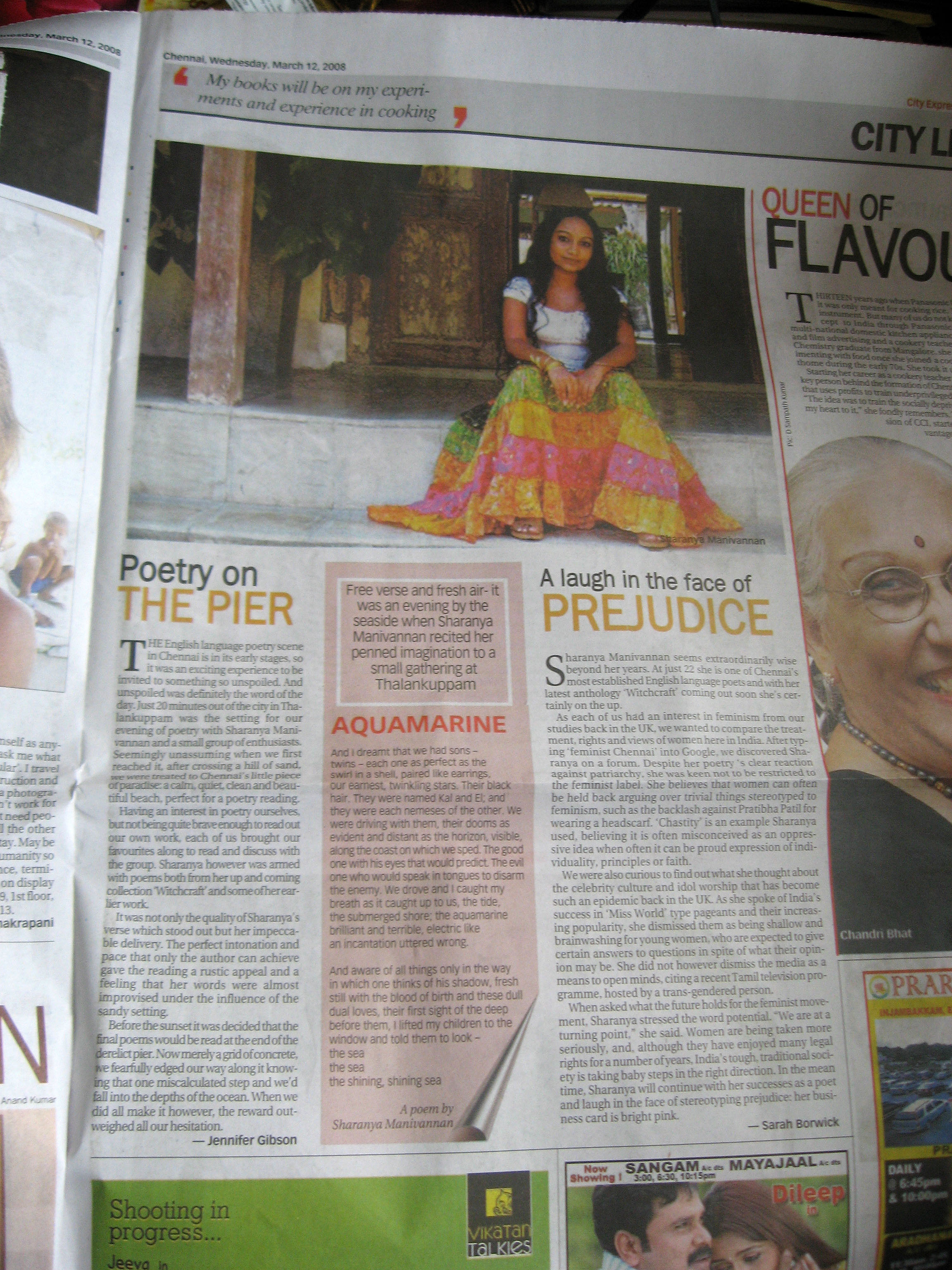
Poetry On The Pier

Pier-flyer
For more on the location, please see here. We’ll coordinate a meet-up point in the city from which to head out to the beach. Please get in touch so we have some idea of how many people to expect. And feel free to forward!
This is a small, indie event, open-mic style (but without a mic). This is not a workshop or a slam. Bring poems, and an open mind and open heart.
Update: Please click on the flyer for date and time details! Thought this was obvious, but I guess it wasn’t. :)

“The Lovechild of Anaïs Nin and Johnny Cash. Pure Sin on Amphetamines.”*

(Or, Contrary to popular belief, I am not in love with the sound of my own voice.)

But I enjoy using it, especially in artistic expression. And there is some evidence (occasionally culled from speaking to distracted drivers from the backseat…) that shows that there are folks out there who kinda like it too.

No hidden brag posts here, just a nice dose of the shameless usual. I resurrected my Myspace account as a musician one, so as to upload spoken word recordings. You can find me here. Two poems are up now: Karna Considers Yuanfen and And If You Still Must Leave, both recorded by Kieran Kuek at 2am studios, Kuala Lumpur, last year. The latter poem is up in two versions — the violent rendering, in which I usually perform it, and a colder, more controlled one, which Kieran encouraged me to explore as an alternative method of delivery.

To be honest I wouldn’t say that it’s these two poems that should introduce people to my work, but those are the ones I have good recordings of.

I’ve found that I don’t enjoy recording in studios, or for the sake only of recording, very much at all. I slip up more. I feel less in my element. There is an absence of a certain haphazardness, which gets lost in multiple takes. I remember something I read in a magazine maybe a dozen years ago, when I certainly could not relate but was intrigued enough to keep it in mind — the singer Jewel in her pre-sellout days likening recording in a studio to faking an orgasm.

Nonetheless, there are more recordings in the works. The final cut of Poem, which I did with Kieran and also in a different persona, hasn’t grown on me enough for me to upload it. I did some recordings for the Australian Broadcasting Corporation last month, and if any of that is workable, will definitely upload.

I recommend using headphones, and listening to them loud.

Find me. Add me. Listen. If you like.

* That would be a quote. The subject line is because I think Jerome’s line, “poor man’s Kylie in shorts” is way cool. My friend the actor and credit card abuser Branavan Aruljothi offered me the above for a “sounds like…” comparison. It is not nearly as cool. But neither am I.

Kitab 2008 in Mumbai This Weekend

I have been wanting desperately to announce that I will be doing the opening event of this year’s Kitab Festival ever since I was asked to!

The schedule on the website is subject to update. All events are free and open to the public except for the nightly parties.

Me, me, me time: I am on at 11am, Friday February 22nd, at the Asiatic Library. Will be reading poems and fielding questions from the audience.

Ugo Untoro + How To Eat A Wolf

I never did blog about the Utan Kayu International Literary Biennale 2007, and neither did I blog about the Singapore Writers’ Festival 2007 — both festivals which invited me and took care of me and fed my stomach, literary appetite and ego very well in all. Blogging about the first was sidetracked by preparing to move back to India, and as for the second, well — if you don’t know what kept me distracted at the same time, leave be! Am just thinking about this now as I’m heading off to Mumbai this week for another major festival, Kitab, for which I have the privilege of doing the first event open to the public this year.

The Biennale, I think, will remain in my memory as a pivotal career and life experience. It was my first real festival, my first taste of the literary high life (as opposed to the boho cult stuff, and utter mediocrity). It brought me closer to three friends, one of whom I in fact feel like I owe a great professional and personal amount to, and made me several more. It was a spiritual, thrilling, insightful ten days. I really must blog about the whole experience.

Reading at Borobudur was one thing, visiting Candi Prambanan was another, but this — this was the moment when I realised that I really and truly was what I always wanted to be. A writer.

Ugo Untoro's painting inspired by my poem

This was a very, very special moment. I am in front of the painting “Selamat Datang” by the Indonesian painter Ugo Untoro, which was inspired by my poem “How To Eat A Wolf”. Selamat Datang means Welcome in Bahasa, and this artwork was at the entrance of the exhibit, which featured various Indonesian artists’ interpretations of the prose and poetry of the writers participating in the Biennale. This was easily one of the proudest moments in my life, and completely unexpected — it had never crossed my mind until then that so large and beautiful a painting by a famous painter could somehow be attached to any poem of mine.

The Foreword

The foreword to Witchcraft, my forthcoming book of poems from Bullfighter Books.

BY INDRAN AMIRTHANAYAGAM

“There’s a ghost of/another language/shadow-dancing/under my words,” says Sharanya Manivannan in one of the several powerful poems in Witchcraft. Manivannan dances herself both on stage and throughout these pages. By dancing I refer to all sorts of movement: linguistic, emotional, religious. Manivannan assumes the mantle of Mahadevi Akka or some other devotional poet but her betrothal goes beyond Siva to include the lives and aspirations of her self and fellow mortals.

But this slip-sliding poet, who unravels shawls as she pirouettes in front of us, insists on embracing a reality greater than India. She seizes duende from Lorca and Spain, and shows an ear for Latin migrant and Native American sounds as she constructs imaginative space from iyari or heart-memory, and from the chicano rhythms of Sandra Cisneros, one of her guiding poets. Manivannan is well-read, and in the most surprising places. Eclectic is the right word and confident: the world’s poetry is her main course. Ambitious. She will draw from all the traditions that interest her, to make the Sharanya Manivannan poem.

That poem is bloody, sexy, beguiling as in a dance with veils. “Women with/blood/glistening in the partings/of their hair, they come to me in dreams.” (from Witchery).

Or does the poet’s name matter? Is Manivannan just a vessel, actor, for a drama both female and divine, which she explores in her poems? “Beware the bard in black lace, the naiad with/the nine inch nails.” (from A Horse Named Notoriety)

This is a first book, a glorious, chilling and sensual debut, waking up goose bumps and turning the libido into over drive. I find myself muttering lines over and over again from different poems “dipping ginger biscuits in hot plain tea,” and astonished by the daring of the poet’s youthful fearlessness. In How to Eat A Wolf, the persona of the poem says “I loved my wolf./I held him tethered like/a pussycat.” And later in the poem, “he snaked a tongue so/hungry in its kiss it/turned my body to salt.”

The daring is language. There is something charming and disturbing—and liberating—in reading the various crude and sassy words that grow like hibiscus flowers in these private gardens. The daring is also curiously to be expected, as if inevitable that a young poet must set off firing from the hip and the head. India needs a Ginsberg, female poets a model drawn from Sappho through Sor Juana Inez de la Cruz to Sylvia Plath . Manivannan puts herself right in that family tree. She has the linguistic gifts to keep tilling her gardens wearing black lace and listening to too much jazz at 3 am, and she has begun here a delightful, if risqué, career.

Indran Amirthanayagam won the Paterson Prize for The Elephants of Reckoning (Hanging Loose Press, 1993) and the Juegos Florales in 2006 for the poem Juarez. He is a New York Foundation for the Arts fellow and a past recipient of an award from the US/Mexico Fund for Culture for his translations of Mexican poet Manuel Ulacia. His other books include The Splintered Face: Tsunami Poems (Hanging Loose Press, 2008), Ceylon R.I.P. (The International Centre for Ethnic Studies, Colombo, 2001), El Hombre Que Recoge Nidos (Resistencia/CONARTE, 2005), and El Infierno de los Pajaros (Resistencia, 2001). He is a poet, essayist and translator, and works in English, Spanish and French.

Blogging on Red Room

I just cross-posted the previous entry on Red Room, a very interesting new website which describes itself as follows: “Welcome to Red Room, the official home of the world’s greatest writers. Through original, author-generated content, we offer a trustworthy and creative social network unlike any other. Here, you can connect with your favorite authors, access current industry news, and comment on engaging features. By fostering true community between authors and readers, Red Room showcases esteemed writers and inspires the next generation. We also give back to the community we aim to nurture with our commitment to the Causes We Support.”

I first heard about Red Room a few days ago (via whose blog, I can’t remember — but thank you!), and applied to be one of their authors, just trying my luck. I was surprised and honoured to learn that I have been accepted. Some of my favourite authors, including Amy Tan and Salman Rushdie, are involved as well. My page is here, but it is not up yet. Hopefully they’ll approve it, now that I’ve made a submission and added some other content. (Update — it’s up.)

Speaking of writing communities, someone asked me to share more about what happened last night. It was a small event at Eric Miller and Magdalene Jeyarathnam’s home, with special guests New Yorkers Bob Holman of the Bowery Poetry Club, Ram Devineni of Rattapallax Press and language conservationist Catherine Fletcher — as well as members of the local fishing community whose storytelling and oral narrative techniques were shared and discussed. Translations by the sportingly irrepressible Meena Kandasamy, a bit of folk singing from her father, and a debate about whether or not it would be appropriate to have mourning songs sung in a home with a baby livened proceedings up considerably. A personal moment I am proud of was when Bob asked me to perform a poem from memory impromptu in front a video camera, and I did “Witchery”, the opening poem from the book, and a few lines into in, all other conversations in the room had ceased. “You stopped time, you stopped the room,” said Bob. By the end of the evening, I felt very stimulated, very certain that what I’m trying to do in Chennai makes more sense now than ever before, that something is about to spark.

Notes Upon Viewing An Oppari

Tonight the oppari singer didn’t just stop singing when she was asked to. She wept as she stopped. She wept like it mattered — and it did matter.

We were in a home with a small baby and no death in sight. Only poetry. And yet she wept as she took her seat. Somebody took her in their arms and kissed her on both cheeks, led her to her chair. Someone else brought her, and the other singer she came with, fruit.

Their work is the mourning song. When asked to sing lullabies, they could not. Their melody could not change: it was entrenched in the work of grief, the work of allowing the bereaved to shake loose from their spirits the weights of loss.

The singer and the song. The poet and the poem. There is a moment of transcendence in which the two are indistinguishable, and this is rare. Epiphany. To perform is to be; to be is to perform.

Months ago, I wrote: “The work of the oracle is through body and voice. The work of the oracle is to give voice to the bodies upon which are inscribed our fates. The work of the oracle is to go beyond body-memory, to transcend into ancestral memory. To excavate. To restore. The work of the oracle is as much past as it is future.”

And so, too, is the work of the oppari singer. The one who serenades death and the departed, soothes those who are left behind. As much future as it is past.

It didn’t matter that only the song was real. No funeral. No reason to sing but an audience. Because the song was the only thing that did matter.

Sometimes I stand on stage and I don’t know anything but the page before me. I forget the life I must return to, the life from which I came. Sometimes I stand there and I cannot see a thing. I cannot feel my body. I am only a voice.

And sometimes I can feel my body but only because it is so small, it cannot contain me, it cannot contain this voice with which I am so full that I am fit to burst.

Koldovstvo Coming

The witching hour draws nearer and nearer. After six months of sitting on a secret, I’m finally able to talk about my publisher (for my book of poems, Witchcraft). Bullfighter Books is tiny, new, Asian-centric. Their vibe is indie, guerrila, curious. Other books they’re putting out this year include poetry by Inzaman Amjad Khan and two anthologies.

We’re negotiating the cover of the book now, because I have my heart set on a photograph by Somebody Famous. The photographer has to okay it, and then BB have to see if they can afford it.

Once that’s outta the way, and it’s the biggest thing at the moment, we’re all set to print. So we’re looking at April, May, maybe June. Before the end of July, because I want it out before I’m 23. It helps to have a deadline. And I’m just vain that way.

Oh — Koldovstvo, my translator informs me, is Russian for “witchcraft”. Work on the Russian version hasn’t started yet, so the publication of that hasn’t been scheduled. (No, really, it’s coming out in Russian! Surreal isn’t it? The translator found me through the Internet last June, contacted me asking if I’d let them translate, and… Bless the blog, I tell you!)

So this is the first of the Witchcraft posts. Don’t really have a plan in mind, but I know one thing for sure — as the example of my translator illustrates gorgeously, I owe quite alot career-wise to having had an online presence for almost a couple of years now. So it only makes sense to share my thoughts during the lead-up to an event I have been waiting for since I was seven years old, an event which may have still been a long way off had it not been for the… dare I say it?… fans (lurkers and loud ones both) being online has generated.

The first of the advance praise specifically for the collection has come in. Cyril Wong, whom I first got to know after he had published some of my poems in Softblow, and Mani Rao, who heard of me through the poet and blogger Sridala Swami, liked my poems on Softblow and got in touch (my life has always been saturated in heavy-duty synchronicity) have given their blurbs, both of which are in the About section of the blog.

In the next few months, I’ll share updates, a few poems, and interviews (if any).

But better not jinx anything. ;)

Poetry? In Madras?

My post, Audiences, below has generated some interesting discussion on poetry (performance poetry, to be precise) in Madras in the comments section. Do join in! In the absence of the pre-existing is unlimited possibility. (Turning comments on this post off so there is some continuity to the discussion.)

“Tonight I Can Write…”

This is one of my favourite poems (favourite translation of, also). I am in love with this reader’s voice. And haunted by the effect in total. (Via Lainie)

Audiences

What’s with the all-male (or nearly) audiences?

My reading yesterday evening hosted by the Rotary Club of Madras South had four women (not including me) and somewhere under forty members of the audience in total. My reading at Apparao Galleries as part of the Prakriti Festival, which was a sort of official Chennai debut, was exclusively male. So was the one at Landmark Spencer’s, with the exception of one Prakriti volunteer. That makes three out of five. The other two had mixed crowds.

I was nervous about Chennai audiences from the start, so you can imagine my trepidation at being confronted by a group of men at my first “proper” reading here (previous ones, organised by and for friends and without publicity, don’t count). My poetry is very, very female. We can get into a long discussion about what I mean by this and the general semantics of such a label, but the point is, it is. I’ve heard that right from when I began to do readings, but had never had to think about it until now.

What does it mean to be a poet who writes out of her femaleness, consciously or subconsciously, and to present this work to male audiences?

From the little experience I’ve had with the three readings I’ve mentioned, I can tell you right off the bat that it changes things. It did for me, anyway. I’ve never apologised for the darkness or explicitness of my work before. But I did, even as I heard myself saying “I don’t feel the need to justify what I write about or how I write about it”, I could feel the “but” creeping up. And it did.

But could the reason why I did that just be a Chennai thing, perhaps? Audiences known for their hostility to young women upstarts were what I anticipated, but the testosterone overload totally surprised me the first time, made me start wondering the second time, and had me somewhat bemused by the third. That being said, the only reading at which I felt truly in my element was my last one with the Prakriti Festival, which was at Distil. I warmed up so much I even read “Poem” and “A Horse Named Notoriety”, which were strictly off-limits otherwise. This had much to do with the audience, and I always feed off the audience’s energy (hmm… interesting, perhaps that would explain why someone told me he felt exhausted after yesterday’s reading. In a good way, though — he said he felt the same after hearing a recording of The Iliad). Plus, bars are always my favourite places to read in. Even off-hours ones.

Still, that doesn’t explain why so many more men than women have been coming to my readings. Sadly, I didn’t get the sense that the faghag thing entered the picture at all. I love gay men, and they generally like me. But that didn’t really seem to be the case. I think.

I have to admit I don’t know if I want the trend to continue. I haven’t enjoyed these few readings as much as I usually enjoy performance, as grateful as I am for the opportunity to have done them. But again, is it just a Chennai thing? Maybe what I used to enjoy so much before was not the readings themselves as much as the during and after-partying, something noticeably absent so far.