Happy new year, everyone! Here’s a poem from the early post-Witchcraft period, two years ago. It’s called “Mahabalipuram” and you can read it in Muse India. I was a bit surprised to find it in the new issue of the magazine, because I had received neither an acceptance nor rejection note when I submitted it, which obviously isn’t standard protocol. Strange.
Book Review: The House of Five Courtyards by Govind Mishra
Govind Mishra’s The House of Five Courtyards provides occasion for one of those kneejerk declamations about work in translation on its very first page, when the mellifluous and charmingly Indian “chik-chi, chikh-chikh, tick, toon-tick-tidding, chi-chiya, chi-chi-chi… kutock, kutock” of birds rising in harmony with an ahir bhairav is rudely interrupted by a rooster that actually crows “cock-a-doodle-do”. One decides, as one does in these cases, to shoot the messenger – in this case, Masooma Ali, who translated the novel from Hindi.
This, as it turns out, would have been a grave mistake. The errant foreignness of that rooster is one of the few moments of being snapped to attention in this book, and given the tedium of the rest of it, one is actually grateful. Here is a novel so utterly cliché, so incapable of making up in charm what it lacks in innovation, that to pin its failure just on how it was adapted into a different language would ring hollow.
The novel opens in Benaras in 1940, where a large family share their lives together in a massive mansion of five courtyards, its three lynchpins the advocate Radheylal, the elderly matriarch Badi Amma, and the imposing Badh Baba, the banyan tree. Its inhabitants are not atypical of such settings: Sunny abandons his studies for the sarangi, and then abandons music for the mendicant life. The boy Rajan recites a patriotic Urdu verse in school and is caned for anti-imperial sentiments. The dignified courtesan Kamlabai visits often for musical soirees and is considered one of their own; when an in-law of Radheylal’s house seeks her services as a brothel madam, she turns him away with a subtle reminder that he has married into her family.
Radheylal disappears into the underground of the independence movement. The ties of the next generation to the house of five courtyards dissipate more and more: in Kanpur, Rajan and his wife Rammo occupy a small flat with their children, Shyam educates his children in English and lets their Hindi lapse, and the house is eventually divided up and let out to tenants. All the makings, in short, of a saga about a changing world.
It isn’t that we, as a collective readership, have grown jaded of sagas – there is a timelessness to them that bears, if not begs, many renderings by many voices. It is simply that Mishra has injected no identifiable colour, humour, magic or humanity into this narrative. Its characters lack idiosyncratic appeal, and even the pathos of the end of an era, which the writer says in an afterword is what inspired this book, is not adequately transmitted. Perhaps it is Ali’s interpretation that makes this book so lackluster, but perhaps it is not – as with all translated works, only the sufficiently bilingual will ever know. And who knows, perhaps in the original, the rooster also crowed “cock-a-doodle-do”.
The House of Five Courtyards won the 1998 Vyas Samman (a lucrative award for Hindi literature), the same year in which a plethora of similar novels filled with extended families, sprawling chronologies and nostalgia for “Indiannness” flooded the market in a variety of languages – the Arundhati Roy afterglow. Few matched Roy’s masterpiece; all attempted to. The success of Mishra’s novel seems, at best, to be a product of the same, and as with other such products, its glow has not survived the decade. If there is anything that sets it apart from its numerous counterparts in English, it’s only that it doesn’t resort to the easy exotica that characterized many of them. Ironically, this may have made the book so bad that it would no longer have been boring – which, ultimately, is far worse the crime to the reader.
An edited version appeared in today’s The New Sunday Express.
The Venus Flytrap: Winter
For one month every year, the city becomes “elsewhere”, which is to say, anywhere but here.
Its famously sweltering conditions become chilly enough to bring out the cashmere shawls, the ponchos, all the warmer selections of one’s collection of clothes for eventual migration (am I the only one who makes no secret of mine?). The fans are voluntarily turned off all day, and particularly at night. Wooden doors swell with rain, refuse to shut, and compromise one’s privacy in a place in which one has very little already. Cyclonic winds waltz with treetops, twirling and twirling, raising goosebumps as if they were fingertips circling on skin. The sun, when we see it, we greet like family.
We put on our sturdiest rubber chappals and pay the monsoon price for autorickshaws, because for once Chennai is too exciting to miss, its excess of activity dismantling every stereotype we know of its lassitude. Once a year, there is everything to do, and too few days to do it in. It’s the season of being spoilt for choice, of shows and showing off, of cultural pursuit becoming a matter of daily routine. You can almost hear the crackle of newspapers dating to February being removed from those sarees, starched and saved for the season. Time compresses: we who are so used to a city that never wakes up find that there aren’t enough hours in the day to rest. It expands too: we drink our fill of lectures and performances, the classic, the avant-garde, the homegrown and the foreign – like students who only crack their textbooks open just before a final exam, we absorb in weeks what could have been spread over a year. And most elegantly, time stands still – every sabha in the city thronging with that generation of women who wear a floret of diamonds in each nostril, and a pavé of roses coiled into white hair.
All this romance, sprung entirely from this decidedly tender climate. “Baby-making weather,” a friend winks. It must be true. One of the sharpest images this city has seared in my mind is of the man and the woman I saw one night as I walked a bridge across the Cooum. They were under a piece of cloth, which he was gently tucking over her with one hand, stroking her cheek with the other.
Chennai in the winter becomes a city whose exits shift into sight: its weather and its bustle both insinuate other places, windows into other worlds. But there are those who have neither doors nor windows, whose city it is much more than yours or mine, and for whom its year-end guise is not the same one we experience. I’ve spent a lot of time this winter wondering and worrying about them, those who make their homes on the pavements and the beach. My bad throat and muddy shoes are bourgeois trifles beside their concerns. So this year, some items of that pile of clothing for eventual migration have found their use. As have curtains and blankets in surplus in my household. In giving them away to assuage the coldness in someone else’s bones, I’ve found that, in my comforters and comforts, the thing that lets me sleep soundest is the sense of having done something useful. It keeps me as warm as a hug.
An edited version appeared in The New Indian Express. “The Venus Flytrap” is my column in the Zeitgeist supplement. Previous columns can be found here.
A Poem In The Honey Land Review
You can read “The Country In My Hair” in the new issue of The Honey Land Review, here.
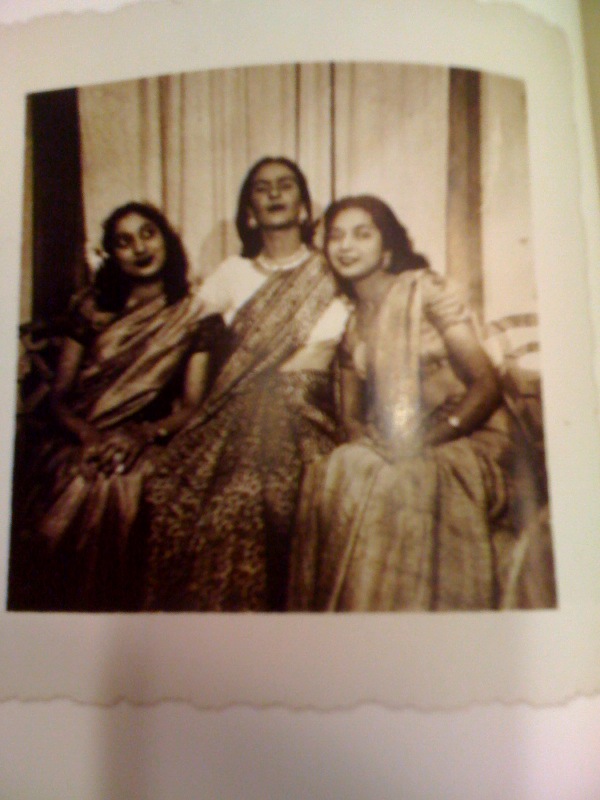
Frida In A Sari
A friend in New York snapped this picture of a picture, found in a coffee table book (title not remembered), and sent it to me. I’ve never seen a photo of Frida Kahlo in a sari before!
Book Review: Ranjan Kaul’s Through The Forest, Darkly
Somewhere in the three hundred-odd pages of Ranjan Kaul’s Through The Forest, Darkly lies a novella of half its length and twice its appeal. That book, I imagine, would be a precise, ethically complex account of some of the political extremes currently shaping India, taking a young man out of his well-to-do Delhi comfort zone into the hinterlands of Maoist occupation – and the reader with him. This book, on the other hand, is a prolonged, mostly monotonous telling of that journey, pedantically detoured and ultimately unimpressive. Aseem, a recent graduate trying to find a sense of direction, chances on the idealistic Swati, who teaches at slums and rejects her parents’ Communist allegiances as not being radical enough. Bored with urban ennui and not realising the hypocrisy of having met her in the first place at a socialite gathering, he becomes politically active – thus condemning himself to repeat the failures of his father Avinash, a former Naxalite.
The novel opens with a short, captivating prologue describing two funerals, but recedes as soon as the first chapter begins into a prosaic and sometimes grating style. There’s a vexing schizophrenia to the narrative: portions set within the forests of Bastar carry a genuine lyricism, while everything else is written with a marked lack of craft. By the time a corporate mission that turns mutinous sends Aseem into the forest, the setting that inspires Kaul’s better passages, we have meandered through too many pages of stilted, adverb-qualified dialogue, redundant scene selection and lines like “No one in the car was interested as the driver proceeded to unravel the silk from the cocoon of his knowledge about caterpillars” and “’Fine, give my love to Aseem,’ said Menaka, and went back to the epicurean world of cocoa”.
The caricaturish Menaka, Aseem’s insipid and opportunistic aunt, is the source of most of the novel’s troubles – not because of how she contrives certain events of the plot itself, but because of the author’s evident lack of facility in rendering her in a manner that is either fully-fledged or at least relevant. A disproportionate amount of attention is paid to her tangential conversations and fixations, and one gets the sense that Menaka is Kaul’s real obsession, his muse if you will, but one with whom he grapples with little reward. The motivations of other characters – supposedly less facile than this one – are not given this sort of attention. Thus we don’t understand why Sri Sri Narayanaji, the godman whom Aseem’s uncle Aroon is repackaging for the world, agrees to go along with the commercialization of his image. We don’t understand why Aseem’s mother Ritika tolerates her sister’s manipulations, or even what drives Swati, whose do-gooder actions clash with her belief that the adivasis are naïve and incapable of compound thought. We aren’t presented, in any insightful way, the extent of ideological and ethical conflicts at the novel’s heart, or the complex relationship between adivasis and the “civilized” world, with its contrary forces of Maoism and capitalism. We do, however, get an exasperating amount of detail about Menaka’s toilette, libido and moods – as well as her dog’s.
Still, Kaul’s portrayal of everyday life in the forests of Chhattisgarh is a vivid and convincing one. This is where the novel’s entire potential can be found, and one wishes that Aseem, and the novel, had found their way into it sooner and with less petty distraction. Through the Forest, Darkly mirrors, in its failure, the activism of some of its protagonists: what counts is the commitment to be immersed in the nucleus of the situation, regardless of whether or where else action has flared. All else is peripheral.
An edited version appeared in today’s The New Sunday Express.
The Venus Flytrap: Old Tricks of the New Age
“You need to fully inculcate your complete maternal self,” he said, between mouthfuls of a fine continental spread. “You need to nurture and give and embrace your true nature.” He paused, significantly, and swallowed. “This just came to me, a message to help you on this journey: start by buying me breakfast. Providing nourishment will allow you to reconnect with yourself.”
We were at The Park. I could have bought breakfast or I could have posted bail.
Well, I should have known better then than to set up an appointment with a holistic healer whose business card read: “Tarot, Hypnotism, Arts Therapy and African Voodoo”. Now, after a couple of years’ worth of questing and questioning, I do. Self-styled spiritualists of the small-time variety are common, ineffective and quite hilarious. The thing about surviving all of that existential anguish is that you’ll have very few tangible takeaways you can talk about afterwards – except the fun anecdotes you’ve collected from those who claimed to have answers for it.
One of my other favourites was the breathing exercise teacher who took a rather unsavoury interest in my toilet habits. “Did you oil your rectum today?” she asked each time I saw her. Taking my uncomfortable expression to be mere stupidity, she would then proceed to gesticulate, in detail, exactly how I ought to do this. I suppose I ought to be thankful that she didn’t take it upon herself to offer a comprehensive demonstration. I can’t say I felt the same hesitation toward the hot chakra cleanser, though.
Which brings me to: why was I prescribed ashwagandha for my insomnia without being informed that it was also the great Indian aphrodisiac? Between the hours I was keeping and the touted potency of that herb, I could have turned into some rampaging nocturnal succubus.
Which I avoided, I hasten to add, by virtue of developing an intense obsession with transcendental mysticism and the fine sciences of auguring the future through the study of the feng shui of fridge contents and the Facebook newsfeed. In fact, I learned during this period that I am so intensely obsessive because I am a Scorpio Rising, that too born in the anaretic degree. This also makes me vindictive, envious, secretive and paranoid. Now you know why I’m so popular.
All of this came, of course, thanks to my involvement with a self-professed visionary. She interpreted my dreams (“To dream of a cat indicates a craving for cheese”), she analysed my psychosomatic conditions (“A pain in the ass indicates grief over betrayal – or an unoiled rectum”) and ran zodiac compatibility tests on my suitors (“Oh what’s a little BO with such a spectacular Mars-Jupiter trine?”). She was as efficient as predictive text on a cellphone. She was oracle and Oprah combined. It all toppled like a house of archangel cards when, in the process of severing my auric cords to malevolent influences from my past, she accidentally singed my eyebrows. Astrally.
“Shame about the eyebrow – now how will you know where to tap to activate your acupressure points?” she said.
I know. Even excusing a little hyperbole, I should be a hardcore cynic by now. But some people are just incorrigible (like Scorpionic types). I’ve just learned that divinity doesn’t come neatly packaged. Aromatherapy oils, though, still do.
An edited version appeared in The New Indian Express. “The Venus Flytrap” is my column in the Zeitgeist supplement. Previous columns can be found here.
Feature in Ritz Magazine
I’m in the December 2010 issue of Chennai’s Ritz magazine, as part of a feature which also includes Kuttirevathi, K. Ramesh and Tishani Doshi.
Click the image below to check out the article (it becomes legible once you double click). I should note that the name of my novel in progress is wrong (why do many journalists get it wrong? It’s not Stars, it’s not Czars, it’s not SARS. It is Scars.) But you already knew that. :)

Four Poems in Superstition Review
As the year draws to a close, I’m glad to be able to share some of my favorites from my recent work. In Superstition Review, four poems – “Distant Star”, “Lightning Over Dindivanam Highway”, “Sun Swallower” and “Keeping The Change”. You can read them here.
What I also like is that there are two poems each from both the manuscripts I’m working on. “Distant Star” and “Sun Swallower” are from Bulletproof Offering (the latter owes something to a poem by Laksmi Pamuntjak); and “Lightning Over Dindivanam Highway” and “Keeping The Change” are from Cadaver Exquisito, although not very representative of the impulse and tone of that collection.
Featured Writer at Anak Sastra
I’m the featured writer for the November/December 2010 issue of Anak Sastra, a new literary magazine with a South East Asian focus. You can read an interview with me (in the “featured writers” tab) and my slightly twee short story for young adults, “Spark”, here.
Book Review: The Story That Must Not Be Told by Kavery Nambisan
When Simon Jesukumar misses his train back to Madras from Delhi, among his lost possessions are his deceased wife’s thick manuscript, which he has lugged from publisher to publisher over the years out of a sense of guilt and duty. Aging, curmudgeonly, and living alone in an apartment complex beside the city’s vast and thriving slum, Sitara, he is returning from a stay with his son – whose mother-in-law he has struck a slightly dubious friendship with. His only companion at home is his cat Thangu; when his formerly-estranged daughter Sandhya visits, he tolerates her with a mix of parental affection and genuine dismay. Kavery Nambisan’s The Story That Must Not Be Told opens with tremendous promise, introducing to the reader this complicated old man, one of the most interesting protagonists seen in recent Indian fiction.
Throughout the novel, similarly adroitly-sculpted characters make their appearances, only to fade in importance. Each of them – from the noble butcher Gaffur to the quack doctor Prince to the envious and dastardly Ponnu – come with a compelling backstory. The slum itself is drawn with a strong sense of the overbearing spirit pervasive through locations as complex and gritty as Sitara (or even Madras itself). The trouble is, cast and setting both arrive fully-formed and precisely executed in a novel that loses track of its own plot.
The Story That Must Not Be Told is essentially a story about the human condition as it plays out in urban India today, dichotomized by privilege and its lack, and juxtaposed by sheer proximity. Simon decides to buy a water cooler for the school in Sitara, and thus begins his involvement with the slum and its people. This is at odds with his neighbours at Vaibhav Apartments, who want to see to it that the slum is cleared. Questions of crime and hygiene have become issues; nonetheless, manual labour – from schoolboys running errands for the elderly to construction workers, and most especially, cleaners of toilets – comes directly from Sitara.
It’s a familiar scenario to any Indian: one may have people from lower classes cleaning their houses, may work for people of higher classes, or may take a conscientious approach and attempt or claim to eschew this system altogether, but ultimately all of us exist within it. This means that realistically, we already know how the story ends, and the onus on the element of surprise and originality rests with the author.
Still, Nambisan’s finesse at etching her characters is hugely admirable. Despite his cantankerousness and stubbornness, one finds it impossible not to side with Simon entirely. In a perfect echo of his sentiments, the slum dwellers are notably more nuanced than his own family and apartment neighbours – all of whom irritate the reader just as much as they do Simon. One roots for Simon and Sitara, and reads the book through in order to find out what happens.
That the book devolves into unresolved loose ends, a pat finish, and a bit of political commentary is thus all the more disappointing. There is a sense that the horse and the cart were switched at some point during the narrative; instead of being led by the natural pathos of its characters, the thematic and didactic aspects of the story gain precedence. Much is lost: the truth behind the misplaced manuscript is never resolved, the burgeoning friendship between Simon and his son’s mother-in-law is unexplored, and the eventual fate of Sitara is given an almost cursory conclusion. A much stronger and more stunning novel could have emerged if the focus had remained on the details, and not the pursuit of a bigger picture.
An edited version appeared in today’s The New Sunday Express.
The Venus Flytrap: Forbidden Fruit
This morning, I woke up humming, absolutely arbitrarily, the refrain “movin’ to the country, gonna eat a lot of peaches; movin’ to the country, gonna eat a lot of peaches”. It took a few moments to remember that this is the opening lyric of a song from the mid-90’s – and when I recalled that it was by a band named PUSA (Presidents of the USA) and made the obvious phonetic association, my day began in an auspiciously giggly mood.
If you miss my gist entirely, I can only direct you to T.S. Eliot, whose existentially-ailing J. Alfred Prufrock rued his lack of luck with women and pondered, “Do I dare eat a peach?” Though of course, peaches aren’t for all of us. This brings to mind the cat’s pyjamas of suburban legends I’ve heard about people who really, really love their fruits and veggies (and this is a genre in itself – let’s call it pulp fiction). This one’s set in one of those histrionically chauvinistic universities, in which male and female students are segregated to a degree that suggests that whatever’s in the water in those campuses must be so lushly virile that even the boys risk pregnancy.
That the young woman in this apocryphal tale took a liking to bananas will sound just like any hostel story you might already know involving carrots, cucumbers or – I wince at the thought – corn on the cob (of the venerable and trusty lady’s finger, one never hears). That a banana took too much of a liking to her, became stuck, and went rotten over the course of several days will also remind you of all the wickedly hilarious medical emergencies these stories always seem to end up in. But the really juicy part? It seems that ever since this unfortunate incident, bananas in the women’s canteen of this institution are only served chopped. The men’s canteen continues to serve them whole. Boys, apparently, don’t like bananas. No word, however, on how apple pies are served.
I mean, you’ve got to wonder: why are all these sex-crazed orchard-marauders always girls?
If these stories have any truth in them, I think it’s fantastic that these girls have sexual agency even within such repressed environments (though the effects on their physical and emotional health are a concern). I don’t see a cause for shame in the least. In fact, I feel a little sorry for the boys who are expected to be ripe with lust, and whose escapades lack the extra succulence that all fruit that is forbidden has.
And there isn’t that much that is forbidden to the heterosexual male in our society, or for which he is judged.
I hope this isn’t going to influence anyone impressionable into expressing his raw longing with pineapples, mingling seed with melons, or channeling his desperation into dates with dates. Though if it does, and a proctologist and an institutional policy change get involved, I’d hope it makes its way into the rich archive of similar rumoured romances.
Still, I’ll say this: if raiding (or raping) the grocery store is only a temporary means, there is one thing in particular one can practice on. It’s the straight man’s (and zigzaggy lady’s) only known permanent cure for desperation. The question is: do you dare eat a peach?
An edited version appeared in The New Indian Express. “The Venus Flytrap” is my column in the Zeitgeist supplement. Previous columns can be found here.
A Poem In carte blanche
I’m still juggling with the title, but I am certain about the poem, currently known as “Mouna Raga/Dawning”. You can read it here in carte blanche.
I know my readers are composed almost entirely of lurkers and stalkers (what? y’all are so silent — the editor of a distinguished magazine once told me that my poems were the most-visited webpage of that entire issue; typically, all was pin-droppable on this blog), but if you have a suggestion about the title (or if you think it works – I can be convinced either way), drop it in the comments, won’t you?
 Sharanya Manivannan
You must be logged in to post a comment.