The Venus Flytrap: Old Gods And New Ones

I’m often asked how I reconcile my irreverent delight in multiple mythologies with my, well, devotion. How can I say that Rama is a terrible husband, but still murmur a couplet from the Vishnu Sahasranamam to soothe my weary nerves? How can I light candles in churches, wishfully say “Inshallah” and also chant in Sanskrit? The answer is that I see story, history and spirit as distinct threads. Braided together, they make an ethos, one way to absorb and encounter. To be a human reaching for the divine is to have the humility to know that only by holding those threads as distinct in the mind can the braid then be experienced in polyphonic fullness, through the heart.

We have the capacity to accommodate variations, unpredictability and what might appear to be inconsistencies. In forests, I rustle with the thought of the Rig-Vedic Aranyani; pining, I reach for the Inuit Sedna: when I sense the feline mystique, I remember the Egyptian lioness Sekhmet. If a story soothes my heart, is it not a prayer too?

New deities are constantly being made, just as old ones are being retired (have you read American Gods, Neil Gaiman’s unputdownable novel about what happened to the figures of European folk religions, gradually forgotten by migrants to North America?). It’s fascinating how, on a national stage, the latest expression of patriotism is to pledge allegiance to one such new deity, an artistic creation of late 19th century Bengal.

So Bharat Mata’s official temple, which contains not an idol but a map of India, is one kind of religious expansion. There are of course shrines to film stars and politicians, replete with garlands and aartis. There are also those which emerge from organic impulses, rooted in faith and incident, such as two dog temples in Karnataka built in 2008 and 2009, respectively – in Channapatna, the canine is worshipped as an animal familiar of the village goddess; in Ranebennur is a temple to a pet that’s said to have miraculous posthumous powers.  The Bullet Banna temple in Rajasthan, which sprang up in 1988, has an interesting origin: a rider was killed one night, and no matter how many times the police took his bike to the station, it kept mysteriously reappearing at the site of the accident. The idol in the shrine is the bike itself.

In the 1970s, a Hindi film called Jai Santoshi Ma popularised a new myth about a daughter of Ganesha. Until the film’s popularity had women all over the country undertaking new fasting rituals, the spot of what became the “ancient” Santoshi Ma temple in Jodhpur had been a shrine to the folk deity Lal Sagar ki Mata. Presiding deities are replaced, subsumed, emerge elsewhere, become obsolete, turn into cult figures. This happens both naturally and through imposition.

Spiritual practice is not monolithic – as lived belief, it is constantly enriched and complicated by many sources. It is porous, subjective, disorganised. When we streamline it, let be strictly defined, and – most importantly – limit the rights of others to pursue it in their personal ways, we lose more than just entwined stories and manifold possibilities. We lose spirit itself.

An edited version appeared in The New Indian Express on March 24th. “The Venus Flytrap” appears on Thursdays in Chennai’s City Express supplement.
The Venus Flytrap: The Casual Casteism Of The Term ‘TamBrahm’

It was a night like so many others in my mid-twenties. My friends were already at the dimly-lit club, along with a very young couple, new to the clique. I was the last to arrive, and much inebriation had already taken place. “You must be a Tam-Brahm too, right?” asked the cheerful girl, shortly after we’d been introduced. Before I could launch into the response that my friends could expect of me, her boyfriend piped up: “No, she’s not. Brahmins don’t keep names like Manivannan.”

This is true – my surname comes from the Tamil bhakti movement; it’s in the verses of the Azhwars, including the foxy and mysterious Andal’s. Do I like my father’s name? Sure, I do. Am I proud of it? No, because pride is about achievement. I did nothing to achieve a poetic surname, just as my companions that evening had done nothing (not even karmically!) to be ranked upper caste. I was struck that a young person in a casual, urban social setting, that too in a state of intoxication, had maintained such a sound grip on how to peg people quickly. And the infuriating, ugly question thus raised: what could my caste background possibly mean to that setting?

Don’t get me wrong, it was a nice evening. But it was also an encounter that in many ways exemplified how caste still holds its gridlock in the minds of otherwise cosmopolitan – and even very lovely – people. I was raised abroad, of mixed heritage and caste-oblivious; I never encountered it as a personal marker until I tried to apply to college in India, at almost 20. This too was a privilege. Once I moved to Chennai, I found that almost all my friends came from atop the caste pyramid. This was not incidental: it spoke to the fact that the artsy, alternative, more affluent circles (what a Venn diagram; why aren’t our associations more diverse?) that I moved in were thus dominated. I was among the very few odd ones out, and was made, suddenly, very aware. Even if I hadn’t chosen to educate myself, there were countless slips, suggestions and jabs that reinforced the need.

I can relate several more of them to prove my point, but instead I’ll make a request: it’s time to retire the term “Tam-Brahm”. Don’t try to make a horrible thing sound hip. That it rhymes doesn’t make the history – or the present – it references any cooler, or more palatable.

When you sit with me – or to put a fine point on it, anyone who is not like you – in a conversation and cavalierly place the words “Tam-Brahm” on the table, it is more than just an uncomfortable allusion. It is a subtle act of aggression. Through this ID, what you make clear to me (perhaps unconsciously) are your rank in a hierarchy versus mine, your defensiveness about the caste system, your negating of centuries of violence, oppression and inhumanity, and most of all, your unapologetic embrace of all the same.

Casteism will not die until caste does. And you are so much more than what your ancestors did to other people – including, perhaps, to mine.

An edited version appeared in The New Indian Express on March 17th. “The Venus Flytrap” appears on Thursdays in Chennai’s City Express supplement.

The Venus Flytrap: Not This, Not This | This Too, This Too

There’s a love that looks like no love you’ve ever seen. And on some days, and certain nights, you can almost convince yourself that it looks for you, too.

Almost. The deeper you travel into a life of your own design, the further away the mirage of a co-sojourner appears. There is no one who falls asleep thinking of you. The face you see when you wake up is your own, in a mirror, all evanesced dreamscapes and smudged kohl.

But you must indulge it, a little dulcet speculation. You parse the present as though it already comprises kernels of a different future. Everything that has happened to you has happened in the absence of the one who loves you, who does not know it yet, whom you contain no memory of. The world appears less maimed through this awareness, this version of the story in which there is someone you would walk through the rain to meet, had you only known how to reach their door.

What you do contain, positively, is wisdom. It beams in you like a blacklight tattoo when you need it most. Like that night when you came home after seeing someone so perfect you could have sworn you wrote them into being, but you couldn’t sleep, and not because you’d been hit by lightning. There you were, your palm on your chest at 2am, breathing deeply, sitting still and listening to your heart. How it wouldn’t stop saying, “neti, neti.” Not this, not this.

“Not never, but not now,” you explained to those who were dismayed. But even then, you knew.

A seer tells you to say affirmations to draw love into your life. A priest prescribes garlanded circumambulations. A doctor puts you on multi-vitamin supplements so your hair might stop falling out and you’ll have the energy to go dancing. A friend downloads another app into your phone. You’ll do some or all or none of these.

But mostly you’ll just do what you have to do. You’ll return to the poems, and when the wish to mouth their magic into someone’s ear becomes too much, you will go to Rilke’s “You Who Never Arrived”. You don’t cry like you used to, emotion billowing from you as unmistakably as a bullfrog’s throat. Your sorrow gets mistaken for anger. Your strength for coldness. Your grace for forgetting. Now your tears are scant and taste like tea steeped far too long.

And the flights of speculation too grow fewer, which is why you notice them, lift them to the light in curiosity. There is nothing to anticipate. Days and nights of lacklustre certainty. And it’s you who must tell your heart, this time: “Iti, iti”. This too, this too. Even this. This with its saudades. This with its cosmic signs that anagram to red herrings. This with its gambles made on someone else’s loaded dice (but you’ll make them anyway). “Heads you win, tails I’m lost” – that country ballad by Jewel you’re surprised to remember, so many years later. This now, this here, this always – with its almosts that only almost count.

An edited version appeared in The New Indian Express on March 10th. “The Venus Flytrap” appears on Thursdays in Chennai’s City Express supplement.

The Venus Flytrap: When The Devadasis Were Virgins

Aruna Sairam shuffled onto my playlist with a song of a longing devadasi, and I called a friend who knew it well. He had the original Telugu text of Paiyyada, while I pored over an English translation. Together, we transliterated: ‘The one who rested his head on the fabric over my breast is embittered by me – aiyo…” At the end of our spontaneous cultural salon, he mentioned another Kshetrayya padam, one in which the raconteur says frankly to the deity Konkaneswara that it will cost a hundred gold coins just to enter her house, and three crore to kiss her.

The poem reminded me of one of my favourite devadasi songs in Tamil, which goes – “kathavai saathadi / kaasilathavan kadavul aanalum, kathavai saathadi”. “Shut the door, girl – if he’s empty-handed, even if he’s god himself, shut the door!”

When Rukmini Devi Arundale appeared on a Google doodle last week, it was the devadasis I thought of again. In the 1930’s, Arundale appropriated the devadasi dance known as sadir, angularised its sensuality, censored its eros and turned it into the caste-privileged form renamed as Bharatanatyam. This was part of a larger project of erasing their matrilineal, woman-centred culture, which had garnered disrepute (it came to be banned all over India). This should be widely-known, and isn’t, because of the sheer domination of one narrative over another. Before their fall from grace, devadasi women from as early as 8th century were known as: dancers, musicians, multi-linguists, land-owners, endowers of public infrastructure, impresarios, polymaths and poets. Today, they are dismissed as sex workers.

We forget them both: the mid-20th century devadasi in a system of ruin and abuse, and the medieval devadasi whose empowerment and erudition remains beyond what many women enjoy today.

I’ve also been reading about the Asur people of Jharkhand and West Bengal. I heard about them just a few days ago, when their traditional telling of the epic battle between Durga, my beloved goddess, and the buffalo Mahishasura, whom the Asurs trace their lineage to, became the stuff of headlines. A fascinating alternative rendering, not unlike how Ravana has the sympathies of Tamil people.

But I’m not convinced that the story we’re being told is the one the Asurs themselves tell. When the word “prostitute” was raised in reference to Durga, as a means of literally demonising those with this belief, I wondered – what if the original word was “apsara” (like the transgendered Mohini, who used her seductive charms on asuras too, before she bedded Shiva). What if, indeed, the word was something like “devadasi”? And if it was “sex worker” – well, as a woman who happens to be Hindu, I am frankly more offended by misogyny than blasphemy.

Another mythological word we misunderstand is “virgin”. It means a sovereign woman or goddess, by no means devoid of sexuality, and in complete control of her own. Hence, unmarried. Like a devadasi was, except to her god and her art.

Myths are full of history, and history is full of myths. We can love their messy richness, and if we must sieve them of anything, let’s sieve the manipulations that serve only their blinkered tellers.

An edited version appeared in The New Indian Express on March 3rd. “The Venus Flytrap” appears on Thursdays in Chennai’s City Express supplement.

The Venus Flytrap: Dialogue Is Protest

Many years ago, I was playing with a then 6-year old cousin of mine when for reasons I cannot remember, the second World War came up. What I do remember, however, is having to sit him down and as gently as possible explain some of the human costs of that era. I remember him quietly and seriously absorbing what I was telling him, wrapping his understanding of the world around this difficult, new information.

You already know this difficult information. You encountered it in your textbooks, as my cousin did eventually, because your textbooks included it. Textbooks do not include everything. And while it is easy to look at streamlined history in hindsight, it is not easy to watch it unfold or to prod at silences and erasures. So we look away, convinced we are not a part of what proceeds. And by doing so, we become complicit.

Recently, I’ve found myself doing for adults what I had to do for my cousin as a child. I’ve had to ask them to join the dots and consider how their personal experiences of gender, caste, language, race and other defining barriers are connected to the way power is structured, formally and informally. And to ask them what they mean, when they repeat what they’ve heard elsewhere. I’ve even had to ask them a question that makes me feel ashamed to have to put to any person who has gone to school: do you read before forming opinions; and what do you read?

In doing so, I’ve laid my own principles open to interrogation. I’ve laid myself open to hostility. I am tired, I am frightened, but my conscience demands that I engage. What motivates me to have these dialogues is not the need to impose my perspective, but the bleak awareness that alternate perspectives are rarely provided with compassion, without resorting to belittling. This is true for all sides.

Which is why, as much as possible, what I try to do is ask.

If you are worried about fundamental freedoms, you probably feel cornered of late. You don’t have to march at a protest or be active on social media to feel the corrosion even in your personal interactions. ‘Are we really so few – those of us who care?’ you wonder. Maybe. But couldn’t it be that people don’t care mainly because they don’t know?

The resistance is not to an open mind, but to that profoundly scary step of leaving a comfort zone of distraction and denial.

How did you develop your views? For instance, for myself, I know that having felt like, and been, an outsider from childhood is probably why I gravitate toward the underdog. Let’s think about how people come to social consciousness, and make it easier for them, rather than simply attacking their ignorance.

It is true that propaganda is, sadly, more effective than conversation. Fear and laziness allow for that. But my belief is this: instead of shouting back at structures from an ivory tower of our own, let’s talk. If it’s people we’re fighting for, it is people we must talk to.

An edited version appeared in The New Indian Express on February 25th. “The Venus Flytrap” appears on Thursdays in Chennai’s City Express supplement.

The Venus Flytrap: Wild Song

Sometimes the forest stretches her limbs, lets loose her hair so its tendrils unfurl – a little like territory flags, but those are human contrivances – into the places in our lives where we have forgotten her.

She reminds us. She asks that we watch, and that we listen for her. On certain city roads, there is an even keen of insect sounds that surrounds us for exactly as long as we ride under an arbour of embracing branches. Then we re-enter the sunlight and that forest essence vanishes.

Do you hold your breath under that canopy cover? Do you slow down?

So I both wonder and don’t have to wonder what he’s thinking, the leopard who was caught in a Bengaluru school last week. He was tranquilised and captured, and has since fled his cage again. He is at loose in the Bannerghatta National Park, his habitat, as I write this. It takes only minimal empathy to imagine why he might abhor his cell. Around the city, there other sightings. What could they be: tricks of the eye, wishful mirages, or truly: animals of the wild, wandering?

The forest seeps into civilisation in ways brutal and beautiful. Sometimes, both at once. In Munnar, mountain elephants stumble onto highways, lumber into jeeps and onto people. In the Sundarbans, tigers whose ecosystems are ravaged by natural upheaval seek human meat. Meanwhile, at the BRT Tiger Reserve in Karnataka, where Soligas live alongside them as per longstanding tradition, the tiger population doubled between 2010 and 2014, and no animal-people conflicts occurred. In times of disaster, there are rumours circulated about beasts escaping captivity: about disintegrated walls at Vandalur Zoo during the recent floods, for instance.

Tell me who among these is most brutal: the lost one, the lacking one, or the liar?

So one reads about these leopards, at a safe distance admittedly, and watches and wonders a little more.

Sometimes, I sit with people and sense the sea in them calling. Or the mountains, or the starlight. Or once in a while, in the aura of a particularly battle-weary individual, the desert. Most of all, though, it’s the sea – biologically, our bodies are made almost entirely of water. A sun-kissed beach and a cliff-jagged coast will each offer a different conversation, but it is nourishment just the same.

The forest calls to me often, and even if I no longer chase its song, I know its resonance. Amidst the vehicle horns of the city and its bandage of artificial light, I seek it. And in doing so, invoke it.

I am waiting for April, when a particular jacaranda tree will empurple my daily route. I am waiting for a dark crow taking shelter among tamarind pods on a day of rain. But most of all, I am waiting for escape: for the helix of a montane highway, for the bite of clear cold air, for a place where I can sink my feet into the lush red earth and know it to be a homecoming.

An edited version appeared in The New Indian Express on February 18th. “The Venus Flytrap” appears on Thursdays in Chennai’s City Express supplement.

The Venus Flytrap: Dear Mrs. XOX…

The other day, I received an email that could have been a threat, a case of mistaken identity, a prank, or a strategy by some slick operator. The sender warned me to stay away from their boyfriend – let’s call him Mr. XOX. They’d even created an email address expressly for this purpose – “Mrs. XOX” was their chosen pseudonym. Considering that I don’t know anyone by that name, I had no initial clue what to make of this.

Bizarrely enough (and this is where the slick operator suspicion comes in), Mrs. XOX told me, in explicit terms, that women crave her boyfriend due his impressive appendage. She also told me to delete a particular number (which, of course, I never had to begin with). Yup, my poison penpal gave me the phone number of a well-endowed man.

First, I laughed. And then, just in case this sender was real, I felt very sorry for anyone who’s been driven to such insecurity in a relationship.

So, Mrs. XOX, if you’re reading this – I want you to know first of all that I don’t know and have never met your boyfriend. I’d never want to meet him either, because something tells me he doesn’t treat you right. And I don’t like to be around those who disrespect women.

Maybe you’ve written to me because your boyfriend put the idea into your head that he’s involved with a stranger. This tactic is called gaslighting. It’s when someone controls you by convincing you of a false reality, wearing away at your reason and intuition, until you can no longer trust yourself. As a result, you become paranoid and are driven to extreme behaviours. Gaslighting is one of the most common tactics of emotional abuse.

I want you to know, Mrs. XOX, that emotional abuse is abuse. Don’t be afraid to call it by its name. It happens to the best of us.

You’re not crazy. You’re not possessive. You’re not desperate. These may be words you have been called. But they are not who you are, they are just the effects of this abuse.

But those harsh words are not what other women are either. If he has cheated on you, remember – that was his decision. The fault is entirely his and you can blame no one else. If he has made you hate and punish other women, he has made you hate and punish yourself. You must look squarely at him and see him for who he is. And then, freed of the need to possess or belong to him, begin the process of rebuilding who you are.

Most of all, Mrs. XOX, I want you to know that I don’t mean to insult your intelligence. You probably know all of these things already. I’m only here to remind you: you deserve so much better. This is not what love is supposed to feel like.

Maybe you’re Mrs. XOX. Or maybe you’re someone like her – pushed beyond your pain threshold out of love. My wish for you is this: walk away. You will heal. You won’t need to be Mrs. XOX when you can truly be your own person.

An edited version appeared in The New Indian Express on February 4th. “The Venus Flytrap” appears on Thursdays in Chennai’s City Express supplement.

The Venus Flytrap: #SorryNotSorry? #NotOkay.

Over the weekend, I strapped on a pair of red stilettos for a poetry reading organised by the feminist think-tank Prajnya. The theme of the event was “Zero Apologies”, and the poets shared writing in Tamil and English about being forthright, without fear. For me, I find that the first line of apology begins at appearance. I enjoy clothing, ornamentation and maquillage – but my enjoyment of the same is where external judgement of me also begins. It’s a topic I explore at greater length in an essay in a new book called Walking Towards Ourselves: Indian Women Tell Their Stories, but for now, suffice to say: I wasn’t sorry at all for the thigh-high slit in the skirt I wore that evening, and I laughed off the fact that my gorgeous shoes were falling apart even as I stood in them.

What an empowering thing it is to stop apologising for being ourselves.

But even as I said yes to “Zero Apologies”, and was delighted to express none whatsoever, something lingered in my mind and it wasn’t just good manners. While preparing for the poetry recital and finding poems that suited the subject, I found myself thinking not only about when we should never apologise, but also about when we really should.

‘Sorry’ is a beautiful word. We say it both as a habit and as a force of conditioning that makes us downplay ourselves, but swallow it at the moments it is made for. We apologise, unnecessarily, for our necklines, our ambitions, our tears, our uncertainties, our emotions. We say the word for all the wrong things, but we’re miserly with it when we’re actually wrong.

I thought back to a few recent instances when I have said it and meant it, a strong word used to keep small lapses small. Once, when I didn’t make it to a dear one’s special occasion; once, when I apologised on behalf of someone I felt responsible for; more than once, when busyness or hunger made me snappy. And I thought further back into the past, to times when my apologies were insufficient. Because sometimes ‘sorry’ is just a placeholder, a way to salve things so they can be worked on slowly. When you have caused damage to another, you cannot justify having done so. You can only say, unequivocally, that you will try better. And then do.

Only in its most routine or manipulative deliveries is ‘sorry’ anything other than a starting point. Because, by itself, it’s never enough. It’s only the key to rebuilding, not an end to itself – and this is where we falter. We misunderstand both apology and forgiveness, centring them on incidents and not on understanding.

I will never apologise for being strong, dedicated, principled or flamboyant. But I will apologise for my blind spots, misreadings, temper and wickedness, should I have the clarity to see them, even if only much later.

And call me old-fashioned, but the one thing that I most believe no one should ever apologise for having or expecting? Good manners!

An edited version appeared in The New Indian Express on January 28th. “The Venus Flytrap” appears on Thursdays in Chennai’s City Express supplement.

The Venus Flytrap: A Handful Of Syncretism

In June of 2008, when Barack Obama was still a presidential hopeful, TIME Magazine published a photograph in which, palm over palm, the candidate held a mélange of metal trinkets. The magazine called them his “lucky charms”, and they included an open bangle that had belonged to a US soldier in Iraq, an icon of the Madonna and child, and a tiny statuette of Hanuman.

            As his two-term tenure as President of the United States comes to end, Obama emptied out his pockets again for a special interview on Youtube. As was widely reported in the Indian press, the monkey god figurine is one he still carries everywhere. I remembered this from 2008; that had been the year that Hanuman had become a vivid presence in my own life, and indeed was the emissary through whom I befriended my muse of many years, Sita. But the tone of the recent coverage bothered me.

            These are the talismans that Obama chose to display during that video interview: a gift of rosary beads from Pope Francis, with a pendant of Christ on the cross; a shiny poker chip that a burly biker gave him while he was on the campaign trail prior to his first election; an Ethiopian Coptic cross, origin mysterious; a Buddha statuette, a monk’s present; and, of course, the Hanuman, given to him by ‘a woman’.

            Taken together, these amulets are a handful of syncretism. Gifts given to a leader as totems perhaps of blessing and protection but more importantly, of responsibility. He carries them on his person the way auto-drivers paste Ganesha-Jesus-mosque stickers on their front windows or on their handlebar cabins. One trinket on its own would only be a personal fetish, but a collection amounts to much more, symbolically and otherwise. And in the current national climate, there’s something just a little saddening about the media focus on that Hanuman statuette. The Buddha too, lest we forget, is just as Indian in origin. Those rosary beads are a part of the worship of millions of citizens. And what, since we’re jousting, could be more secular than a poker chip, representative of the gamble each of us takes on life, every single day?

            Obama may or may not attach spiritual significance to the talismans he carries – and it is his prerogative to discuss this or not. But what he certainly shares openly is that each of these objects was given to him by a specific person – a pope, a monk, an undescribed woman – and reaching for them reminds him of his commitment to people. How successful he has been at this commitment and whether he has acted on it meaningfully in his time in power is a matter of argument. But the least there is to learn here is that one must believe one can do more than try. And when we seek to touch the divine, by any name we call it, let us not overlook that among its marvellous, and certainly, imitable qualities is the one known (not without basis) as ‘humanity’.

An edited version appeared in The New Indian Express on January 21st. “The Venus Flytrap” appears on Thursdays in Chennai’s City Express supplement.

The Venus Flytrap: Devotion, Desire, Darkness

There are places in ourselves we spend our whole lives moving toward, and sometimes we encounter them in literal landscapes, points on maps we can place our fingers on as we might on cherished skin. And sometimes, much later, having travelled far geographically and otherwise, we can go back. This was how I found myself in Kolkata, eleven and a half years later, with a hibiscus in my hand and a recentred (re-centred, or recent red?) heart. In the version of the story I had been telling for a decade about my first time there, I had painted myself as a fool. It was the simplest way in which to explain how something had not been for me, and I had chased it anyway.

The Fool is the first card of the major arcana of the tarot. All journeys begin on a Fool’s footing.

I moved to India a couple of months before my 19th birthday, thinking I would live in Kolkata. It was a wager I had made with my parents after I ran away from (their) home – I’d return, briefly, if they would then send me where I wanted to live, which as far as they were concerned was only away from them. But only I knew of what had been appearing in my dreams, symbols I blandly tried to explain as the desires to study or to be free.

My first time in Kolkata crushed my spirit. Only the temples – Kalighat and Dakshineswar – held anything of meaning for me there.

And with that journey, the desire to move to that city disappeared. I understood that it had only ever been a pilgrim’s longing that had taken me there.

So when something – a book launch – called me back in December, I recognised the calling to be the same. Just as once, a long time ago, I had gone seemingly in pursuit of textbooks, I packed my devotion stealthily under guise of a love of literature and found myself once more in the goddess’ city.

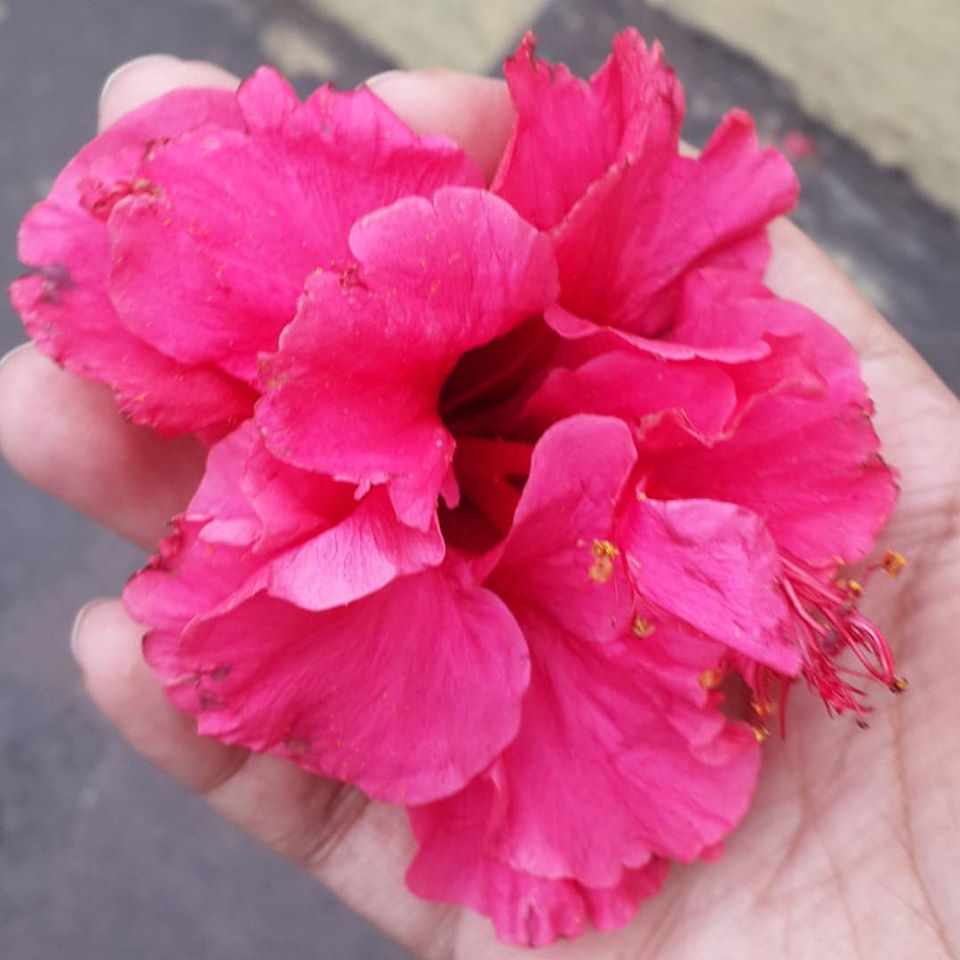
One temple by night, the gold-tongued goddess in the red light district one sees only through shouts and shoving and swindling. And one by morning, bumping out of the city in the dusty dawn to the miracle of no queues, and a moment of sitting quietly by the western window of the sanctum sanctorum to have the priest reach through the wrought iron and place in my palm a compact of kumkum, and a deep pink hibiscus.

If my prayer was a secret, I wouldn’t share it with you. But I know it is etched across my face, these treacherous eyes of mine that yield everything. I want not only to let go of my disappointments, but to let go of my desire for the things that disappointed me.

I have known the darkness of feeling the goddess had let my hand go; and I know the gift of flight that belongs to those who never hold anything in fists.

And so, just as I have taught myself everything over and over again in my life, I will teach myself how to desire again.


kaliflower

An edited version appeared in The New Indian Express on January 14th. “The Venus Flytrap” appears on Thursdays in Chennai’s City Express supplement.

The Venus Flytrap: Looking For The Woman (In Service Of The Man)

The French have a terribly sexy sounding (but actually kind of sexist) saying – “Cherchez la femme”. “Look for the woman.” If there’s a lacuna in the alibi – look for the woman. If it doesn’t add up – look for the woman. If there’s a missing motive – look for the woman. Wherever there is a problem, in short, there is usually a subplot that involves a woman, a tussle for her affections or a drama of her machinations.

I’ve never had reason to drop that phrase into a conversation (never mind that I don’t actually speak French – touché!). Yet I observe its variants around me. There’s a particularly intriguing power dynamic that has nothing to do with an individual’s influence, and everything to do with tacit hierarchy: the curious phenomena of reflex loyalty between and towards men.

Like all deeply-entrenched problems, it’s most evident of all in one-on-one conversation. I’ll share something with a man – an observation of or experience with another man. And my companion will shrug, flash a micro-reaction (a millisecond of a nod or a Cheshire grin) and deftly deflect the topic. It’s not that he doesn’t agree with me. He’s glad I said it, so he didn’t have to. But he just can’t give his bro away. Even if he knows me better than he does him. Even, in fact, if he’s never met him. It’s a response that makes me deeply uncomfortable. The eerie sense that he thinks that he’s looking at the woman, i.e. doesn’t have to look for the culprit. When loyalty is drawn along any demographic line, be it gender, caste or any such category, injustice abounds.

But here’s the reason I’ve never had reason to drop “cherchez la femme” into conversation – I wouldn’t. The only thing scarier than automatic bro-loyalty is internalised misogyny. Which is to say, when the person saying “look for the woman” is herself a woman. There’s no easy way to say this: but in the same way that many men are raised to trust one another first, many women are conditioned to trust one another least.

The woman who rats her colleague out to the resident jerk because she feels ashamed to have confided in her about an abusive partner. The one who would rather believe a distant relative than her molested daughter. The one seeking public office who wants to uphold the two-finger rape test, or criminalise abortion. Each story is equally appalling, and ultimately predictable – in each one, she will pick the man, any man (or “The Man”, as in the one the cool kids stick it to). Over any woman, including herself.

Blind loyalties, stark betrayals. Both in the service of patriarchy. The women unfortunate enough to be tangled up with these turncoats – whether anecdotally or in actuality – get the raw end, every time.

Which is why when I hear an unpleasant story involving an alleged villainess, I do look for the woman. I look for her perspective. I don’t automatically side with her. But I refuse to automatically side against her. Sometimes femme fatale really means femme fatality.

An edited version appeared in The New Indian Express on January 7th. “The Venus Flytrap” appears on Thursdays in Chennai’s City Express supplement.

The Venus Flytrap: Nothing To Laugh About

It was the middle-aged waiter’s sweetly apologetic tone and awkward phrasing that gave him away. Clearly, he was not the one with the objection. He was only the messenger.

This is what he said: “You have independence. But please, laugh a little quietly?” Sudhandhiram – the Tamil word for independence; he knew he was infringing on our rights, and he wanted us to know that he was sorry. We were two women who had finished a long lunch, eaten three types of dessert, and paid the bill. We were loitering, already considered a suspect activity for women. Ladies loitering while laughing loudly. Someone – patron or staff or management – had found this worthy of reprimand.

I have a big laugh. People recognise me by it in crowded auditoriums. Strangers turn to look upon hearing it (possibly to check they haven’t wandered into the set of a horror movie). I do not cover my mouth with a dupatta when I laugh. I do not usually wear a dupatta, in fact, because I don’t believe that anything should be covered unless in the interest of weather or aesthetics, rather than decorum.

I’ve jumped ahead a few paces because there’s something you and I, and everyone in this uncomfortable status quo, knows axiomatically. No one would have dared to go up to a chuckling man about to leave a restaurant and told him (politely or otherwise) to can it.

A woman who makes her presence felt – merely through function, existence or expression – in a public space is a public nuisance. And a woman who does not invisibilise herself makes her presence felt. Anywhere. Women who breastfeed on overnight buses. Girls who sweat through their football jerseys until their coloured sports bras show. Women who have to buy three movie tickets just so that no one sits on either side of them. Women who scream for help through thin walls while the neighbours turn the TV up louder.

I believe in silence in libraries and in meditation halls. I believe public walls should not be pissed against, and bhajans shouldn’t be played on loudspeakers. These are courtesies. They affect large numbers of people as they study, reflect, commute, sleep. They are intersections at which personal liberties can infringe on others. They are not gendered. Not even the open urination thing.

In conversations about women in public spaces, the topic we discuss the most is safety. In this painfully unequal world of ours, it is a concern. But a group of four women will still be asked, “Are you out alone?” (“No, each of us is out with three other people for company”). This is because the conversation has yet to extend to the notion of rights to public space. To be there, basically. To step into a public space should not mean giving up one’s autonomy over one’s body, voice or mobility. It should not mean adjusting (that delightful term used for everything from marriages to train bunks to bra straps) one’s very presence so that it looks, sounds and seems more like an absence.

In a world that makes one weep, we must take every chance to laugh out loud.

An edited version appeared in The New Indian Express on December 24th. “The Venus Flytrap” appears on Thursdays in Chennai’s City Express supplement.

The Venus Flytrap: Trauma’s Loose Knots

Much later, caught in an undertow of memory, the true emotional magnitude of certain events assails us. Trauma leaves live wires all over our lives, faultlines with known and unexpected triggers, unknown and expected after-effects.

Like a rope too thick for anything but a loose knot, we come undone again and again.

Last week, hearing from an eyewitness who was confused as to what the scene they had fled was, I tried to find out online what the tussle and commotion they had seen in Bangalore’s Frazer Town had been. I was dismayed to see a tweet that used the words “small communal unrest”.

Seeing that tweet, I wondered: how is it possible to preface something of a terrible nature with a dismissive adjective? Think of it: “little hate crime”. “Tiny war”. There is no such thing. Only those who are affected have the right of measurement.

Perhaps we rank things on scales so as to be able to process them. The mistake we make is in how we calculate the value of not only human life but the experiential quality of the same. It’s like a zen koan: if no one dies in a conflict or difficult circumstance, and those who survive don’t make a sound, does it matter that it happened?

Always. We often keep the things that deeply shape us from others. Victims of sexual abuse often maintain silences of years. We become embarrassed to share how certain locations or keywords can make our palms sweat and our hearts palpitate – and so we simply withdraw and avoid routes, people, places. Unfulfilled dreams and unrequited desire alter ones ways of being, but the topics are carefully evaded in all but the most trusted company. And then there is the question of narrativisation. People will superimpose their versions onto things that happen to us, or trivialise our struggles, our rights to name things as we understand them – and ultimately, us. And so, sometimes, we don’t tell them our stories at all.

Trauma comes to roost in us both individually and collectively. Chennai continues to stagger from the impact of the recent flooding. People are still in relief camps, some dying of infections. Some cannot go home. Others have lost their livelihoods until their workplaces, vehicles or clients are ready for business again. Someone who briefly evacuated their home told me how in the days and nights since, they still hear the sound of the river in spate at night, and are afraid. Upheaval and shock of any kind – from a bitter breakup to a natural disaster – always bring with them PTSD. Rehabilitation efforts must necessarily consider the emotional and mental costs of survival.

It will sound like I’ve put them all on the same scale – abuse, tragedy, shock and conflict. But trauma is very much like the classic trick question of what weighs more: a 200gm metal coin, or 200grams of feathers. One or the other may not look like much to the beholder, but the burden of each can only be known to its bearer. All trauma is unique – from the cause, to the consequence, to the way we choose to carry it.

An edited version appeared in The New Indian Express on December 17th. “The Venus Flytrap” appears on Thursdays in Chennai’s City Express supplement.