I’m a contributor to this very interesting anthology of illustrated poetry – and they’re looking for a title for the collection. Have any ideas? You stand to win a free copy and and a poster!
Tag Archives: poetry
The Venus Flytrap: Damsel In Dangerlok
Being of a consummately indolent species, and what more, having recently crossed into the zone of being over a quarter of a century old (and therefore prone to, and hopefully excused for, senility and imperiousness), I consider it a bit of an achievement to finish reading two books in a day. The two I read on that particular day were both autobiographical to some degree – one was candidly subtitled as a memoir, while the other carried all the markings of thinly-disguised non-fiction – but were diametrically opposed in the domestic lives of the women protagonists in question.
Isabel Allende, in The Sum Of Our Days, offered a relatively vanilla account of her matronly interference in bringing her “tribe”, her “people”, together over the course of a decade or so. Eunice De Souza, on the other hand – or more accurately, her alter-ego, Rina Ferreira – went about with parrots sitting on her head (there is proof of this elsewhere – a glorious photo of De Souza doing just this while smoking in her kitchen in her bathrobe exists) in Dangerlok, her scrumptious novel about a lecturing poet, single and past middle age, enjoying her solitude and flexing its margins as and when she pleases. There may have been some vanilla in this book, but it was probably infused in vodka.
I know who my tribe are, and I know them to be both a very small group and one that is widely dispersed. This is how I prefer it, although it helps to have a few dear ones within a reasonable radius. I feel the same way about my “people”, and by this I mean (see the earlier point about imperiousness first) my readers. Recently, I had to count the publications my stories and poems have appeared in and noted there were two dozen – half of which featured my work in the past fifteen months alone. What made me happiest was that if I made only one new reader as a result of each of those journals, that tallied up to enough. How many true readers can a poet have in her lifetime anyway? A colleague – or a comrade if you will – once told me that he placed the agreeable number at around twenty. That night, having taken my estimate (and a nightcap for good measure), I slept contentedly, assured my work in the world was plodding along as it should.
What occupies me more and more is not the question of whether to live alone or not, but how. I think my needs are relatively simple. A room to sleep in, a room to work in, a well-stocked fridge, some plants, unobtrusive neighbours (if any), and some sort of animal – either a cat with a sanguine personality or a small dog (I didn’t grow up with dogs and want one thanks to both an acquired affection and a need to compensate). Friends are always welcome but can’t borrow my books or trinkets. Nobody ever wakes me unless explicitly requested to.
How soon can I do this and how far away can I get? 25 and already a curmudgeon (but I will tell you this: I was never young). You can rest assured, though, there will be no parrots in my hair. Owls in a tree, though, if I can have that. And butterflies.
An edited version appeared in The New Indian Express. “The Venus Flytrap” is my column in the Zeitgeist supplement. Previous columns can be found here.
A Story In Curbside Splendor
As threatened, here is “Dashboard Confessional”, a short story about auto drivers, published in the very appropriately named Curbside Splendor.
I also recently had a micro-story published in One Forty Fiction, which you can read here.
And finally (for now), “Cassandra’s Ghazal”, a poem which was published earlier this year in Clementine, was picked by VerseDaily as their weekly feature.
“First Language” – Two Videos
Here are two videos of me reading my poem “First Language”, which appeared in Witchcraft (and before that in the journals Ego Magazine and Istanbul Literary Review).
At How Pedestrian, a website that brings poetry to random places, a simple single-shot video of me reading the poem while sitting inside a cycle-rickshaw, early one morning in Chintadripet, Chennai.
And here, a longer companion piece of me reading the same poem — this time from within both a cycle-rickshaw and an autorickshaw — which captures more of the sights and sounds of the city, and includes one of my other favourite things to do here: buying flowers from the curbside.
Both videos were directed by R. Rathindran Prasad.
Reading in Bangalore
I must warn you about something before I tell you about my next reading.
The other writer I am reading with is someone who has a very strange effect on me.
Sruthi Krishnan is a good friend, and one of the few people who make me blush a lot. Whenever I’m with her, I turn into a giggling juvenile. “I know you won’t believe me, but I’m actually a very serious person,” I’ve told her many times. “You’re right,” she says. “I don’t believe you.”
Consider yourself warned.
Toto Funds the Arts
is pleased to invite you
to a reading of short fiction and poetry by
Sharanya Manivannan
&
Sruthi Krishnan
Venue: Crossword Bookstore, ACR Towers, Ground Floor, 32 Residency Road,
Bangalore – 1
Date and time: Tuesday, 7 September 2010 at 6.30 pm
Reading at Madras Terrace House
And it’s a thriller double-biller!

Monica Mody has published work in Wasafiri, Pratilipi, LIES/ISLE, nthposition, and elsewhere. Her chapbook Travel & Risk was brought out this year by the Wheelchair Party Press. Mody is the winner of the Nicholas Sparks Prize 2010 and the Toto Award for Creative Writing 2007. She has just received her M.F.A. in poetry from the University of Notre Dame.
Sharanya Manivannan‘s book, Witchcraft, was described in The Straits Times as “sensuous and spiritual, delicate and dangerous and as full as the moon reflected in a knife”. Her poetry has also been published in Drunken Boat, Softblow, Pratilipi and elsewhere, and a personal column, “The Venus Flytrap”, appears in The New Indian Express.
Readings by Sharanya Manivannan and Monica Mody
Wednesday July 21 2010
Madras Terrace House, 15 Sri Puram IInd Street, off R.K. Salai, Royapettah, Chennai (Tel: 4503 8391)
7pm – 8.30pm
Please do come – I think this is the last event before MTH closes its doors, and the fantastic sale at the boutique and the nicest chai kadai in town are also not to be missed.
Two Poems In Pyrta
Two new poems, “Dream of Burying My Grandmother Who Has No Grave” and “Halāhala”, are in the first issue of Pyrta, a new India-based online lit and art journal. You can read them here – click “poetry” and scroll down, and enjoy the other offerings on the way.
On The Heart And The Heartlands
I’ve been looking forward to telling you this. In Pratilipi, three new poems — “Last Light”, “Doorway” and “The Distance of a Temple Bell”.
Review: A.R. Venkatachalapathy’s Love Stands Alone
Love Stands Alone, M.L. Thangappa’s marvellous collection of translations of 2000-year old Tamil poetry, is a striking addition to the volumes of academic and creative work that the ancient anthologies have inspired. It is supported by a long introduction by its editor A.R.Venkatachalapathy (who also translated a smaller number of its poems) which contextualizes the work both for an audience that might be new to Sangam poetry and to those who may approach this text as a palimpsest.
The notion of poetry as palimpsest is important here: firstly, all translations of canonical literature necessarily build on earlier scholarship. In this obvious regard, Venkatachalapathy’s introduction is illuminating, concisely explaining the prosody and traditions of the texts, providing historical perspective on the 20th century renaissance of Sangam poetry and locating this set of translations within this milieu.
Secondly, there is something about the particular cosmos of Sangam poetry that also has this palimpsest effect – taken in small doses, a piece may have its own glitter, but set among many gems, the effect is overwhelming. The ethos that is evoked, certain common motifs (such as the loosening bangles of pining women, or the likening of beautiful teeth to jasmine buds) and the nature-centrism of the work all contribute to a mindblowing majesty, as poem accrues upon poem, creating something far greater than the sum of its parts.
Sangam poetry falls into two categories: akam and puram – essentially, within and without. The first deals mostly with the interior landscape of romance in its many facets, while the second revolves around king and country. The book excels particularly when it comes to the puram poems – the latter segment carries the full force and beauty that has kept these poems as relevant today as they were at the time of their writing. Considering that the majority of these poems are description-based, praising and detailing the various attributes of royalty, the translator and editor have been especially masterful in avoiding the natural tendency for such grandiose verse to become overwrought. Take for example Purananuru 8, in which the poet addresses the sun and speaks of his king: “How can you compare with him,/ fast-moving orb of heaven?/ Your realm is limited./ You back away when the moon comes up./ Your hide behind the hills./ And for all your glory/ spread across the sky,/ you can only hold sway/ during the day”.
This is not to say there are not fits and starts. In the akam poems of private longing, from time to time there is a detectable hesitance, perhaps best explained as an absence of the erotic undertone. Compare for instance two renderings of Kuruntokai 131. Here is Venkatachalapathy’s:
A great distance separates me
from the village of my girl,
with large lovable eyes,
and shoulders
shaped like the swaying bamboo.
My heart is desperate
like a peasant
with a single plough
and a field
just wet enough.
O what can I do!
And here is A.K. Ramanujan’s:
Her arms have the beauty
of a gently moving bamboo.
Her eyes are full of peace.
She is faraway,
her place is not easy to reach.
My heart is frantic
with haste,
a plowman with a single ox
on land all wet
and ready for seed.
Ironically, the first stanza of Venkatachalapathy’s translation is the lovelier of the two – but the erotic urgency and imagery of Ramanujan’s second stanza instantly elevates it. This element is lacking throughout the akam section of Love Stands Alone. The voices in which the Sangam bards wrote these poems are passionate, pained (and mostly women’s) voices – and while dismay at a husband’s infidelity, pining for a distant lover, and jealousy toward concubines and co-lovers are all wonderfully evoked, desire is an aspect which seems to have been underplayed. Kuruntokai 185, for example, is titled insipidly by its first line, “Your sweetheart’s forehead”, instead of focusing on the poem’s closing image, “Why don’t you tell this/ to my lover from the mountains/ where the kanthal stalks/ with bright red blossoms/ beaten up by rain/ lie battered and wan on a rock/ like a cobra with his shrunken hood/ lying limp/ and bring home to him/ the run-down state of my body?”. The cobra’s head is a traditional motif for the female genitals, and this image beautifully evokes her sexual longing and frustration – but not to a reader who has no prior knowledge of the metaphor, or in this case, a reason to contemplate it.
All this said, however, there was a point while reading Love Stands Alone, somewhere near the closing of the akam section, when the profound internal logic – and magic – of the work intoxicated me so much that I read it through to its last page and found myself utterly wordless. Gone were the comparisons to other translators, the notes taken during the reading, the critic’s distance: in that light-bleached moment of afterglow, none of them had prepared me to begin commenting on this book.
The book ends on a particularly radiant note, which almost anticipates the impact of Sangam poetry on the whole. “If you weigh/ worldly life/ against the life of the spirit,/ it is not worth a single seed of mustard”, reads part of Purananuru 358. Life is impermanent, most art sinks without a trace, even the true names of these bards are lost, but something elemental endures in this literature. Only that which is timeless remains. What Thangappa, one of many torchbearers, passes down in Love Stands Alone is a triumph.
An edited version appeared in today’s The New Sunday Express.
NXG on Mozhiudal
There’s a nice write-up in NXG, The Hindu today about last weekend’s queer poetry reading. You can read it here.
I like how the writer begins the article by noting how the reading seemed to be a safe space – the same thought occurred to me while I was there, and in the days since I have also pondered over whether to write about it too. It was more than just the fact that I know the organizers and the Pride movement in Chennai well — the vast majority of the audience were new faces. Still, there was a good underlying energy, a welcoming one, that I rarely sense at readings here.
Perhaps I should explain my context. Somewhere early in my publishing career, I got stuck with the tag of being a writer of “erotic” poetry, a label I view with discomfort. Now, I have nothing against erotica. I love it. I have nothing against sex either. What I do have a problem with is reductionism. Erotica by its nature is intended to titillate. My work, by and large, isn’t. Anyone with a little sensitivity who looks over my body of supposedly erotic work should see neuroses, longing, loss. If they see a horny woman poking at her keyboard with sticky fingers, that’s their own oversight. A woman can be horny, complicated, desireless, wounded, surrendering, conquering in different lights. So can a man. If you choose only to see her in one light, then you’re missing out on a whole lot.
What this has come to mean is that I have become defensive (as you may have gathered from the paragraph above, even). In India, or at least in Chennai, I limit what I share at readings. Look, I don’t mean to come off like a snob, but we’re an awfully perverted bunch, don’t you think? So, so as to avoid various unpleasantries, I limit what I share. It frustrates me. I like to have fun at readings. I like to feel free, to play with the audience, to laugh. I like, above all, to be honest.
In this sense, Mozhiudal was one of the safest spaces I’ve read at in Chennai. To me, the very notion of a queer reading is based on the acceptance that sexuality is complex and varied, and is vital to our experience of the world – exactly the sort of basis that removes all need for apologies and excuses. Remember this: sexuality as opposed to sex alone. I opened with what I think of as my lightest piece, and without question the most beloved among my fans, “Poem”, and moved on to more risque work, pieces like “Possession” and “Holding The Man”. Reading the last one in particular, I was struck by how its motifs of arrest and secrecy were, perhaps, rather reminiscent of the queer experience, even though the people in my poem are a heterosexual couple. And also my explicitly queer work – “Hibiscus”, “Linea Negra” – and then looping back to my other much-misconstrued crowd-pleaser, “How To Eat A Wolf”. Not once did I feel like I had gone too far, or become too vulnerable. The last poem I shared, in two voices with Aniruddhan Vasudevan, was my translation of Subramanya Bharati’s “Suttum Vizhi”. How was this a queer work, or a sexual one? Maybe because Bharati would certainly have been no homophobe; in death he certainly has lent his voice to the Pride movement. Maybe because from the tongue and pen of another woman, my transcreated lines – “woman precious as the eye, my love fills me with turbulence” – turn vaguely subversive. Or maybe because this is what it comes down to in the end — love, loss and longing. The human heart. The body and its blood.
Mozhiudal: Queer Poetry Reading
Pride month is well underway, and you can see a full list of events happening in Chennai through June here.
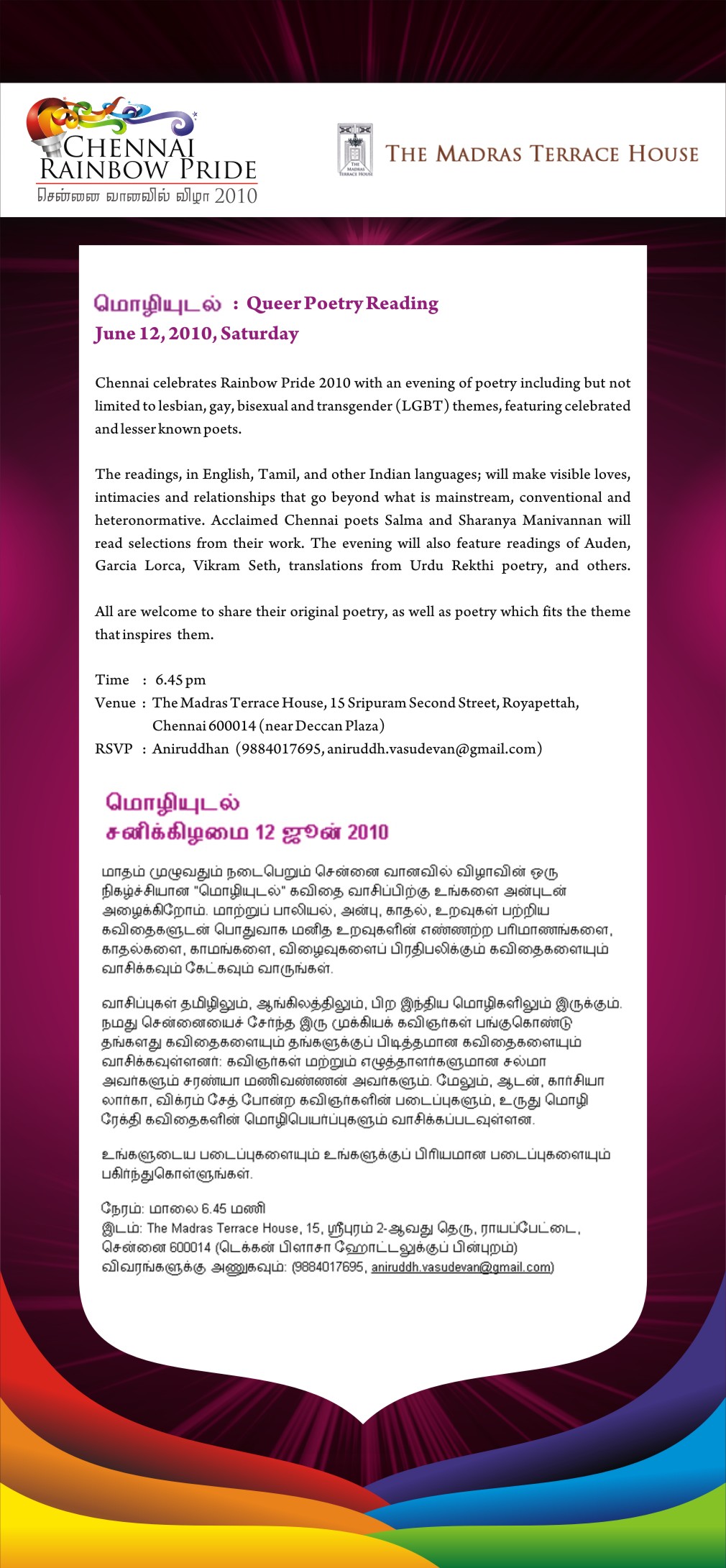
Among them is “Mozhiudal”, a poetry reading and open mic at Madras Terrace House on June 12, featuring Salma and myself. All are welcome – you can share either your original poetry, or poetry that you love which fits the theme. More about “Mozhiudal” is on the flyer below (click to enlarge).
Two Poems in Poem2Day
New ones, “Tin Men” and “Banishing”. Read them here.
Readings in Singapore
Because I’m just a genius that way, I went and practically double-booked myself for two readings on Friday May 21, genuinely thinking (until I pulled the two confirming emails up side by side) that one was on Friday and the other on Saturday. Some apologetic phone calls later, I managed to buy myself a half hour to dash to the other end of town, or rather, country. This should be interesting!
I had a wonderful time in Darwin at the Wordstorm Festival of Australasian Writing, and am taking a few days’ transit in my favourite city – Singapore. So, for the first time since December 2007, when I was here for the Singapore Writers’ Festival, I’ve got a couple of events scheduled for May 21:
4pm (sharp!) – A reading at FOST Gallery, 65 Kim Yam Road. RSVP Clarissa Cortes at clarissa@fostgallery.com or on 6836 2661.
5.30pm – A reading and discussion with Heartlands Book Club at Bukit Batok Public Library, West Mall. RSVP Kweh Soon Huat at soon_huat_KWEH@nlb.gov.sg.
Please note that RSVPs are required for both events. I will have copies of Witchcraft and lipstick, and at least for the Library event, an even breathier voice than usual thanks to all that running between venues!
 Sharanya Manivannan
You must be logged in to post a comment.