Hemant Mohapatra: Place and the Page

You won the 2010 Srinivas Rayaprol Prize, one of the very few accolades available for English poetry in India today, and it catapulted you out of obscurity. In some ways, this is a comment on the “low ceilings” of the Indian poetry scene, in which it’s difficult to get published, but relatively easy to ascend to celebrity. Can you say a little about this landscape itself, and the trajectories available to poets in India?

I am not a very prolific writer — I write in spurts, and take time with my pieces. I also publish very infrequently, but I don’t think it is difficult to get good poetry published in India, what with so many online and print magazines sprouting everywhere. Publishing a full-length book is another story I hear – no personal experience here either. The situation isn’t unique to the Indian literary scene, but poetry is especially marginalized in India (who can recall 5 contemporary Hindi poets under the age of 40?). Moreover, established literary journals are very risk-averse; I see the same 20-30 names whichever Indian lit-magazine I choose to read. Given this limited crowd, the path to ‘celebrity’ is short, and perhaps not as satisfying. We cannot expect to see these trajectories expand and diversify till we are ready to bring poetry into the mainstream academic curriculum.

Has your recent notability within India had an effect on your reception abroad?

Not really. Somehow, the Indian poetry scene seems disconnected from the rest of the world, though I’d like to see this change in my lifetime, and also participate in that process.

Can you comment about poetry in public spaces, and what role readings play in increasing the public appeal of poetry? On that note, is the public appeal of poetry important, or is it best left to flourish as a niche artform?

My goal, with my poetry, has always been to demystify the craft, and poetry in public places may play a role there. I don’t fully grasp the necessity of  poetry readings, but I can appreciate the curiosity of a reader to hear the poet’s take on his/her own piece. There is a need we all have to connect personally with artists that inspire us, and poetry readings achieve that.

Public appeal of poetry? Absolutely, but there is too much formalization, too much abstraction in much of modern poetry. Sure, a well-crafted, clever poem could be a thing of beauty, but if it doesn’t change me in any way then I am not interested. Poems are not puzzles to be solved; they work with insight, not cognition. As long as this is done right, whether poetry stays as a niche artform or not is of little concern to me.

I noticed that you rarely look up from your text, at the audience, when you read. Is the performative aspect of readings something you think about?

I am hardly the performance poet, preferring to focus on what I express on paper rather than on the stage. I read a lot of poetry to myself, out loud, but that is because I enjoy how a piece tightens or releases my breath; I am interested in exploring that. My early readings likely had a performance aspect: I would look at an audience member at just the right turn of phrase, at just the right moment and make her feel exactly what I wanted to. That sort of attitude can easily corrupt, so I backed off. I want to vanish and be unimportant during a reading, so if the audience stays engaged it is due to the poem not the poet.

You’re originally from Orissa, and are now based in Texas. You’ve also lived or travelled in a variety of other places, including Russia, South America and South East Asia? What impact has travel and geographic movement had on your poetry?

I am some sort of a ‘reverse traveler’. I don’t move around to get inspired, but the other way round. I hear or read about a particular place and that stays with me. A year or two later, if that memory hasn’t left, I start making plans. The sort of poetry I prefer to write cannot be written on a tourist visa, so I much prefer to stay at a place for a month or two at a time. It helps me find stories I would miss otherwise.

One of your significant poetic sequences is called “Letters From Exile”. Can you comment on exile as a concept – what does it mean to you, and in what sense do you approach this word?

I started writing the ‘Exile’ series in the early winter of 2005 at the end of a significant phase of my life. For me, it was an attempt to be inspired by absences and that attempt has spanned over 5 years. By exile, I do not mean just the physical but also the emotional distance I had to put between myself and my life to be able to write about things that interested me in a dispassionate, non-sentimental way. The distance was important to gain that vantage, that perspective.

As a pianist, what influence does music – composing, playing and listening – have on your poems?

Music is just another form of expression, another method of self-exploration. There are things I cannot express with poetry alone, so there is certainly an opportunity to merge both media — I haven’t been very successful at it so far, but I am trying. For example, right now I am working on a set of poems that will read in sync with a few Chopin nocturnes, the narrative, the punctuations, and line-breaks allowing the poems to ascend and descend with the music.

What about your day job as an engineer – does your job or your training have an influence as well?

Absolutely. I find what I do as an engineer very challenging and enjoyable. Also, it pays the bills, allows me to travel on whim, and to take creative risks. I know there are writers who are inspired by poverty, but not me.

You’ve said that as a confessional poet, you feel as if you are running out of material. But all artists, even those who don’t work in autobiographical modes, are limited by their experience and knowledge. What do you do you keep being inspired? Do you see yourself writing beyond the scope of your own life in future?

I don’t want poetry (or the writing of it) to interfere in the living of my life. I don’t do anything to ‘find’ inspiration, although poetry does present a very real and measurable way for me to assess myself. If I am uninspired, it shows. What I do with that knowledge is not always straight-forward. Writing fictional stories is not important to me, so I don’t think I will ever write beyond what I have known, felt, possessed, or lost.

An edited version appeared in today’s The Hindu Literary Review.
Reading at Spaces with Yalini Dream, Shailja Patel and Ramki Ramakrishnan Tomorrow

It’s an honour to be one of Yalini Dream’s special guest performers at her show at Spaces, Besant Nagar (1 Elliots Beach Road, Chennai) tomorrow. The show will start at 7pm, and will also feature Shailja Patel and Ramki Ramakrishnan (on veena). I will read for about five or ten minutes — my work is the least performative among tomorrow’s poets, so I hope you won’t mind me mellowing the evening out for a little bit!

I’m sorry this is both last minute and rushed and I haven’t provided all the relevant links – I encourage you to look up more details!

The Venus Flytrap: Unsentimental Fool

Sometime last year, after a lifetime of oversensitivity and a positively medieval sense of the tragic, I thought I had finally become unsentimental. Which meant, in optimistic terms, that my days of weeping in restaurants might finally have been put behind me. I was quite relieved about this. I had spoiled a lot of mascara crying over spilt milk.

I thought I had become unsentimental about, for instance, Leonard Cohen, the artist formerly known as my downfall. So what was I doing at four in the morning, at the end of December, riffling through page after page of Agha Shahid Ali’s collected works to correctly source the poem from which the line that had haunted me all that day had come from – just so I could put it in a letter? And not even a real letter, the kind that sensible people write in order to communicate, but one of those hopelessly twee things I’ve called a postcard: a poem not even sent to its intended, but left in the open (because actual communication would be, you know, too much for the nervous system).

I thought I was over Cohen, but he was in my subliminal impulses, as every thing that ever crosses one’s way becomes. And there I was, having perfectly internalized his mythology, playing it out without a thought.

In any case, I could not find the line anywhere in the book. “I’ve seen how things/ that seek their way find their void instead”. I fell asleep to the realization it wasn’t at all from Ali, but from Federico Garcia Lorca, a hero both of mine and – incidentally – Cohen’s. Fitting, considering that my new year’s resolution is to fully inculcate my complete demonic self, demonic the way Lorca meant it, which is to say – not so much to consume with a mad passion, but to once again also let myself be consumed, be possessed, to stop standing in the way of life, and love, and ferocious intensity.

Which, as you might correctly surmise, might just be a noble way of saying “start crying again in restaurants, if you like”. But it goes a little further than that. What I’ve learnt from my period of emotional austerity is that yes, unsentimentality is a survival mechanism and its opposite (intensity) is a choice – but to choose to live deeply doesn’t mean to choose to live without discretion. Too much contrived emotion only results in not knowing the difference between god and chemical – every sensation inducible, and hence inauthentic.

Maybe you’ll find what I say next more diffident than demonic, but I’ll say it anyway. Today I bought a gramophone, an impulse acquisition, right off the side of a street. An unthinkably romantic purchase if there ever was one, and one I would never have made ever before. I have neither vinyl nor space for décor – and for the longest time, too much drama about anything resembling a symbolic commitment. I have, however, finally found the space in my life again for a little tenderness, a little twinkling; and enough lines in my head, and enough groove in my body, to provide the music and lyrics – but only the kind that comes of its own volition, not the kind that’s just blank noise interfering in a dense, deliciously loaded silence.

An edited version appeared in The New Indian Express. “The Venus Flytrap” is my column in the Zeitgeist supplement. Previous columns can be found here.

January 2011 Events in Bangalore

I have two events in Bangalore this weekend.

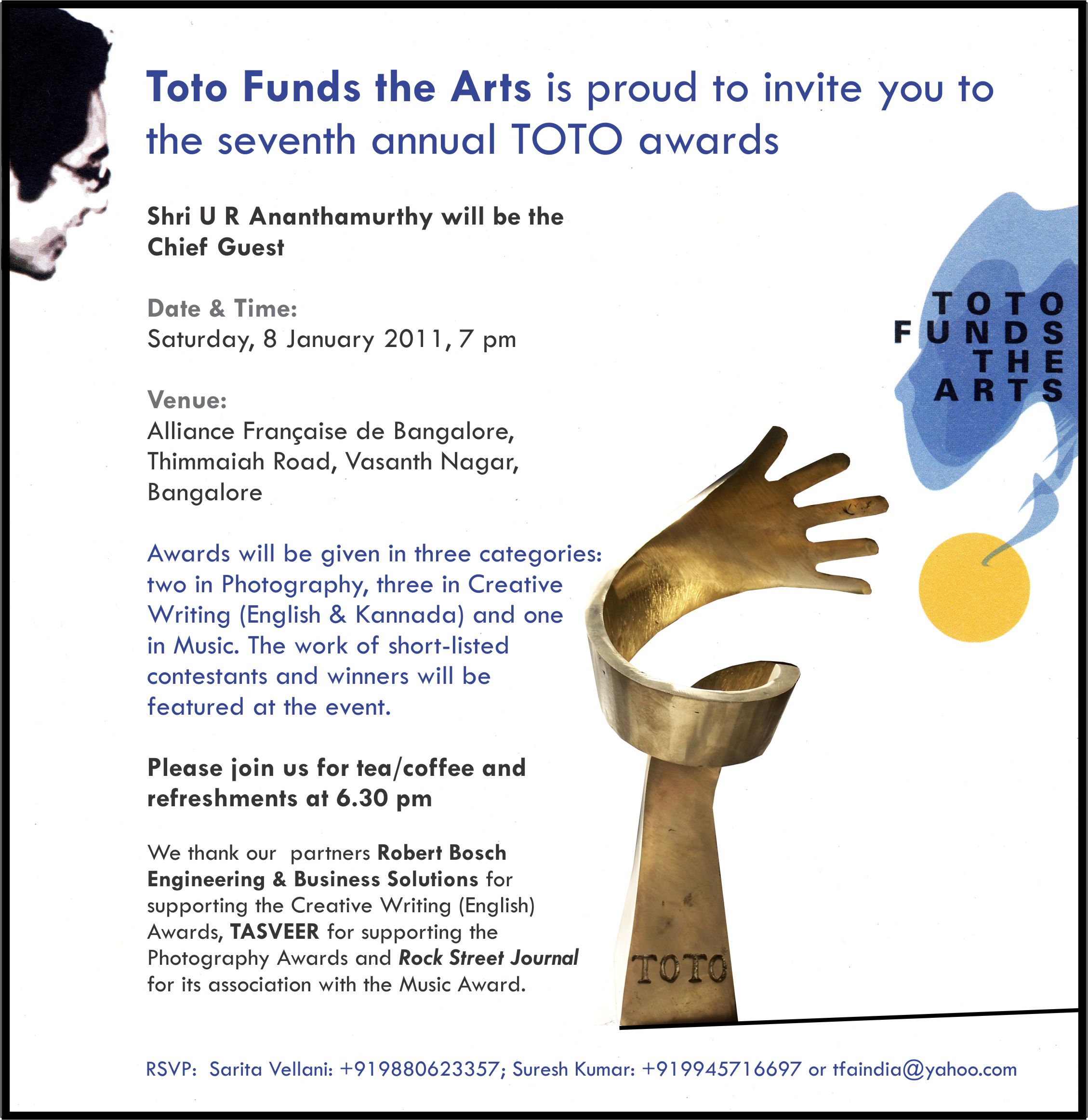
I’ll read briefly at the Toto Awards on Saturday the 8th, as I am shortlisted again this year. I have “always the bridesmaid” syndrome when it comes to this sort of thing, but we shall see… :)

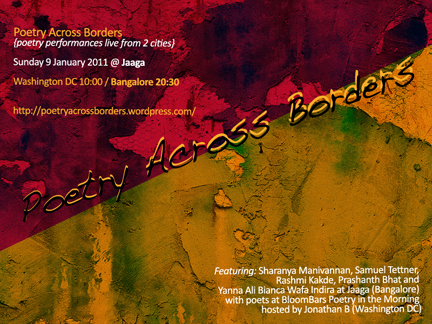
And on Sunday the 9th, I will read at Poetry Across Borders at Jaaga. Please do come.

A Poem In Muse India

Happy new year, everyone! Here’s a poem from the early post-Witchcraft period, two years ago. It’s called “Mahabalipuram” and you can read it in Muse India. I was a bit surprised to find it in the new issue of the magazine, because I had received neither an acceptance nor rejection note when I submitted it, which obviously isn’t standard protocol. Strange.

Four Poems in Superstition Review

As the year draws to a close, I’m glad to be able to share some of my favorites from my recent work. In Superstition Review, four poems – “Distant Star”, “Lightning Over Dindivanam Highway”, “Sun Swallower” and “Keeping The Change”. You can read them here.

What I also like is that there are two poems each from both the manuscripts I’m working on. “Distant Star” and “Sun Swallower” are from Bulletproof Offering (the latter owes something to a poem by Laksmi Pamuntjak); and “Lightning Over Dindivanam Highway” and “Keeping The Change” are from Cadaver Exquisito, although not very representative of the impulse and tone of that collection.

A Poem In carte blanche

I’m still juggling with the title, but I am certain about the poem, currently known as “Mouna Raga/Dawning”. You can read it here in carte blanche.

I know my readers are composed almost entirely of lurkers and stalkers (what? y’all are so silent — the editor of a distinguished magazine once told me that my poems were the most-visited webpage of that entire issue; typically, all was pin-droppable on this blog), but if you have a suggestion about the title (or if you think it works – I can be convinced either way), drop it in the comments, won’t you?

A Poem in deuce coupe

A poem, “The Painted Boats“, in deuce coupe.

In other exciting news, two of my poems were shortlisted by Chad Sweeney for Asia Writes for Best of the Web 2010, and one was nominated. Read what Sweeney had to say here.

I know I have been silent; I surface slowly because I wouldn’t have it any other way.

Pondy Reading

I’m sorry for this being on such short notice, but I will be reading (possibly with percussion interludes) at Touchwood Studios/Bindaas Cafe, Needarajaprayar Street, Pondicherry, today at 6.30pm.

Dead Centre

The 50 poems since Witchcraft was published two years ago are perfectly halved into two different manuscripts. Which means I am either halfway through or almost finished with them, depending on whether you take the view that it’s 30 poems or 50 that make a volume.

Maybe I could tell you more about them.

Bulletproof Offering

The part about this manuscript that is easy to talk about is its mythic element. Set in what is essentially the Jungian forest, the poems deal exclusively with this suffering, an anguish so deep that one can hardly keep from burning down the forest herself. The sufferers here are Sita and Lucifer. Sita spends most of her life in exile, in the wilderness — and at one point she is exiled in paradise, the most beautiful garden on earth. Lucifer, in the Persian myth of his fall from grace, is exiled from paradise for refusing to bow to any other than God. Both suffer because of an impossible devotion to their divine beloveds. Both are demoted divinities – Sita is named in the Rig Veda, which predates the story of Rama,  not as the earth’s child but as a goddess of fertility and harvest in her own right, and Lucifer was the most exalted of the angels. Both enter the underworld, walking through fire.

At some point, perhaps when the book has come out, I would like to tell you about the odd cosmic synchronicity (and hilarity, a counterpoint to the cosmic heartbreak at the centre of all this) that helped my research. The Ramayana found me in multiple incarnations, in multiple moments, often in incredible scenarios. The motifs in the Sita poems are (naturally) of the earth, the trees, light and shadow, mirrors, and a mysterious place in the forest where she is loved and left behind. The Lucifer poems have a cosmic angle in the literal sense — Lucifer is the Latin for “lightbearer”, and is associated with Venus, the morning star, the planet of love. Before I began to work with this archetype, I had been pondering the pulsar, the dying star that emits a death song, imprinted in the universe for light years after And so the motifs in these poems are astronomical.

I tell people that Witchcraft is a very depressing book but many have told me they read it to cheer up (and as an aphrodisiac, in which case, happy to help and cheers). I think Bulletproof Offering is a very depressing book that is likely to do neither. But it means so much to me — these archetypes have been necessary for my very survival over the past two years, and I’m so attached I almost don’t want to finish the book and have to let them go.

Cadaver Exquisito

In the parlour game Exquisite Corpse (I prefer the European name for the working title, because the English one already belongs to a famous journal and many other things), a piece of paper is rotated around a room, and players take turns adding a new image or word to it without having seen the ones that came before. The simplest version might consist of three players, who divide a page into three and each draw a head, a torso and feet. The resulting creature might be grotesque or humourous — a cat’s face, a mermaid’s breasts, a chicken’s claws perhaps.

I’ve been consumed with the notion of dismemberment.

To have one’s feet in one location, one’s heart in another, and one’s ideas in a third is a sort of dismemberment. Having your life torn to pieces is another kind. Both inform this work. If Bulletproof Offering is the mythic, psychospiritual landscape I inhabit, then Cadaver Exquisito is its absolutely literal cousin, a purgatory I could pick out on a map. The soul a glass-stringed kite, tethered in this undergrowth, yearning for release. What you will read here are poems of the city, poems of inertia, poems of desperation and a displacement that cannot be romanticised (though, of course, I try a little).

~~

You may have seen a number of pieces from both books already, though some of what I think are the strongest poems have yet to find individual homes. At this time, neither collection has been committed to a publisher. I have yet to start my search, and I find the idea daunting. One of the only things I know for sure is that this time, I want to work with folks who have their distribution sorted out.

I feel very far removed from Witchcraft, and deeply immersed in these two manuscripts. I was confiding in a friend recently about the disconnect I feel from my readership, my uncertainty about whether my poems really have one, and he suggested that I do more to meet them halfway. So here I am, meeting you halfway, with my two halfway books, hopeful.