Viva La Vida – Postmortem

We spent a beautiful late morning yesterday at the most gorgeous cemetery I have ever been in (prettier than any park in this city, I think). The Madras War Memorial is a small, impeccably maintained place, holding the remains and/or remembrances of Commonwealth citizens who died here during the first and second world wars.

The raven that showed up as Anand read from Edgar Allen Poe, the monarch butterfly that did the same when I read a persona poem as Frida Kahlo speaking to me, and the Cohen tombstone near where we were (Deesh read from Leonard C)… Someone told me recently that the signs are everywhere, even when one doesn’t look for them. But I love metaphor, and mythology. I’ll connect the dots.

On the phone the night before, working out lunch plans: “We’ll decide at the graveyard! *cackle*”. How cool to be able to say things like that and mean them. :)

Left to right — Anand, Anita, Harish, Deesh, Chandrachoodan, Arun, Raji, Anita’s daughter (sorry!), Sharanya. Photo by Dilip Muralidharan (link goes to clearer version of pic).

Nursery Rhyme For Brana Bono

Posted this on a more private space this morning. Thought I’d share it here, just for fun.

Medusa-seduca, you declared,
and crossed your legs at tea.
Rapunzel-schmunzel, I shrugged.
You don’t mean little old lady me?
But don’t take me at my bashful blush,
I was only feigning surprise.
I think we already know: my hair is
a certifiable home-wrecking device.

The Viva La Vida Reading

Please feel free to distribute! Hope to see you at this, if you’re in Chennai.

P.S. As everyone already knows, I have a kindergartener’s sense of colour. A different version should be up at Chandrachoodan’s soon.

The Viva La Vida reading: an open mic on Frida Kahlo’s 101st birthday, celebrating the spectacularly macabre.

On Spoken Word As A Sort Of Shamanism

This appeared in the Chennai edition of The Times of India today, under the “What’s Hot” section.

Years ago, I read that when a woman weaves out of her iyari, she doesn’t need to copy a design. I took this to heart, or took it back into my heart, rather – iyari is the Huichol concept of heartmemory. Eventually, I would twine this with the concepts of duende – the dangerous driving force behind Andalusian flamenco deep song – and ananku – the lost Tamil idea of the sacred malevolence in certain objects and locations, including the woman’s body.

To me, although widely divergent geographically, this trinity of concepts represent one and the same. It is what I enter and try to evoke in performance. I’ve been doing spoken word since I was 15 years old, long enough for me to know my element and try to draw others into theirs. So I teach, and co-organise events. Spoken word is my shamanism.

Having experienced firsthand the transcendental and transformative power of poetry in performance when it hits a point of alchemy somewhere between rock concert and book reading (but not, as some may have you believe, theatre), I am convinced that Chennai is ripe for it.

What I’ve said must sound terribly pretentious. And I’ll tell you the big secret: it is. Ironically, vocabulary limits us when trying to describe the overwhelming. But music, words, visuals and movement have saved my life time and again. Who hasn’t lived through a night sustained by a single song, or sat in the cinema and wept until everyone else in the hall had left? This is why I do what I do. Because art is meaningful. Ultimately I myself, my great loves and disasters and fears, may mean nothing. But what I create on this time on earth could – just maybe – make someone, somewhere, feel less lonely for just one profound moment. And that is enough.

If You Forget Me

But if each day,
each hour,
you feel that you are destined for me

with implacable sweetness,
if each day a flower

climbs up to your lips to seek me,
ah my love, ah my own,
in me all that fire is repeated,
in me nothing is extinguished or forgotten,

my love feeds on your love, beloved,
and as long as you live it will be in your arms
without leaving mine.

Pablo Neruda

It’s funny that I was thinking of this poem and the time I read it at a friend’s wedding, because I just found out it’s their 3 year anniversary today. (Hugs to you both). The rest of the poem is here.

The Venus Flytrap: No Love In This Democracy

At their most basic, our survival needs have at least three components: food, shelter and love. The first and second are physical necessities. The third appears almost as a technical error – in no medical book will you find a prescription for causing or curing love. Yet, we know it is possible to die of heartbreak, even literally. It is the alchemy that makes the distinction between a life lived and one that is merely survived.

If Love is God, as some like to say, then it is equally contentious. Whose business is love? If recent reports are anything to go by, it is strictly under the jurisdiction of state and society. Consider two incidents in Tamil Nadu that made headlines in late May. An eloping couple in their 20s were forcibly separated with no less than the intervention of political parties. Two women, both around 40, committed suicide out of shame over their “unnatural” relationship; in an ironic twist, their families chose to cremate them together, giving them in death what was so mercilessly denied them in life.

This preoccupation with telling people how to conduct their most intimate relationships is deeply unhealthy. To enforce discipline on teenagers is one thing. To persecute adults for following their hearts is another, a malaise that reveals deep prejudices against fundamental freedoms. We live in a version of democracy which allows adults to vote for their leaders, but not for their lovers.

Race, age, gender, religion, caste, location, affluence and incompatible horoscopes have served to keep people apart not for their own good, but for the good of a system that refuses to evolve. What disturbs me is how many people continue to adhere to these codes willingly. I see shades of this mental servility even among the most intelligent people I know.

That onlookers fear love is disheartening and challenging; that those in love fear their own love is downright disillusioning.

Those who raise, erroneously, the flags of tradition and culture should consider this 2000 year old poem by Cempulappeyanirar, brought from the Sangam age to our Anglicized ears by the genius of A.K. Ramanujan. Way back in the glory days of Tamil culture, this is what was seen, sung about, surrendered to:

What could my mother be
to yours? What kin is my father
to yours anyway? And how
Did you and I meet ever?
But in love
our hearts have mingled
as red earth and pouring rain.

There, in a nutshell, is all I think I will ever need to know about life, and love. You love who you love. The end.

The most enduring romance I know of is between a beautiful artist in her 30s and someone twice her age, whose son she had gone to school with. When he dies, she does not know whether she will be permitted to go to his funeral. Theirs is a portmanteau love, patched together between countries and children from other marriages and the steadying force that has kept them together through years. It is a relationship that inspires me, one that shows courage. It is a relationship that sees the daggers, feels the fear, and takes the leap anyway.

Not all of us are so lucky as to find the ones who are made for us, cut from the same cloth of the soul. But those who do, do. It’s as simple as that. You love who you love. And the rest be damned, then? But here’s the thing: there is no rest, not really. No social construct, legal diktat or political enemy that cannot be dismantled. As cheesy as it sounds, love is all there is, and the rest is just window dressing.

An edited version appeared in The New Indian Express. “The Venus Flytrap” is my weekly column in the Zeitgeist supplement.

Remembering Paula Gunn Allen

Paula Gunn Allen, the revolutionary writer, teacher and cultural historian passed away of lung cancer on May 29.

THE TEXT IS FLESH

by Paula Gunn Allen

They tell me that in Beirut
men lounger around the tables
over thick syrupy coffee
and recite poetry.

Not the ones they’ve made themselves,
but everyone’s poems.
These are people who know
poems are word in flesh, incarnate.

In safer, more sterile worlds we site
lounging over thin brown water
that steams, reciting formulas
about poems nobody read before.

Here, we are people who are not carnal.
Here, we do not hear the song flesh sings
on its way to death. Neither shadow
nor light are kenned.

In Beirut the bombs. Uzi and oud.
Rocket flares, explodes. Flesh splattered on walls.
Blood flows in cobbled alleys with all the filth,
among which in still courtyards oranges bloom.

Idiom is language of the heart.
I and thou and nowhere at all.
Ya babbebi, anine, ya babeebi.
Here over tiny cups a poem perches

on the edge of lips, stutters once;
talking breath feathers lift
winged flesh into sky
trembles into flight.

Conversations with the dead
convert energy to strengthen
on the rez we talk such tales,
the ones who can talk, who know how.

A community of spirits,
kopisty’a, some in flesh,
some embodied words. A presence
don’t you know. All in mind.

Feathered nests of minds. Such university, these cells,
these breathings, where wings of hair
flutter and fall to the ground. In Beirut
recitation, chanting. Uzi and oud,

carnal rotting, blood washing streets clean.
Life exploding into song,
chanting. Coffeehouses full of poetry,
courtyards full of blooms

flown and scattered, held,
passing back and forth, flower into flesh.
You know, carnal. Like that. Tu es mi carnal,
mi carnales
. Flesh that is known.

In Beirut they chant together
stylized runes, incanted dreams.
Generations, thousands of them
around a table, chanting.

On the rez thunderheads, shiwanna,
mass around the mesas
chanting. We’ve watched them becomes
bolts of flame. Smokes of blast. The noise.

Seem them become rain. bring at last the corn.
Here in fleshless luxury we imagine
they’re in cause and effect relation.
On the rez and in Beirut we know it’s not the same.

What there is, is text and earth.
What there is, is flesh.
And chanting flesh into death and life.
And somewhere within, exploding, some bone.

The Blasphemy Reading

Venue is a mystery because it is extremely cool.

RSVP to find out.

Ok, we discussed it and changed our minds.

It’s the Rama temple in Koyambedu, near the outstation bus stand and the market. Meet us at the little cupola-like thing (CC’s description: small platform with a roof) outside. 10am. Bring poems that fit the theme.

April 12 — Lazy Saturday Poetry Open Mic

So, April 12 is a big day for me. It’s when the first installment of my column in The New Indian Express comes out. And it’s also when my dear buddy Jerome Kugan’s album launches. At least two reasons to celebrate, but what does one do when feeling too lazy?

Have a Lazy Saturday Micless Open Mic of course.

This time, we’re planning on being so laidback that:

1. We’re not booking the venue. Just be at the Barista on G.N. Chetty Road at 2.30pm on Saturday April 12.

2. There’s no theme.

Why? Why not? You’re here. We’re here. Everybody likes coffee. And even if you don’t, you love poetry. Right?

So bring thyselves and thy poyems. See you there. More details, and if you’re not too lazy to RSVP, email me or call Chandroo at 9844467463.

Poem: Mermaid

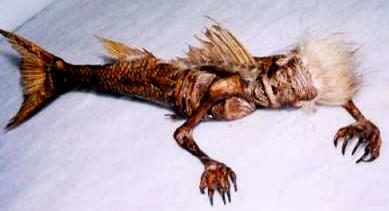
MERMAID

They found the mermaid the morning after.
She was the colour of homemade toffee, burnt
in places, mellow in others. Her hair fragile
as flax. Her beautiful, brittle fins. When the man
who found her, lifting the seaweed veiling her face,
knelt at her hip, his breath like broken glass, she
looked to him like she would crumble to the touch.

Around him, the shore lay shattered like the
heart of a woman who knows her mother has
turned against her. He traced with hands anxious
with liquor the aghast shape of her jaw. Her bones.
Her ribs like stacked haloes, her tough browned
skin. The delicate, exquisite patterns of her scales.
The sharp, ridged points at which her tail flared
into a crescent, a sinewed handheld fan.

His tears came slowly, at first, and then in little
detonations of despair. The first lesson of the ocean,
he had always known, was reciprocity. What the
mother took from mortals, she would return in
equal fervour. Her sleeping child coiled into
the tentacles of weed and debris, sucked deep
within the womb and expelled like so many other
bodies. He listened to her roar then and heard not
cruelty, not death, but hideous, intolerable grief.

(For back story, please see here)

Karna Poems on Kritya

The only video of my readings that I’ve seen so far and liked was shot by Sze Ying Goh at No Black Tie, Kuala Lumpur on April 1 2007. You can find this video in the ‘Narc Is I’ section of this blog.

In it, I am reading “Karna Considers Yuanfen”. This was the first of the poems that reimagine the Mahabharata’s Karna as a woman and alter-ego, juxtaposing the epic character with personal history. When I first wrote it, I was not sure — it is a prose poem, clunky with text, drenched in heavy imagery. I did not think it could translate to the stage. But I found, repeatedly, that it was among my most popular works, the kind in which the audience stays silent for a moment after it ends before they begin to clap.

Although there are other poems outside of this trilogy, “Karna Considers Yuanfen” leads into “Karna Considers Light” and “Karna and Kunti”, neither of which have been published before. The former is a rumination on the nature of Karna’s relationship to her omniscient, unattainable father, the god of the sun, the latter a more traditional retelling of her encounter with her unknown mother on the battlefield. In the first poem, the closing lines are engraved on a plaque in the crypt of the astronomer John Brashear; the second contains a phrase from Ainkurunuru 13 (trans. Ramanujan). I realise my poems and blog have niche audiences who are probably already familiar, but Yuanfen is the Chinese concept of the apportionment of love one is destined to have in one’s lifetime.

All three are published in the April issue of Kritya. Click on the “more poems by SM” link there to take you to the second and third.

Why is Karna a woman, and why have I chosen this character to explore biomythography? Because the story of Karna is the story of why art has any meaning to me. It was the first story I ever heard that devastated me, that taught me immediately of both the power and pathos of storytelling and shaped my moral universe as a very young child. Karna is my mythological archetype, and the deeper I delved into creating my own art, the more I wanted to appropriate this story in a way that was truly mine.

Online Now: My Reading at One World Cafe

I’m very happy to share that a specially-commissioned recording of twelve poems from my forthcoming book, Witchcraft, is up at Her Circle‘s One World Cafe Reading Series, as a feature for the month of April. Her Circle is an international website focusing on arts and activism by women. Do check out the whole website and archives — there’s some awesome work there.

I’m absolutely thrilled that it is up, with an introduction by the poet Kimberly L. Becker that’s going to have me smile to myself for the next couple of days. You can take a listen here.

Special thanks to Misty Ericson of Her Circle, and of course, my friend the sound engineer, Anand Krishnamoorthi of Prasad Studios.

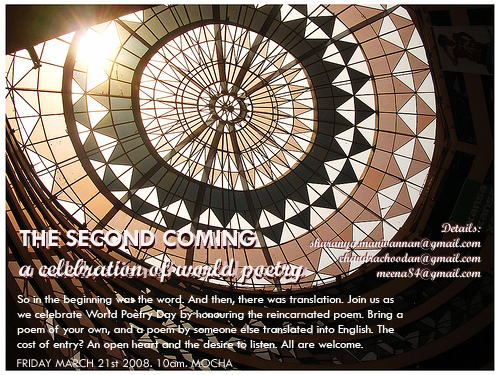
“The Second Coming”: The Reincarnated Poem Open Mic

After the success of the reading at Thalankuppam just over a week ago, we decided to hold something a little more mainstream, just to spread the word that poetry, open-mic style, has come to Chennai.

“The Second Coming” (all puns and cleverness intended) is going to be a mix of two formats. Original poetry, and poetry in translation. The idea is to not only encourage people to get a feel of performing their own writing, but to also hone poetry appreciation and performance poetry in itself, by sharing some of the best verses through the ages. Because March 21 is World Poetry Day we celebrate translation in particular, the gift it gives to the world at large. Basically, in addition to any poetry of your own, bring along a poem that was not originally in English. Think Octavio Paz, Rabindranath Tagore, Anna Akhmatova (for examples) and you’ll see what we’re trying to do.

Friday is a public holiday, and Mocha in the mornings is a lovely setting. This reading will be held on the upper floor, with special permission from the management. All are welcome.

Please click on the flyer below for details. It’s a little cluttered but they’re there. Really. ;)

mocha-copy.jpg