The Venus Flytrap: Is There A Holy Text As Hardcore As The Kavasam?

After a lapse of a few years, I began to listen to the Kantha Shashti Kavasam again. The hymn has sentimental value to me – in the past, it gave me a sense of connection to my childhood and ancestral ties and generally operated in the role of a mnemonic. In the unholy ennui of the present, however, my rediscovery of it brought out a whole different kind of awe: the schmaltz of my memories and the high-pitched vocals are the only delicate things about it. The Kavasam isn’t just beautiful; it’s badass.

If you’re not familiar with the text (there are some terrific English translations online), the Kavasam (meaning “armour”) is a long invocation to Muruga, beloved deity of the Tamils and crown prince of the Saivite cosmos. Composed in the 19th century by Devaraya Swamigal, it’s a lyrically magnificent work. It begins, naturally, with praise and welcoming, and then, once the little lord is nicely flattered, begins to get quite specific in its demands.

Up until about midway through the hymn, the devotee puts forth requests for protection, mostly in the form of a list of the various body parts long enough to sound like a recitation from an anatomy textbook. Having ensured that the pretty prince with the pretty vel has been appointed to look over everything from each of the thirty-two teeth to the colon, things start to get very lively.

Now, up until this point, things are still pretty standard, as far as devotionals go. Then out pop the monsters. Great tail-shaking devils are named and dismissed, as are fire-eating ghouls, baby-devourers, night-roaming spirits, folk entities special enough to have names of their own – all of whom henceforth must run away as if struck by thunder upon hearing no, not our little lord’s name – but the singing supplicant’s! After this comes the litany of voodoo tricks – of which the supplicant has a suspiciously impressive knowledge of. The hymn ends with more medical grievances and praise to the deity, but not before its most spectacular segment: in which Muruga is asked to tie up the devotee’s enemies, roll them up, stomp stomp stomp on them, break break break their bones, pierce pierce pierce their bodies and set them on fire.

Basically, if you want proof of the inherent badassness of the Tamil people, look no further than the Kantha Shasthi Kavasam.

Is there a holy text as hardcore as the Kavasam? Maybe some old Hebrew stuff – but then, the god of the Old Testament is generally seen as curmudgeonly and cantankerous. Unlike the adorable little Muruga, sweet-smiling with bells around his ankles and flowers behind his ears… who will eviscerate your enemies.

There are lots of things from my Tamil heritage that I’m grateful for. Most importantly among them: Sangam poetry, curvy hips and a high tolerance for libations. The drama, intrigue, sabotage and high stakes apparently also come with the genes, if the texts and arts of this culture are anything to go by, but then so does the little avenging god, resplendent, ecstatic – completely aware of the devious nature of his chosen people, and just as prepared to bestow the grace of his bling in your moment of need. Bring it on mofo, my lord has a vel and I’ll have you know that it is bejeweled, baby.

An edited version appeared in The New Indian Express. “The Venus Flytrap” is my column in the Zeitgeist supplement. Previous columns can be found here.
NXG on Mozhiudal

There’s a nice write-up in NXG, The Hindu today about last weekend’s queer poetry reading. You can read it here.

I like how the writer begins the article by noting how the reading seemed to be a safe space – the same thought occurred to me while I was there, and in the days since I have also pondered over whether to write about it too. It was more than just the fact that I know the organizers and the Pride movement in Chennai well — the vast majority of the audience were new faces. Still, there was a good underlying energy, a welcoming one, that I rarely sense at readings here.

Perhaps I should explain my context. Somewhere early in my publishing career, I got stuck with the tag of being a writer of “erotic” poetry, a label I view with discomfort. Now, I have nothing against erotica. I love it. I have nothing against sex either. What I do have a problem with is reductionism. Erotica by its nature is intended to titillate. My work, by and large, isn’t. Anyone with a little sensitivity who looks over my body of supposedly erotic work should see neuroses, longing, loss. If they see  a horny woman poking at her keyboard with sticky fingers, that’s their own oversight. A woman can be horny, complicated, desireless, wounded, surrendering, conquering in different lights.  So can a man. If you choose only to see her in one light, then you’re missing out on a whole lot.

What this has come to mean is that I have become defensive (as you may have gathered from the paragraph above, even). In India, or at least in Chennai, I limit what I share at readings. Look, I don’t mean to come off like a snob, but we’re an awfully perverted bunch, don’t you think? So, so as to avoid various unpleasantries, I limit what I share. It frustrates me. I like to have fun at readings. I like to feel free, to play with the audience, to laugh. I like, above all, to be honest.

In this sense, Mozhiudal was one of the safest spaces I’ve read at in Chennai. To me, the very notion of a queer reading is based on the acceptance that sexuality is complex and varied, and is vital to our experience of the world – exactly the sort of basis that removes all need for apologies and excuses. Remember this: sexuality as opposed to sex alone. I opened with what I think of as my lightest piece,  and without question the most beloved among my fans, “Poem”, and moved on to more risque work, pieces like “Possession” and “Holding The Man”. Reading the last one in particular, I was struck by how its motifs of arrest and secrecy were, perhaps, rather reminiscent of the queer experience, even though the people in my poem are a heterosexual couple. And also my explicitly queer work – “Hibiscus”, “Linea Negra” – and then looping back to my other much-misconstrued crowd-pleaser, “How To Eat A Wolf”. Not once did I feel like I had gone too far, or become too vulnerable. The last poem I shared, in two voices with Aniruddhan Vasudevan, was my translation of Subramanya Bharati’s “Suttum Vizhi”. How was this a queer work, or a sexual one? Maybe because Bharati would certainly have been no homophobe; in death he certainly has lent his voice to the Pride movement. Maybe because from the tongue and pen of another woman, my transcreated lines – “woman precious as the eye, my love fills me with turbulence” – turn vaguely subversive. Or maybe because this is what it comes down to in the end — love, loss and longing. The human heart. The body and its blood.

The Venus Flytrap: In Song And In Silence

I recently enjoyed the chance to perform alongside the Australian writer and cellist Kevin Gillam, who interweaves his poetry with the magnificent timbres of the instrument. Far from the city which I soften daily with Bach’s suites, I made two discoveries: firstly, the music evoked no Pavlovian responses in me, no memory of that which needs softening. And, these celebrated ouvertures may have been written by the other Bach – his wife.

Gillam spoke of research by the conductor Martin Jarvis that proposed that Anna Magdalena Bach had composed the suites; their pacing and sensibilities differ significantly from Bach’s larger body of work. This stayed with me. The unaccompanied cello suites accompany me everywhere, and now this thought did too. History remembers us as it will. We cannot influence its remembering. Our work is not to contrive the echoes we leave, but to live life’s opus with operatic feeling. It matters not whether we survive in song or in silence, but only that we deliver our clearest cadence.

I had been introduced to the baroque suites by a musicologist I had befriended while travelling in the Thanjavur district. A year later, I returned to that part of the country, and again, what I took back with me resonated for a long time afterward.

Pilgrims to a music festival, we had travelled out to the village of Thirupughazhur for a meal and to see a certain house, an excursion within a longer one, and after an extraordinary banana leaf lunch – the best vegetarian South Indian meal of my life – were on the backyard portico, napping or talking in the somnolence of the first few weeks of real heat since the rains had ended. A temple tank faced us, the view tainted only by the telephone towers in the near distance. Thirupughazhur literally translates to “town of the praise-song”; it is sacred to the legends of the poet-mystics Appar and Sundarar (not all poets are mystics, but I think all mystics are poets, even the ones who do not speak).

Among our party was the Indologist David Shulman, who spoke of the Tantric concept of the vibrating universe. As in string theory, the world is always singing. God, perhaps, is eternally humming. In stages, this supreme vibration becomes audible. From an intensity impossible for us to hear, it devolves into speech, noise, melody. The urmani is the moment of epiphany: the moment when silence turns to sound.

By April, months later, the rains still had not returned. I soften the city with cello suites, I wrote. A few days after I sent it to him, another friend – yet another soul who blesses the orchestra of my life – told me he had set the poem with this line in it to music. I was surprised; much as I have an interest in multidisciplinary art, my writing, like a cello suite, is almost always imagined unaccompanied. I listened to a rough cut of the piece, and in the silence after the song’s ending, I thought of the urmani. I thought of when it might have been when, reading the page, the words became infused with sonority. In my friend’s head, a harmony had formed. In mine, it had happened backwards. The world is always singing. I am always only trying to write down its songs.

An edited version appeared in The New Indian Express. “The Venus Flytrap” is my column in the Zeitgeist supplement. Previous columns can be found here.

Mozhiudal: Queer Poetry Reading

Pride month is well underway, and you can see a full list of events happening in Chennai through June here.

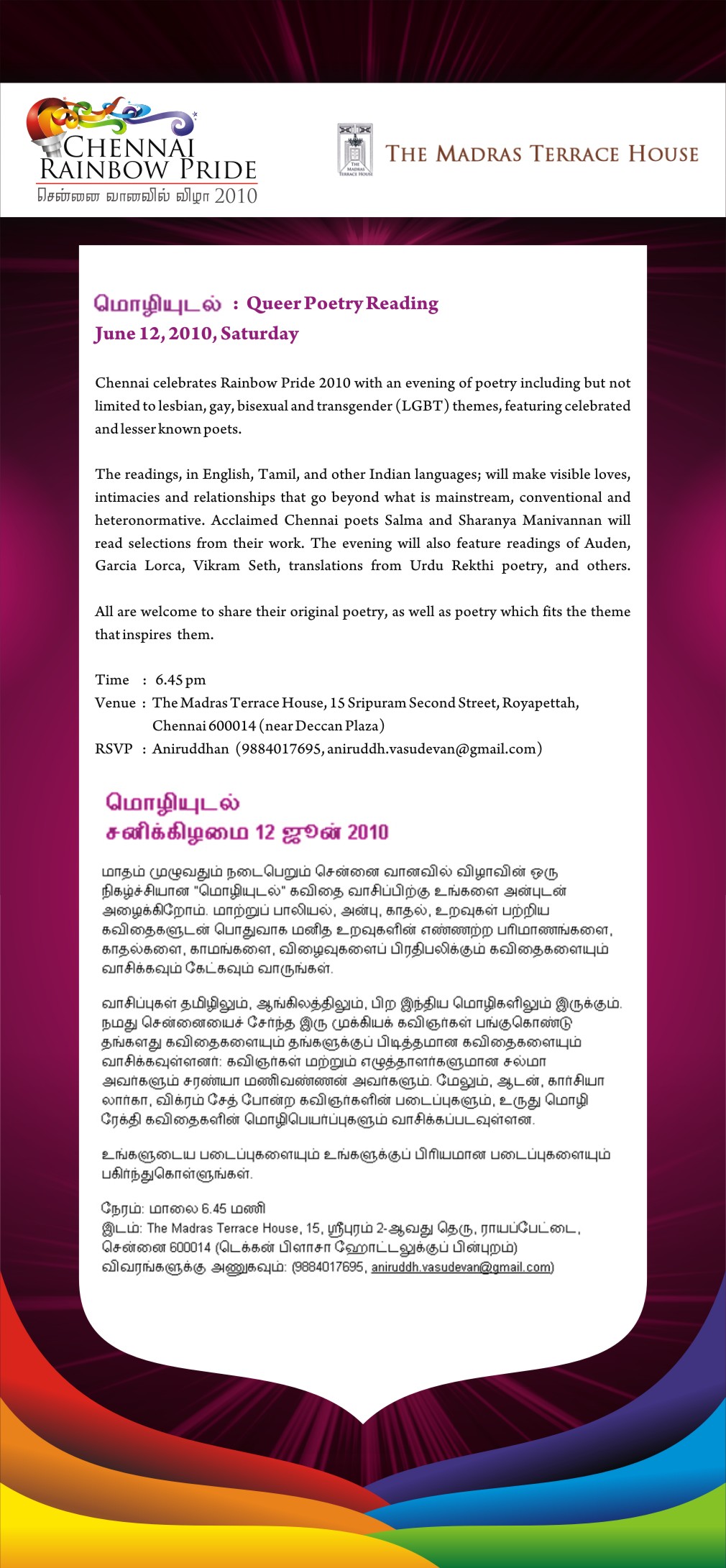
Among them is “Mozhiudal”, a poetry reading and open mic at Madras Terrace House on June 12, featuring Salma and myself. All are welcome – you can share either your original poetry, or poetry that you love which fits the theme. More about “Mozhiudal”  is on the flyer below (click to enlarge).

I’m Keeping The Yellow, But The Rest Has Got To Go!

In a curious oversight, given how much I was looking forward to it and how I love how it turned out, I forgot to pimp my redesigned website. It went live just before I left for Australia, and although it’s not fully done up just yet, I’m very happy with how it’s looking so far. There’s much more content, and it carries my vibe much better than the first design — which, while splashed with my darling Pondicherry yellow, reflected “me” so little that a close friend called it my “Gone Fishin’ ” look.

Here you go: www.sharanyamanivannan.com

Big thanks to Mihir Ranganathan’s fabulous design chops.

The Venus Flytrap: Places Called Home

Long after most of the shops had closed in the small city of Darwin, we were having a late dinner of streetside gyros, when the interlude of an inebriated and entertaining stranger to whom we’d lied, saying we were all locals (until my clumsy handling of the gyros gave me away), veered the conversation toward homes and homelands. A mixed group of two Australians, two Malaysians and yours truly – new friends and old – in the city for a literary festival, all of us had travelled widely and were involved with culture, lawmaking or indigenous interests. I expressed the opinion that I find ethnonationalistic separatism deplorable, because it reinforces divisions instead of harmonizing them, and because identity relies on emotional geography, which political cartography can only brutalize. The other Ceylonese person at the table disagreed, citing the example of India’s state divisions upon independence, and the recently-sovereign Timor Leste. Just then, surreally, the Sri Lankan anthem began to play. Here on a hot night in northern Australia, a cricket match on TV, and there it was, emotional geography in a nutshell: memory, coincidence, the things that bind.

The following week, I was in Singapore, the city I most feel at home in, although I have never technically been a resident. It was the first time in two and a half years that I was there for longer than a day’s transit, yet I fell back into its pace and energy instantly. All of my old haunts: the bolt-rope beach which is the key setting of my novel forever-in-progress, the red light district where I would stay overnight in those poorer, madder days in which I lived in Kuala Lumpur on a visa that required me to exit that country every month, the mall in a far suburb where I’d visit a now-estranged uncle, where I’d ironically enough been invited to read. When people stopped me to ask for directions, I could give it to them. I can do without maps, I have had as many homes as a hermit crab, but emotional geography is something I cannot do without.

I felt like myself again: an antevasin, one who lives on the border, in sight of more than one world, belonging to either and neither. In Darwin I had chatted with East Timorese and Indonesians in Bahasa, in which I am fluent; in Singapore I felt at once shy and amused that two baristas were discussing how pretty I was in that same language, thinking I couldn’t understand them. I was ripe with a sense of belonging, deeply connected to every moment and at ease in it, comfortable in both my otherness and my familiarity.

How long does one have to know a place before an emotional geography is charted? In Chennai, which has been my base for almost three years, I have none. I know this because in the many contortions I have attempted in order to peg my angularities into this determinedly round hole (what kind I’ll leave you to guess), I have tried very hard to create it. But emotional geography is not something that can be willed, no matter how varied the experiences one engages in. Here’s a more relevant question, maybe: how long can one remain in a place without an emotional geography to it?

An edited version appeared in The New Indian Express. “The Venus Flytrap” is my column in the Zeitgeist supplement. Previous columns can be found here.

Readings in Singapore

Because I’m just a genius that way, I went and practically double-booked myself for two readings on Friday May 21, genuinely thinking (until I pulled the two confirming emails up side by side) that one was on Friday and the other on Saturday. Some apologetic phone calls later, I managed to buy myself a half hour to dash to the other end of town, or rather, country. This should be interesting!

I had a wonderful time in Darwin at the Wordstorm Festival of Australasian Writing, and am taking a few days’ transit in my favourite city – Singapore. So, for the first time since December 2007, when I was here for the Singapore Writers’ Festival, I’ve got a couple of events scheduled for May 21:

4pm (sharp!) – A reading at FOST Gallery, 65 Kim Yam Road. RSVP Clarissa Cortes at clarissa@fostgallery.com or on 6836 2661.
5.30pm – A reading and discussion with Heartlands Book Club at Bukit Batok Public Library, West Mall. RSVP Kweh Soon Huat at soon_huat_KWEH@nlb.gov.sg.

Please note that RSVPs are required for both events. I will have copies of Witchcraft and lipstick, and at least for the Library event, an even breathier voice than usual thanks to all that running between venues!

The Venus Flytrap: The Artist Is

I had never wanted to travel just to sit across someone in complete silence until I heard about Marina Abramović’s grand retrospective, currently ongoing at New York’s Museum of Modern Art. As fascinating as I find the most extreme of her works – ingesting medication for catatonia and schizophrenia to induce radical effects on the body and a ritualistic game of five-finger fillet among them – what truly transfixes me is her newest installation, “The Artist Is Present”. Abramović, in a single braid and an operatic dress of red, navy blue or white, sits in silence and looks at whoever wants to take the chair opposite her. Members of the public are welcome to participate. When the exhibit ends this month, she would have done this almost every day, during museum hours, for eleven weeks.

It could be argued that this is the least sensational or vulnerable of her productions. It does not endanger her physically, as most of her earlier works have done, or invade her privacy (by comparison, take the 2002 installation in which she spent twelve days in a gallery structure, exposing every moment of her life to onlookers), but it is probably her most revelatory. Its effects on participants have been profound. The Internet is full of images of those who weep as they sit across the artist and look her in the eye. Juxtapose this work against an early piece in which she remained passive for hours, inviting spectators to have their way with her using 72 instruments of pleasure and torture: Marina Abramović has long proven that she gives herself without limits to her art and her audience. But this is by far her most spiritually generous act – the invitation to be borne witness to. And for this reason, it is her magnum opus.

For an artist in the modern world – working in any discipline – it is becomingly increasingly difficult to make a lasting impact. Celebrity as we know it today is remarkably easy to achieve, and it’s become increasingly clear that “art” is tailored to suit our shrinking attention spans. Forget entertainment (which has its uses); we are in the age of distraction: anything to keep the viewer from switching tabs or channels. To be shocking or controversial is easy – too easy. To shake a person to their core, however, is a far more elusive reaction.

And so this is why I have been entranced by Abramović’s installation. The artist at the height of her powers, returning to her audience the gaze which it has trained on her for forty years, and thus becoming the artist as redemptrix. She has taken that common creative conceit of “witnessing the world” to the only level at which it truly matters – the individual, the smallest detail in a crowd.

As a writer who frequents the stage, this is meaningful for me both in terms of presence – personal elemental force – as well as absence. Language as distance, language as defense, language as disguise. Stripped of how we choose to present our inner workings, through speech, text or movement, what remains? What would get communicated anyway? If I sat before you and said (if only in my head), I myself am my poem – what would happen? Would you hear it, or see it, or most importantly, feel it anyway?

An edited version appeared in The New Indian Express. “The Venus Flytrap” is my column in the Zeitgeist supplement. Previous columns can be found here.

Review: Don DeLillo’s Point Omega

In September 2006, in the thick of the United States’ war in Iraq, a man stands day after day in the shadows of a room at the Museum of Modern Art, watching an installation of Hitchcock’s Psycho slowed down and stretched to a 24-hour videowork. When the book opens, it is the second to last day of the screening, and he is watching the infamous shower scene with a devotional, and yet dispassionate, engrossment. He has spent five days immersed in this altered reality. We don’t encounter this man again until the epilogue, when weeks have passed in the lives of our protagonists, but he is still there, in decelerated time. It is the sixth and final day of the installation and when he leaves this room, his reality isn’t the only one that will be permanently lacerated.

At just under 120 pages, Don DeLillo’s Point Omega has the effect of a small, slick razor – the cut itself is brief, the sting far more lasting. A disturbing yet remarkably accessible novel, it leads to ponderings about human consciousness and conscience, heavy and even dark subjects, without resorting to labored rhetoric. The “war intellectual” Richard Elster has retreated into the desert upon retirement, which is where an experimental filmmaker named Jim Finley seeks him out. Finley wants to make a single-take documentary featuring an unscripted monologue by Elster, who in spite of his reluctance has invited the filmmaker to visit. The visit runs into weeks of dialogue and Scotch, and Finley stops counting the days, until Elster’s daughter Jessie also comes to stay, and an inexplicable event throws things into disarray.

Slim in pages and sparse in its prose, for a story largely about the distortion of time and space, Point Omega zips by rapidly. This makes it all the more successful; unlike the prolonged Psycho of its prologue and epilogue, it saturates the mind far quicker – densely packed as it is with ideas that might be described as almost post-apocalyptic. Having left his work under the Bush regime disillusioned (“They think they’re sending an army into a place on a map”), Elster’s mind turns increasingly toward concepts of reality and how it is experienced. Once a scholar who wanted the profound simplicity of a “haiku war”, and who traced the etymology of conflict jargon, he has begun to believe that language itself has lost its purpose, and that humanity seeks to devolve into a point of lower consciousness. Out in the desert, he aspires to a sort of disappearance into the landscape – a wish that proves to be ironic.

What this novel owes to cinema is reflected not only in elements of plot detail, but in its entire mood and pacing. It is not so much the gothic horror of Hitchcock that DeLillo takes as influence here, but modern films with a dystopian sense of foreboding, evoking, among others, the surreal desert landscapes of Bruno Dumont’s 29 Palms, or the unnerving noir of a David Lynch work.

Point Omega is a formidable novel, and deceptively enjoyable. Absorbed by the concepts of modern existence it presents, one forgets that the realities and probabilities it describes are neither fictional nor of a time other than ours. Like Elster, who believes that cities are built to keep out “the terror” (even as they are the arenas on which terror, as we know it today, plays out in the world), and yet is utterly unprepared to see it magnified and manifested in the desert, one emerges from this book disoriented by its power.

An edited version appeared in today’s The New Sunday Express.

The Venus Flytrap: Sharanya Manivannan And The Amazing Technicolor Magic Realist Life

My friend the filmmaker says that cinema is about one thing only: pace. It comes down to choreography: internal rhythm, internal logic. You can tell any story, you can even tell a non-story, as long as you find its stride.

Like all people who use their life in their work, I tend toward the grandiose. I’m a hypochondriac, an obsessive, a constant connector of dots. Me and my Amazing Technicolour Magic Realist Life (complete with cinematic soundtrack). This is the only lens through which I can bear to look at all – it’s too much otherwise, too intense and too painful.

Yet, there are things I cannot absolve. I cannot fall into their stride, or find a way to absorb them into mine. It takes me months, even years, to name them – and to name something is to attach a value to it, incorporate it into a lexicon of reason. As a writer this is a fundamental of my world. Without this, I can only agitate, like a breathless creature throwing itself against the glass of the bottle that entraps it.

So here I am, replaying over and over in my mind the things I find irreconcilable, the things I cannot find language for. I cannot control them, I cannot rewrite them – and I cannot simply look away. Stripped of language, the power of baptism, I attempt to make this about the visual and the kinetic. Life as train wreck, life as narrative, chronology as dance.

And the body emotes, of course. I took ill, I coughed blood, and spent a night and a day crying, waiting to find out why. I thought – this is my lost voice, trying desperately to find a way out. I thought – this is it, I am going to die in this miserable place, all potential and no plot, a trailer with no film to follow. “The X-ray will show you I no longer have a heart,” I declared imperiously to someone who bothered to indulge me. All my usual dramatic tropes and deus ex machinae. I had a vision of myself as Neelakanta, the bitterness in his throat, eternally caught between belly and breath. To spit or to swallow? Do I deny the fact of these irreconcilable experiences, or do I wallow in them?

But here’s the rub: this amazing cinematic life of mine? I’m not the director. I didn’t even write the script. The control I seek is illusory. The truth, and the trick, is that one can never find a stride – at best, one finds herself having fallen into it. What I am doing then is hardly dancing. This is shadow-boxing.

Realising this, I stop in my tracks. The blood on my gloves is only paint. The gloves themselves, costumery. What if the pace of this time in my life is no pace at all – only stillness, silence?

We measure time in exacting ways. But we experience it with no real sense of its structure – the fulcrums of moments, the futility of years. Maybe it’s time for me to zoom in and take the pointillist view – to invest fully in that single dot, single shot, and trust that it means something. And let go, knowing this: even off-scene, a star is a star. And I’ll never be an extra in my own show.

An edited version appeared in The New Indian Express. “The Venus Flytrap” is my column in the Zeitgeist supplement. Previous columns can be found here.