The Venus Flytrap: A Handful Of Syncretism

In June of 2008, when Barack Obama was still a presidential hopeful, TIME Magazine published a photograph in which, palm over palm, the candidate held a mélange of metal trinkets. The magazine called them his “lucky charms”, and they included an open bangle that had belonged to a US soldier in Iraq, an icon of the Madonna and child, and a tiny statuette of Hanuman.

            As his two-term tenure as President of the United States comes to end, Obama emptied out his pockets again for a special interview on Youtube. As was widely reported in the Indian press, the monkey god figurine is one he still carries everywhere. I remembered this from 2008; that had been the year that Hanuman had become a vivid presence in my own life, and indeed was the emissary through whom I befriended my muse of many years, Sita. But the tone of the recent coverage bothered me.

            These are the talismans that Obama chose to display during that video interview: a gift of rosary beads from Pope Francis, with a pendant of Christ on the cross; a shiny poker chip that a burly biker gave him while he was on the campaign trail prior to his first election; an Ethiopian Coptic cross, origin mysterious; a Buddha statuette, a monk’s present; and, of course, the Hanuman, given to him by ‘a woman’.

            Taken together, these amulets are a handful of syncretism. Gifts given to a leader as totems perhaps of blessing and protection but more importantly, of responsibility. He carries them on his person the way auto-drivers paste Ganesha-Jesus-mosque stickers on their front windows or on their handlebar cabins. One trinket on its own would only be a personal fetish, but a collection amounts to much more, symbolically and otherwise. And in the current national climate, there’s something just a little saddening about the media focus on that Hanuman statuette. The Buddha too, lest we forget, is just as Indian in origin. Those rosary beads are a part of the worship of millions of citizens. And what, since we’re jousting, could be more secular than a poker chip, representative of the gamble each of us takes on life, every single day?

            Obama may or may not attach spiritual significance to the talismans he carries – and it is his prerogative to discuss this or not. But what he certainly shares openly is that each of these objects was given to him by a specific person – a pope, a monk, an undescribed woman – and reaching for them reminds him of his commitment to people. How successful he has been at this commitment and whether he has acted on it meaningfully in his time in power is a matter of argument. But the least there is to learn here is that one must believe one can do more than try. And when we seek to touch the divine, by any name we call it, let us not overlook that among its marvellous, and certainly, imitable qualities is the one known (not without basis) as ‘humanity’.

An edited version appeared in The New Indian Express on January 21st. “The Venus Flytrap” appears on Thursdays in Chennai’s City Express supplement.
A New Short Story

To celebrate its second anniversary, The Hindu Business Line’s BLink magazine has published a fiction special. My short story on Sri Lanka, family and faith, written exclusively for this issue, is in it.

Warakapola

In Warakapola we stop for the first time, at the Bhadrakali-Hanuman kovil by a hill on the A1 highway, the first of many roads on this journey. We climb the few stairs to the temple to see its strangely companionable deities, but our grandfather gets out of the vehicle only for the Pillaiyar at its base. He holds a dried coconut with both hands, and circles it in the air, making his entreaties to the god of beginnings. And then he breaks it open on the ground, using his better arm. On the second try, it cracks open.

We bought the coconuts as we left Wellawatte and divided them into two bags. One is in the backseat, the other lodged between the driver and my grandfather, in the front. They must not be stepped on. We stretch our limbs out and try to sleep.

Nobody tells us — although there are those in the van who know — that it will be 10 hours to Batticaloa, in all.

You can read all of “16 Coconuts To Pillayaradi” here.

The Venus Flytrap: Devotion, Desire, Darkness

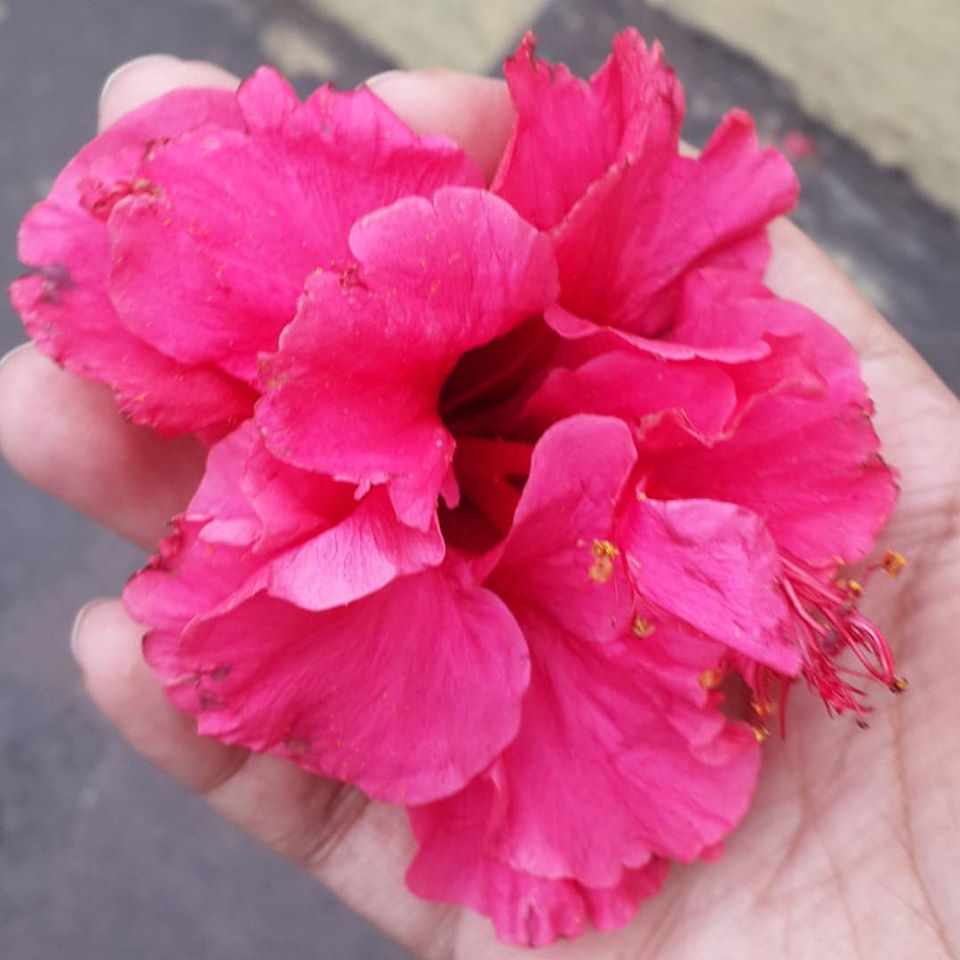
There are places in ourselves we spend our whole lives moving toward, and sometimes we encounter them in literal landscapes, points on maps we can place our fingers on as we might on cherished skin. And sometimes, much later, having travelled far geographically and otherwise, we can go back. This was how I found myself in Kolkata, eleven and a half years later, with a hibiscus in my hand and a recentred (re-centred, or recent red?) heart. In the version of the story I had been telling for a decade about my first time there, I had painted myself as a fool. It was the simplest way in which to explain how something had not been for me, and I had chased it anyway.

The Fool is the first card of the major arcana of the tarot. All journeys begin on a Fool’s footing.

I moved to India a couple of months before my 19th birthday, thinking I would live in Kolkata. It was a wager I had made with my parents after I ran away from (their) home – I’d return, briefly, if they would then send me where I wanted to live, which as far as they were concerned was only away from them. But only I knew of what had been appearing in my dreams, symbols I blandly tried to explain as the desires to study or to be free.

My first time in Kolkata crushed my spirit. Only the temples – Kalighat and Dakshineswar – held anything of meaning for me there.

And with that journey, the desire to move to that city disappeared. I understood that it had only ever been a pilgrim’s longing that had taken me there.

So when something – a book launch – called me back in December, I recognised the calling to be the same. Just as once, a long time ago, I had gone seemingly in pursuit of textbooks, I packed my devotion stealthily under guise of a love of literature and found myself once more in the goddess’ city.

One temple by night, the gold-tongued goddess in the red light district one sees only through shouts and shoving and swindling. And one by morning, bumping out of the city in the dusty dawn to the miracle of no queues, and a moment of sitting quietly by the western window of the sanctum sanctorum to have the priest reach through the wrought iron and place in my palm a compact of kumkum, and a deep pink hibiscus.

If my prayer was a secret, I wouldn’t share it with you. But I know it is etched across my face, these treacherous eyes of mine that yield everything. I want not only to let go of my disappointments, but to let go of my desire for the things that disappointed me.

I have known the darkness of feeling the goddess had let my hand go; and I know the gift of flight that belongs to those who never hold anything in fists.

And so, just as I have taught myself everything over and over again in my life, I will teach myself how to desire again.


kaliflower

An edited version appeared in The New Indian Express on January 14th. “The Venus Flytrap” appears on Thursdays in Chennai’s City Express supplement.
The Venus Flytrap: Looking For The Woman (In Service Of The Man)

The French have a terribly sexy sounding (but actually kind of sexist) saying – “Cherchez la femme”. “Look for the woman.” If there’s a lacuna in the alibi – look for the woman. If it doesn’t add up – look for the woman. If there’s a missing motive – look for the woman. Wherever there is a problem, in short, there is usually a subplot that involves a woman, a tussle for her affections or a drama of her machinations.

I’ve never had reason to drop that phrase into a conversation (never mind that I don’t actually speak French – touché!). Yet I observe its variants around me. There’s a particularly intriguing power dynamic that has nothing to do with an individual’s influence, and everything to do with tacit hierarchy: the curious phenomena of reflex loyalty between and towards men.

Like all deeply-entrenched problems, it’s most evident of all in one-on-one conversation. I’ll share something with a man – an observation of or experience with another man. And my companion will shrug, flash a micro-reaction (a millisecond of a nod or a Cheshire grin) and deftly deflect the topic. It’s not that he doesn’t agree with me. He’s glad I said it, so he didn’t have to. But he just can’t give his bro away. Even if he knows me better than he does him. Even, in fact, if he’s never met him. It’s a response that makes me deeply uncomfortable. The eerie sense that he thinks that he’s looking at the woman, i.e. doesn’t have to look for the culprit. When loyalty is drawn along any demographic line, be it gender, caste or any such category, injustice abounds.

But here’s the reason I’ve never had reason to drop “cherchez la femme” into conversation – I wouldn’t. The only thing scarier than automatic bro-loyalty is internalised misogyny. Which is to say, when the person saying “look for the woman” is herself a woman. There’s no easy way to say this: but in the same way that many men are raised to trust one another first, many women are conditioned to trust one another least.

The woman who rats her colleague out to the resident jerk because she feels ashamed to have confided in her about an abusive partner. The one who would rather believe a distant relative than her molested daughter. The one seeking public office who wants to uphold the two-finger rape test, or criminalise abortion. Each story is equally appalling, and ultimately predictable – in each one, she will pick the man, any man (or “The Man”, as in the one the cool kids stick it to). Over any woman, including herself.

Blind loyalties, stark betrayals. Both in the service of patriarchy. The women unfortunate enough to be tangled up with these turncoats – whether anecdotally or in actuality – get the raw end, every time.

Which is why when I hear an unpleasant story involving an alleged villainess, I do look for the woman. I look for her perspective. I don’t automatically side with her. But I refuse to automatically side against her. Sometimes femme fatale really means femme fatality.

An edited version appeared in The New Indian Express on January 7th. “The Venus Flytrap” appears on Thursdays in Chennai’s City Express supplement.
The Venus Flytrap: A Jarful Of Joy

At the start of this year, I decided to keep a jar of wonders. Each time something very good – truly meaningful, or in the form of an accomplishment – happened, I wrote it down, folded the paper and kept it in a container meant just for this purpose.

Some years ago, during a time of struggle, I had embarked on a similar exercise, though far different in scale. Each day I would find three things I could be thankful for and write them down. They were the smallest things. A chance to wear certain earrings. Somebody’s smile. Ice cream. They were all I could have at the time.

A new year is like a birthday: no matter what we say about not taking them seriously, we do. Something in the stardust of our bodies responds to the orbit of the earth around the sun, and so we keep score, mark off tallies, calculate and clear the slate. Some years allow you to enjoy looking behind you; some years demand that you turn your back on them.

And where do I find you? Here we are at the very last page of that free tearaway calendar everyone has in their kitchen. Are you looking forward, or are you holding back? What did you make, using what you were given, this year? What do you carry with you as you step over, trying to keep your lucky foot forward, into the next?

It doesn’t feel like December in Madras this year. It’s not cold enough. It’s quiet, too. The intangible fabric of the city has been creased by the strandline of floodwaters.

But tomorrow can still feel like January. We’re only two weeks deep into mystical, romantic Margazhi. The harvest is around the corner – may our pots overflow!

Tonight, I will open my jar of wonders and read the notes, and bask in gratitude. This was the year I was blessed enough, and brave enough, to ask for more. This was the year the Queen of England was in my audience, listening to me recite a poem. This was the year I finished writing books I worked on for years. This was the year I started writing The Venus Flytrap again! For every piece of paper I fish out of that jar, I will be thankful, thankful, thankful.

I feel like I should add a dhrishti-dab, so let me just say that somewhere there’s an inverse of that jar and it contains disappointments, dead-ends, lost friendship, fear, grief, nights when even the moon snubbed my company and – of course – my perennial heart condition (i.e. broken). But I didn’t keep that jar.

And so, after reading the notes in the one I did keep, I will clear it out so that it will be not empty, just not yet filled. I don’t know how I will measure the coming year, whether it will be a year for asking or for accepting. Whether I will collect pebbles or count cairns. But that’s the beauty of a turning year, and the human need to reckon. We can always begin again.

An edited version appeared in The New Indian Express on December 31st. “The Venus Flytrap” appears on Thursdays in Chennai’s City Express supplement.

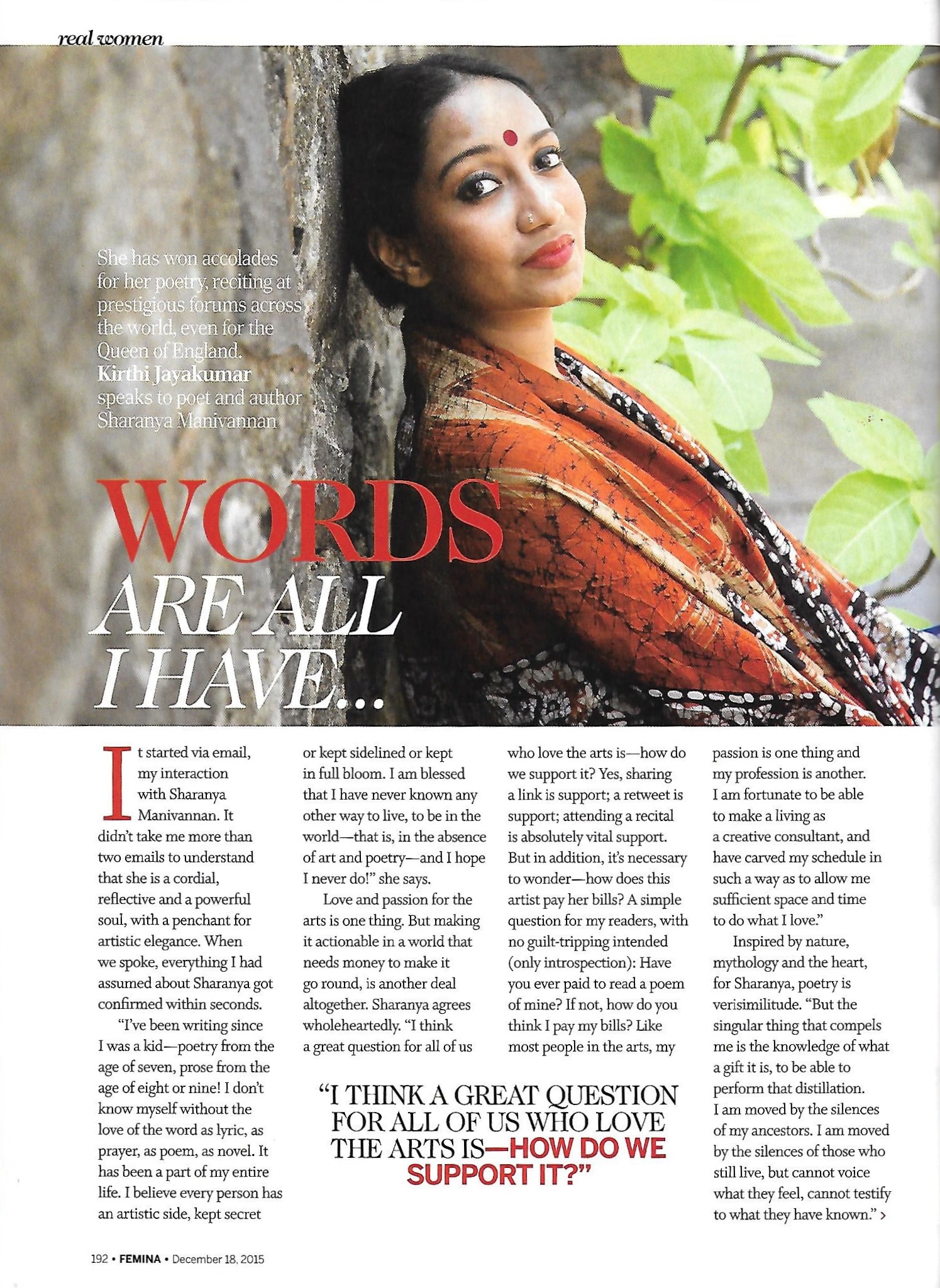
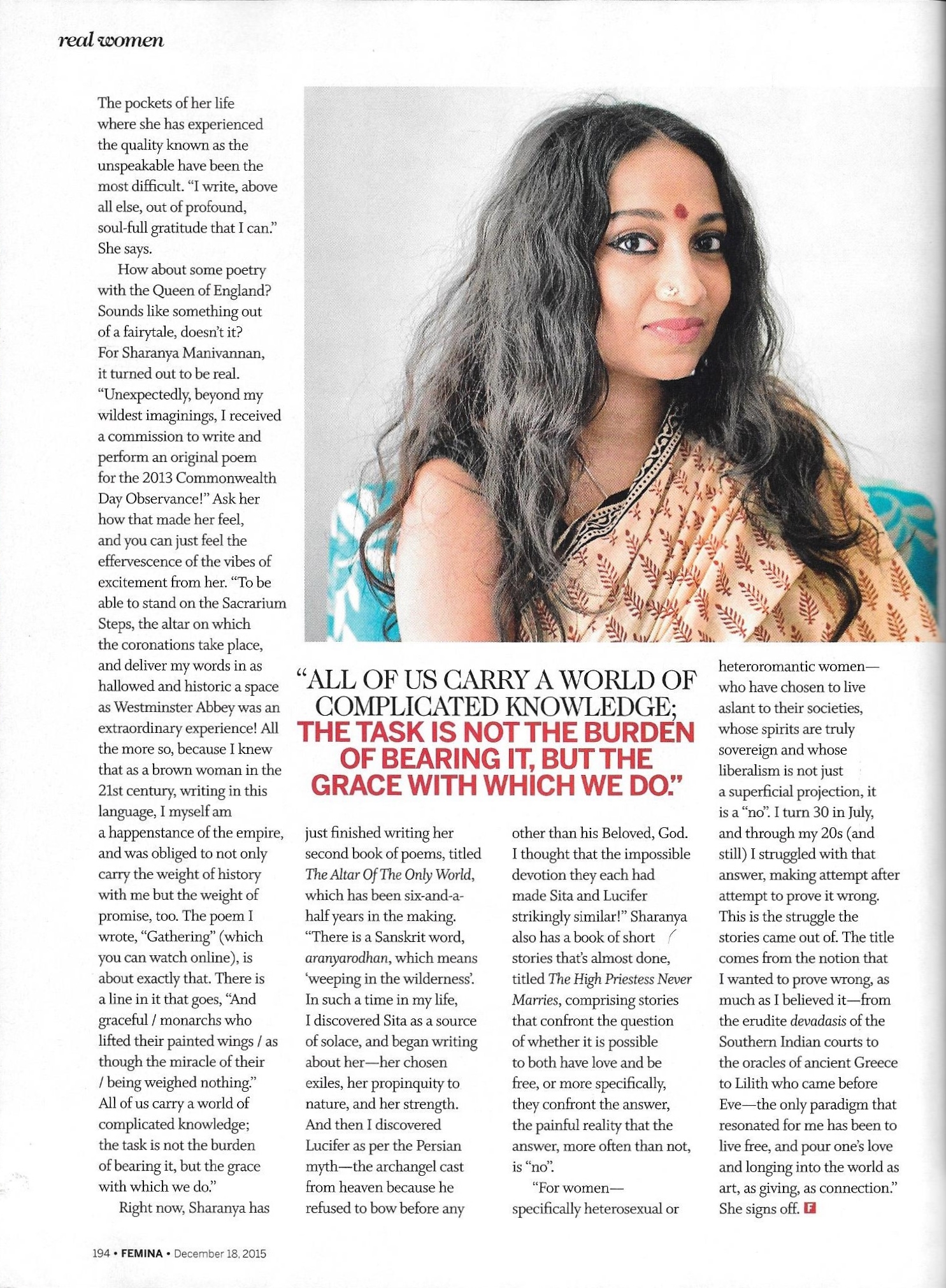
In Femina Magazine, Dec 18 2015 Issue

I was very thoughtfully interviewed by Kirthi Jayakumar earlier in 2015 for Femina. The piece appeared in the Dec 18 2015 issue of the magazine.

Please keep your eyes and hearts open and your loving wishes sent in the general directions of The High Priestess Never Marries (HarperCollins India, 2016) and The Altar Of The Only World (HarperCollins India, 2017). And me, if you have more love to spare. Because I do, and I’ll try to make more books from it :) Happy new year! xo

Sharanya Manivannan Femina 1Sharanya Manivannan Femina 2

The Venus Flytrap: Nothing To Laugh About

It was the middle-aged waiter’s sweetly apologetic tone and awkward phrasing that gave him away. Clearly, he was not the one with the objection. He was only the messenger.

This is what he said: “You have independence. But please, laugh a little quietly?” Sudhandhiram – the Tamil word for independence; he knew he was infringing on our rights, and he wanted us to know that he was sorry. We were two women who had finished a long lunch, eaten three types of dessert, and paid the bill. We were loitering, already considered a suspect activity for women. Ladies loitering while laughing loudly. Someone – patron or staff or management – had found this worthy of reprimand.

I have a big laugh. People recognise me by it in crowded auditoriums. Strangers turn to look upon hearing it (possibly to check they haven’t wandered into the set of a horror movie). I do not cover my mouth with a dupatta when I laugh. I do not usually wear a dupatta, in fact, because I don’t believe that anything should be covered unless in the interest of weather or aesthetics, rather than decorum.

I’ve jumped ahead a few paces because there’s something you and I, and everyone in this uncomfortable status quo, knows axiomatically. No one would have dared to go up to a chuckling man about to leave a restaurant and told him (politely or otherwise) to can it.

A woman who makes her presence felt – merely through function, existence or expression – in a public space is a public nuisance. And a woman who does not invisibilise herself makes her presence felt. Anywhere. Women who breastfeed on overnight buses. Girls who sweat through their football jerseys until their coloured sports bras show. Women who have to buy three movie tickets just so that no one sits on either side of them. Women who scream for help through thin walls while the neighbours turn the TV up louder.

I believe in silence in libraries and in meditation halls. I believe public walls should not be pissed against, and bhajans shouldn’t be played on loudspeakers. These are courtesies. They affect large numbers of people as they study, reflect, commute, sleep. They are intersections at which personal liberties can infringe on others. They are not gendered. Not even the open urination thing.

In conversations about women in public spaces, the topic we discuss the most is safety. In this painfully unequal world of ours, it is a concern. But a group of four women will still be asked, “Are you out alone?” (“No, each of us is out with three other people for company”). This is because the conversation has yet to extend to the notion of rights to public space. To be there, basically. To step into a public space should not mean giving up one’s autonomy over one’s body, voice or mobility. It should not mean adjusting (that delightful term used for everything from marriages to train bunks to bra straps) one’s very presence so that it looks, sounds and seems more like an absence.

In a world that makes one weep, we must take every chance to laugh out loud.

An edited version appeared in The New Indian Express on December 24th. “The Venus Flytrap” appears on Thursdays in Chennai’s City Express supplement.

The Venus Flytrap: Trauma’s Loose Knots

Much later, caught in an undertow of memory, the true emotional magnitude of certain events assails us. Trauma leaves live wires all over our lives, faultlines with known and unexpected triggers, unknown and expected after-effects.

Like a rope too thick for anything but a loose knot, we come undone again and again.

Last week, hearing from an eyewitness who was confused as to what the scene they had fled was, I tried to find out online what the tussle and commotion they had seen in Bangalore’s Frazer Town had been. I was dismayed to see a tweet that used the words “small communal unrest”.

Seeing that tweet, I wondered: how is it possible to preface something of a terrible nature with a dismissive adjective? Think of it: “little hate crime”. “Tiny war”. There is no such thing. Only those who are affected have the right of measurement.

Perhaps we rank things on scales so as to be able to process them. The mistake we make is in how we calculate the value of not only human life but the experiential quality of the same. It’s like a zen koan: if no one dies in a conflict or difficult circumstance, and those who survive don’t make a sound, does it matter that it happened?

Always. We often keep the things that deeply shape us from others. Victims of sexual abuse often maintain silences of years. We become embarrassed to share how certain locations or keywords can make our palms sweat and our hearts palpitate – and so we simply withdraw and avoid routes, people, places. Unfulfilled dreams and unrequited desire alter ones ways of being, but the topics are carefully evaded in all but the most trusted company. And then there is the question of narrativisation. People will superimpose their versions onto things that happen to us, or trivialise our struggles, our rights to name things as we understand them – and ultimately, us. And so, sometimes, we don’t tell them our stories at all.

Trauma comes to roost in us both individually and collectively. Chennai continues to stagger from the impact of the recent flooding. People are still in relief camps, some dying of infections. Some cannot go home. Others have lost their livelihoods until their workplaces, vehicles or clients are ready for business again. Someone who briefly evacuated their home told me how in the days and nights since, they still hear the sound of the river in spate at night, and are afraid. Upheaval and shock of any kind – from a bitter breakup to a natural disaster – always bring with them PTSD. Rehabilitation efforts must necessarily consider the emotional and mental costs of survival.

It will sound like I’ve put them all on the same scale – abuse, tragedy, shock and conflict. But trauma is very much like the classic trick question of what weighs more: a 200gm metal coin, or 200grams of feathers. One or the other may not look like much to the beholder, but the burden of each can only be known to its bearer. All trauma is unique – from the cause, to the consequence, to the way we choose to carry it.

An edited version appeared in The New Indian Express on December 17th. “The Venus Flytrap” appears on Thursdays in Chennai’s City Express supplement.

The Venus Flytrap: Flood Stories

I counted myself among the lucky ones, while the city drowned. How lucky to be dry. How lucky to have water to drink, a toilet that flushed. How lucky to be parcelling food and not waiting for it. How lucky to be in my own clothes, and to have excess to give. And even when the power went out and took all lines of communication with it, how lucky to have little to do on a lightless night but to tell stories.

In hundreds of cultures, there is a legend about a Great Flood. The most well-known one comes from the landlocked region of the Abrahamic religions: Noah, and his ark of animals. Strangely, the elements of this myth are echoed in folklore everywhere: from the Aztec story of Tapi to the Masai story of Tumbainot to the Alaskan story of Kunyan. The common tale is as follows: that the world is punished with a terrible deluge because of human wickedness, and a chosen person or family build a vessel in which pairs of animals also took shelter. After days or weeks at sea, they finally release a bird or beast that returns, bringing a symbol of hope and dry land.

Hindu lore also contains a similar story: that of Matsya, the fish or fish-man, the first avatar of Vishnu. He warns Shraddhadeva Manu, a Dravidian king, of an impending deluge, and instructs him to build and fill an ark with animals, grains, seven sages and his own family – enough, as in every version of this tale, for a new world to come.

There are plenty of other twists, other downpours and other tales.

The Yuma of Southwest America have a flood tale which is also the origin story of the desert: a divine deluge is sent to eradicate dangerous animals, but when people insist that some of them must be kept for food, the waters are evaporated by a too-powerful fire. A beautiful Nigerian story goes that the moon and the sun were married, and their friend the flood demurs to visit their home but they insist; finally, the waters come through the doors and rise so high that the couple must live in the sky. In many South American flood stories, human survivors are turned into monkeys who slowly regain human attributes.

Primordial water is the origin of all life. A flood myth is essentially a second chance, to recreate: what must we do, once the earth is once again beneath our feet?

So many stories to tell by candlelight, in a storm, as one waits for the next opportunity to give, to get back out there and connect people, gather supplies, support the bravest among us all who wade into the worst-hit areas. I will not romanticise what it is like to wait, in that same darkness, for rescue.

When the floodwaters abate, there will be other stories. Among them, most of all, will be stories of ordinary heroism; ordinary because the massive outreach effort that the people of Chennai have shown is how humanity should always be. It should be ordinary to care. It should be habitual to think of others.

Flood stories are about destruction and punishment, but they are also about cleansing and renewal. They are about the obligation of survivors to question the methods of the past, and to build a future based on the wisdom of loss. What will we do differently, Chennai, now that we know how much we want that difference?

An edited version appeared in The New Indian Express on December 7th. “The Venus Flytrap” appears in Chennai’s City Express supplement.

The Venus Flytrap: A Tribute To Veenapani Chawla

One night many years ago, I stood in Veenapani Chawla’s kitchen and tried to tell her what it meant for me to be there. So I told her about how in the time since I had first started visiting her home, the Adishakti Theatre outside Auroville, I had been writing poems about my engagement with the space (at once tranquil and terrifyingly charged), my friendships in it, and the Ramayana studies and performances I’d been exposed to there. I remember how, at one moment, she looked me in the eyes and asked if I was happy, and that I weighed myself and said honestly, “Happier.”

As we were speaking, someone came in looking for a knife. VP, as she was known, would not pass it by hand. “I don’t want us to fight”, she said, smilingly. I admired her so deeply, and so simply, that I adopted the superstition immediately.

VP died on November 30th 2014, at 67 years old. She was an artistic pioneer who immersed herself in everything from chhau, kalaripayattu and koodiyattam to western dramaturgy, and dispersed equal energy into developing new work, questing, teaching, and creating and maintaining the magical Adishakti campus. “There is no one like Veenapani Chawla in Indian theatre. There is no other group like her Adishakti – certainly there hasn’t been any since what we call ‘Modern Indian Theatre’ began,” wrote Girish Karnad a few months before her passing. I met many who envied her. But I met so many more who loved her. She was extraordinarily powerful, and equally kind. I had come into her orbit by chance, and stayed in it because of her generosity.

The first time I went to Adishakti, I stayed for a month. I would take my slippers off and dig my feet into the cool earth as though I could shoot out roots, and weep. It was a primal connection. This was where I came to understand intimately that what society calls a fringe is what the psyche knows as a frontier. It was not until a few years later that I found out that my paternal ancestral temple was only twenty minutes away. It had not been an imagined bond between my blood, my bones, those pepper vines, that soil.

I am not a theatre artist. I was not trained in the pedagogy for which Adishakti is famous, developed over decades of intensive research and dedication, and given away to all who wanted to learn it. I never studied performance under VP. I never even learnt how to swim from her – an offer she made me each time I saw her going for her laps in the huge, mineralised pool built on the campus a few years ago. Most of what I learnt from her, though, was intangible – both in its transmission and its nature. Veenapani Chawla was a singular influence on me. Meeting her permanently changed the trajectory of my life. I am who I am at 30 only because I met her at 23. Why I still live in India, why I never married, why I gravitate toward grace and quietude over militancy and glitz – the answers to all of these questions are linked to having known Adishakti and its founder, and having been indelibly transformed by both.

How could so much transpire on the basis of one soft-spoken woman and her home of red earth and verdure? Simple. Above all, knowing Veenapani Chawla taught me that another way, another paradigm, is possible. That one can live a life with devotion at its core: to art, to divinity, and to community.

An edited version appeared in The New Indian Express on November 30th. “The Venus Flytrap” appears on Mondays in Chennai’s City Express supplement.

The Venus Flytrap: A Sequence Of Sugarpuff Crushes

I envy serial crushers. The ones who can go from crush to crush quickly, frequently, wearing glasses both rose-tinted and rhinestone-glammed. I’ve envied them ever since I found out that they exist, that is – that not everybody pines or pledges precincts of the heart as intensely and uncommonly as I do. That it’s possible to want people the way one wants edible things: in a cycle of steady cravings, regular fulfilments, perennial appetites. I’d like to be that way. I’d like to be so often and so easily swayed.

I’d like to be infatuated, always, with one or another among a sequence of sugarpuffs. I’d like my face to light up at the mere mention of their names. I’d like to have sudden interests in topics I don’t care about. I’d like to be pleasantly ruffled each time the phone beeps. I’d like just the thought of seeing them be enough to make me shave my legs.

I’d like to like – a lot.

“Why are you glowing?” asked my friend, the last time I was overcome so deliciously. “Did you…?”

“No!” I laughed. We hadn’t had to, for me to turn to hot buttered toffee. The idea of it, and its attendant cues – flirtation, finding everything really funny, the piri-piri brush of fingertips – were more than enough. A crush is a surf that lets you down softly, all froth and no crash.

The beauty of a crush is that it is often best unreciprocated. You can smile to yourself all day and yet never feel disappointed. Or the best kind of all: when they crush on you too, but can tell a spark from a flame – just like you. You can gush over someone you’ll never meet, or someone you’ll meet just briefly. Briefly being the operative keyword – a crush is not an obsession. A crush is not dangerous. A crush never crushes you, to put it very artlessly. All it does is make you buoyant and blushing, and if nothing else, then amusing to those around you.

And love, that old louse?

You can crush on someone you can never have, and it can be a secret sweetness you carry like a charm or a spritz of fragrance. You can crush on someone and forget. You can crush on someone and tingle a little to remember. But if you love them – oh, if you love them, if they make you cry as well as smile, then there’s no other way to say it – you’re screwed.

I’d be lying if I said I can’t remember when I last had a crush. I know exactly when, and that’s the dispiriting part. I wish I could say, instead, that I can’t keep count. That it could have been yesterday, that is probably is today, that it certainly will be (someone else by) the day after tomorrow. But my affection, unfortunately, is a valuable thing. And I waste it on the worst of them.

Which is why I wish there were more objects of frivolous, fleeting fondness in my life. I’d waste less on each. It’s so much easier to walk away when there’s something new and sparkly and hypothetically kissable to walk towards.

A crush is basically a hypothesis. A crush is a high, and the stakes are thankfully so very low.

But so, unfortunately, are the stats. I desperately await my next crush. I’d take it over money. I’d take it over glory. I’d even take it over love itself, because I’ve been on the scenic route a long time – and another detour or few would do just fine.

An edited version appeared in The New Indian Express on November 23rd. “The Venus Flytrap” appears on Mondays in Chennai’s City Express supplement.

The Venus Flytrap: I’ll Always Have Paris

Paris was the gift I gave myself when no one else would have me. It was an armistice of beauty I bought in a time of despair. I had wept my way through a month in England and a week in Berlin and arrived, fragile cargo, at the city of light. There, I breathed easily for a handful of days near the end of that summer. And then I would go back to India, and to much worse yet to come. But those few and blessed days became some of the most precious stones I’d bead onto the thread of my life. I knew them by touch: a memory I felt for whenever I doubted my gifts, my deservingness or my capacity to love myself. They still shimmer.

            This is what Paris is to many people – those who have set foot in it, and those who know it in fantasy. On Saturday, I woke up to the news about the terrorist strikes on the city. I saw the mourning on social media first before I saw the reason why. “An attack on Paris is an attack on love”, someone* wrote on Facebook. And indeed it is. Not just love in the romantic sense, but love in the sense of altruistic compassion, which is formalised in the ideology known as democracy. Something about the city stands for freedom – whether that is the freedom to kiss or the freedom to think. Paris is beautiful in ways both intangible and palpable. It stands for the idea that life can be beautiful, and then it shows you how. At a distance, the city is a muse. In attendance, it is living magic.

            I took a room in Montmartre that overlooked a ficus-gilded wall. For four days, I wandered by the river, in the churches, to the museums. I saw a woman with a cobalt blue parrot in the Latin Quarter one day and outside my hotel the next. I clicked a love-lock into place. In the most charming sequence from those days soaked in the miraculous, I found myself crying with joy in the Tuileries one afternoon, unable to believe that I could feel anything other than pain for the first time in a long time, and when I left the gardens and crossed a bridge, a stranger stopped me and gave me a gold-plated ring. She said it belonged to me. And so it does.

            This is not entirely panegyric. My first day in Paris was spent in its outskirts, in its underbelly if you will, among refugees. That’s a story for another time. But I know that story too.

            Does Paris matter more than Beirut or Baghdad? Does it matter more than Damascus or Maiduguri? Does it matter more than Muzaffarnagar? No. I am sad about Paris not because of outraged sentiments, but because of pure sentimentality. I am angry, about other places near and far, every single day. None among us is omniscient, which is the simple reason why our indignation or concern appears to be selective. We learn later, and then we know better next time. If you are upset about what happened in Paris because terrorism is terrible, then recognise fear-mongering under any name it appears by. If you aren’t particularly upset about what happened in Paris, but you care about liberté, égalité, fraternité, then recognise what is at stake. Everywhere. Maybe the attacks on Paris hurt so much because the city is a civilisational catalyst, one in which those principles are already – and I use this word deliberately – enshrined.

An edited version appeared in The New Indian Express on November 16th. “The Venus Flytrap” appears on Mondays in Chennai’s City Express supplement.

*With thanks to Narayani Nadesan