The Venus Flytrap: Elderly Loneliness And Elderly Love

The fear of loneliness leads many people into marriage, including the young. Especially the young, more accurately – but that’s a topic for another week. Societally, assumptions about the elderly as well as an overall ease with brushing their existences and needs under the carpet can keep them from seeking partnership later in life. A few weeks ago, a 73-year old retired teacher in Mysuru put out a classifieds ad for a spouse, and found a willing 69-year old suitor, as well as derision. Speaking to regional media, she shared that she had experienced ridicule, even through phone calls, following the ad. She also said that she had undergone a traumatic divorce at some point, which had kept her from wanting to find a partner again in spite of her loneliness, until fears around her health and mobility made her understand it as a practical need.

I find her honesty courageous, and I hope things work out between her and her potential spouse. We are a long way away from societies in which meaningful support and adequate resources are built into the foundational infrastructure, and loneliness is an intangible that cannot always be addressed through such frameworks anyway. Her decision to come forward and put a heartfelt call out for companionship is courageous, too. It is not easy to do this, at any age.

There’s a dampener on this story, however. The retired teacher had a caste requirement for her late-life partner. She had been able to work through hurdles relating to age and other stigmas, but held on to her prejudice. This is just as it was some years ago when a famous matrimonial ad for a gay man that stated a blatant caste “preference” ruined what could have been a welcome step forward in the right direction. But this is the only judgment we can make without having been in her shoes.

The truth is, though, that many of us do walk in similar shoes. The unhappily partnered. The technically, but not meaningfully, secure. The abandoned. The, simply and not so simply, unpartnered.

While hoping to be unobtrusive (mainly because I was aware I was projecting a bit), I’ve tried to imbibe lessons from some elderly people who led solitary lives. I often contemplate those lessons, now that they are gone. Among them are a kind man who built kinships so strong that someone discovered him within half an hour of his passing. A successful woman who kept her heart soft, which I saw in how she enquired gently about what her former beloved’s wife was like, when the opportunity presented itself decades later. A lovely 101-year old whom I helped home after finding her disoriented in a public place, who had never married, and relied on state and neighbourly welfare.

As for the retired teacher, I hope she regains her privacy soon. But I will remain curious, in some way, about how she spent the years between her divorce and her decision to remarry. That’s where the most useful learning may be: in how to live, how to fill the quotidian in spite of the loneliness, not in how to avoid dying alone.

An edited version appeared in The New Indian Express on April 17th 2021. “The Venus Flytrap” appears  in Chennai’s City Express supplement.
The Venus Flytrap: Anhedonia In The Time Of COVID-19

For weeks, the number of new COVID-19 cases in Chennai that were added to the tally each day plateaued around the 150 mark. Like others, I watched the count obsessively. It seemed like it we were in the last leg of a difficult journey, and that this number would taper off – it was just around the corner, really. Then, the figure leapt upwards into the thousand-plus range. There’s no reason to think it won’t keep rising. The positivity rate has almost tripled too. The second wave has come a shock, and speaking for myself, I’m feeling really demoralised.

I’m surely not the only person who spent a whole year being patient and vigilant – making compromises, deferring experiences, taking every precaution – and who, having allowed themselves a glimmer of hope, is once again feeling distraught. These are familiar circumstances: an uptick in public denial and excess, correlated by an uptick in suffering. How many more cycles of this? The bubonic plague ravaged medieval Europe and West Asia for hundreds of years. Is this what the rest of our lives are going to be like?

Whew. I said it. Now that that awful scenario has been articulated, I can try to move on to useful thoughts.

First, I’m trying to learn something from my chagrin towards those who behave recklessly. They deserve the flak, but giving them my energy has already proven pointless over the course of the last year (oh, what a long year it’s been). My judgement is only powerlessness, coagulated into anger. Having the moral high ground doesn’t keep me safe from this contagion.

Mental health experts have been speaking about increased levels of anhedonia – the inability to take pleasure in pleasurable things – along with depression, malaise and other concerns relating to the stress of the pandemic. One of the coping mechanisms I relied on from early on was target-meeting, including even in enjoyable activities (i.e. number of books read, number of pieces drawn). I’ve been wildly productive through this period. I’ve also been very unhappy, like most people. Anhedonia is linked to dopamine deficiency in the brain, which is why it’s common in addiction recovery. In my case, because I linked my dopamine hits to a sense of achievement, the activities that produce relaxation or happiness also began to produce stress. I must now rewire the way I pace things, creating pockets for not just rest but restlessness. Rest for me was spacing out; restlessness is doing nothing, letting the emotions arise and working through them. Burying the restlessness isn’t helping me, long-term.

We’re now in the long-term, and that’s painful to accept. I shared the above because how we cope with our frustration needs recalibration from time to time. If we don’t check in with ourselves and administer to our current states, we risk irresponsibly throwing caution to the winds for a cheap thrill, lashing out at others, or other manifestations of suppressed or sublimated feeling. In the so-called new normal, it is normal to feel demoralised. But the moral high ground has space enough for that – and for the social distancing that forces us to get closer to ourselves, and introspect.

An edited version appeared in The New Indian Express on April 8th 2021. “The Venus Flytrap” appears  in Chennai’s City Express supplement.

The Venus Flytrap: Teigen’s Twitter

“This Tweet is from an account that no longer exists.” Twitter now shows this message when you click on a link that used to lead to something model Chrissy Teigen had posted. During a decade on the platform, Teigen had become known for self-deprecating jokes and searingly honest revelations – such as uploaded a photo of herself grieving a miscarriage just a few months ago, which inspired others to share their own experiences cathartically. Everything she published was dissected – she literally couldn’t even make a nonchalant remark about discovering jacket potatoes without news outlets spinning stories about it.

But Teigen faced the complete breadth of online harassment – from a conspiracy group attacking her family to cheap blows from anonymous accounts. In her final note on the platform, it’s clear that these all amount to the same; one of the levelling (but not equalising) characteristics of the internet is that all harassment is delivered without distinction. She wrote: “I encourage you to know and never forget that your words matter. No matter what you see, what that person portrays, or your intention. For years I have taken so many small, 2-follower count punches that at this point, I am honestly deeply bruised.”

Teigen deleted her account shortly after saying the above, but her words are retained in screenshots and media coverage. I wouldn’t be surprised if they circulate in memes too; I saw a stray Tweet from someone making a dig at her expense, claiming she had quit Twitter because of something irrelevant they had done. Teigen’s brave and vulnerable departure message did not deter the trolling.

I sometimes dream of closing my social media accounts. I think most people who use online platforms out of necessity, usually because their work requires it, do. Harassment is a part of the reason why, but so are many other things. The pressure to self-promote, the requirement that one be accessible, voyeurism, and the depletion of trying to be visible without being vulnerable or without resorting to a curated façade are some other reasons.

Those who stay find workarounds that help with the toxicity of being online. These include timed log-ins, apps only on one device, short periods of “digital detox”, as well as the liberal use of the mute, block, unfollow, restrict and unfriend features. I have some friends who don’t have their own accounts, but do check others’ public ones. This runs the gamut from occasionally looking up dear ones’ achievements to stalking love interests, so it’s a mixed bag of caring, curiosity and triggers even so. We each have a motley bag of both boundaried and unfiltered methods to navigate these spaces, through our presence as well as in our observance or our participation. The aim is to find a balance that mostly works, at least on enough days. Right now, my equation in flux. I’m interested in finding out how life can be restructured with less constant online activity, and how my engagement and connection modalities will evolve. We don’t have proof of it – we have no right to have proof of it – but my sincere speculation is that Teigen is enjoying hers much more now.

An edited version appeared in The New Indian Express on April 1st 2021. “The Venus Flytrap” appears  in Chennai’s City Express supplement.

The Venus Flytrap: A Rip In The Fabric Of Society

I had no idea that ripped jeans were some kind of statement until a few days ago, when Chief Minister Rawat of Uttarakhand bemoaned women wearing them. This “culture of the scissors”, as he called it, is apparently shredding the fabric of society.

This made me remember the sad fate of my favourite pair of jeans ever. They were from GAP’s Curvy range, and fit me perfectly. I bought them abroad around a decade ago and they weren’t cheap. I put them aside when an illness made me lose a lot of weight. I pulled them back on again with joy once I gained my health back, and wore them constantly for a few years. One day, while crossing a road, I was hit by a person on a motorbike and fell. Thankfully, I was not injured, but my beloved jeans tore at the knee. I continued to use them, anyway. I wore them to the office. I wore them to temples. They were just bottomwear, no big deal.

I was even wearing this pair in the author photo in one of my books because, well, I just hadn’t thought about it. I had been quite stressed out and uncomfortable about my appearance at the time, and the kind and talented photographer still managed to create a good portrait out of my tense face. Ripped jeans on my folded legs? They were just what I had under the very unassuming white shirt I’d settled on.

If someone were to see that photo and think I was trying to make a statement – well, I feel very sorry for how sexually repressed they must be. Nice of them to overcredit my styling skills that day, though.

I stopped wearing those ripped jeans not because they were ripped, but because my body changed again. They’d survived several years, my physical fluctuations, that incident with the bike, but I felt we’d come to the end of our journey together. I gave them away then, with sadness. They were packed off along with kurtas and other items of clothing that someone could make use of at a polite job. Now that I know that ripped jeans are scandalous to some, I wonder what the woman who received mine did. I’d like to think that she at least wore them happily out at home or with friends with whom she felt free. Or maybe they were just given to a boy, since no one seems to be afraid of boys’ and men’s knees.

I never found another pair as perfect again, and I stopped wearing jeans for the most part because of this. This is almost a moot point in the Zoom era of course, when one can deliver serious lectures wearing a pressed collared top over a lungi and unshaved legs, without anyone knowing. But if I ever find such a pair again, soulmate jeans that feel like they were made for me and enhance my ease in my own skin, I’d wear them all the time. Even if they they tear at the knees. It’s my comfort that matters, not someone else’s seedy gaze or their assumptions about me.

An edited version appeared in The New Indian Express on March 25th 2021. “The Venus Flytrap” appears  in Chennai’s City Express supplement.

MERMAIDS IN THE MOONLIGHT

(Shortlisted for the Atta Galatta-Bangalore Literature Festival Book Prize 2021).

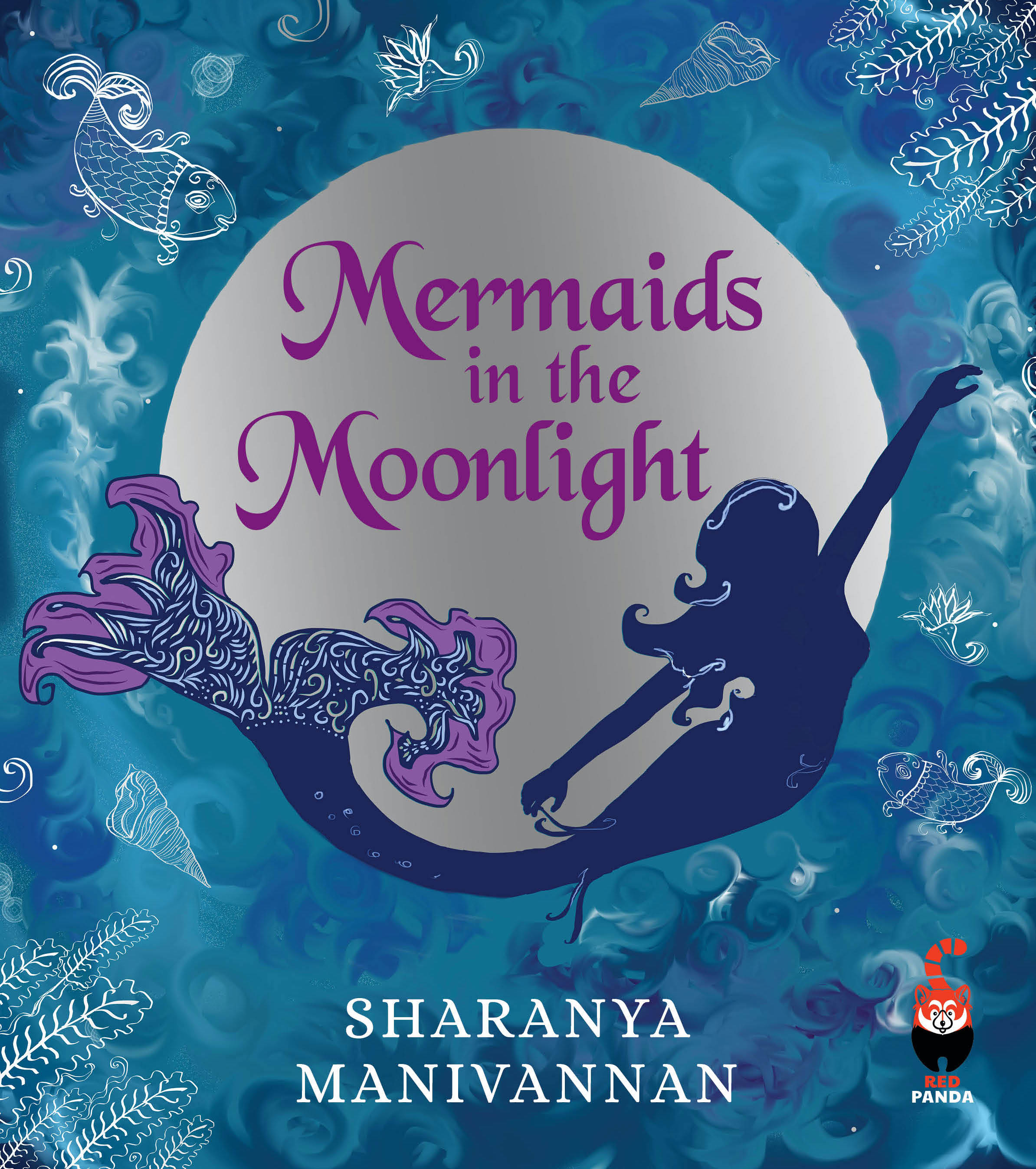
I am delighted to announce the release of my sixth book, Mermaids In The Moonlight, published on the Indian subcontinent by Red Panda/Westland.

Mermaids In The Moonlight is a children’s picture book and marks my debut as an illustrator. It will be followed by a graphic novel for adults, Incantations Over Water.

A press release from my publisher about both books is here:

Selected Interviews, Reviews & Events

Virtual book launch hosted by Bahrison’s Bookstore, in conversation with Neha Singh.

An essay, “Making Up The Mermaid of Mattakalappu” in The Willowherb Review

An essay, “Ila, The Mermaid of Batticaloa” in Mermaids Monthly

An essay in Scroll on Nilavoliyil Meenmathar, Ponni Arasu’s Tamil translation of the book

Mermaids In The Moonlight is intended to be a feminist picture book.” In conversation with Chintan Girish Modi for Hindustan Times

“Some silences come from erasures and deliberate elisions, and some silences exist because one is listening, creating the space for a truth to emerge. Both of these are honoured in Mermaids In The Moonlight and in Incantations Over Water.” In conversation with Priyanka Sacheti for Michigan Quarterly Review

“In Mermaids in the Moonlight, a mother from the diaspora takes her child to Batticaloa for the first time, and they listen to the mysterious underwater sounds in the lagoon. The child, Nilavoli, asks her mother about the story of the mermaid in the depths below, and the mother responds by telling the truth — she does not know — but also by sharing stories from around the world, interweaving them with information about heritage and history. The book is essentially a gesture of inheritance.” – In conversation with Rushda Rafeek for the Los Angeles Review of Books

“One thing that The Ammuchi Puchi—which was a book on bereavement, and took over half a decade to find a publisher because it was prose-heavy, like Mermaids—taught me was that it’s okay to be fearless. It’s okay to write complex narratives and explore heavy themes when writing for children. They already feel everything. It’s we as adults who have sometimes forgotten or lost that capacity.” – In conversation with Avantika Bhuyan for Livemint

“My family is from Mattakalappu (Sri Lanka). My mother would say when I was a child that there was a mermaid in her hometown, who could be heard singing in the lagoon on full-moon nights. This phenomenon is real, usually attributed to either shells or fish, and has been recorded and documented. As an adult, travelling to Mattakalappu for the first time, I was struck by how mermaid (meen magal) figures are all over the town, but there is an absence of lore about them. This folkloric void was my starting point for this work.” In conversation with Paromita Chakrabarti for The Indian Express

“Nestled amid the magic of mer-beings and the mysterious depths of stories from foreign lands is the tender tale of a rite of passage, an initiation into wonder and otherworldliness. A rarely seen depiction of the mother-daughter dynamics that will serve as your anchor in the vast sea of what-could-be.” – Kannalmozhi Kabilan in The New Indian Express

“Dreamlike illustrations” – Praveen Sudevan in The Hindu

“”The stories can hold safe space for adults, and children to understand that the world is kind and cruel at the same time, and to tell children that when life becomes overwhelming, curling up in the lap of stories could be restorative. Amma gives Nilavoli many things – truth, imagination, curiosity, and the cultures of many peoples. A child loved like that can make the healing less painful.” – The Bookdog

“Doubt and faith are equally valued in this book: as a work steeped in collective loss, and which taps into collective lore, I have taken care to acknowledge lacunae, and to leave open-ended questions exactly as they are.” – A picture-essay on the book’s illustrations in Scroll

“Mesmerising… The mythology of mermaids has always enthralled children but I love that this book dives a little deeper into the mythos and explores strong female identities…” – Toka Box

“…a sheer treat for the senses… The book’s vibrant illustrations make the work unpredictable, and yet alive, just like the evocative prose.” – Mid-Day

A session at the Hyderabad Literary Festival, with Dr. Vijay Kumar Tadakamalla and Savie Karnel.

A session at the Atta Galatta Bangalore Literature Festival, with Priya Muthukumar

A conversation with Storyteller Bookstore

“Over and over I have read, to my seven-year-old daughter, Westland author Sharanya Manivannan’s Mermaids in the Moonlight. I received Mermaids as a gift from a friend who breathes books like air, and my daughter and I have both loved it so dearly.” – Durba Chattaraj in Scroll

The Venus Flytrap: The Moon’s Long, Lingering Comet-Tail

Sometimes – often, in fact, though not always, not when secretiveness is deliberate – you can tell when someone is smitten. The volcanologist and science journalist Robin George Andrews certainly is, writing in The New York Timesabout that “beautiful volcanic pearl in the sky and its mystifying moonbeam”. He isn’t the only one – he quotes Sarah Luetgenn, a scientist studying the moon’s tail, as saying, so simply, “It almost seems like a magical thing.”

The moon as a volcanic pearl – the moon as magical – such delight when science and poetry dance together. And yes, it appears the moon has a tail, comet-like: discovered after the Leonid meteor shower of 2008 intensified its brightness and carefully studied ever since, it is made of sodium dust. The planet Venus appears comet-like at times too; its ionosphere billows out in a teardrop-shaped tail when solar wind density is low.

I, a poet who is not a scientist, have turned the thought of that pearl over and over in the palm of my mind, pondering it. Pondering its comet tail. Poetry always comes, or returns, to the smitten.

A beloved who was born under a sting-tailed moon, whose star chart and mine entwined, collided and imploded supernovically, came back. The shape of the constellations revealed themselves to me again after many nights of artificial light.

The moon’s sodium tail cannot be seen by the naked human eye. But it’s there, hundreds of thousands of miles long, a lingering. Because of the moon’s orbit, over the course of each month the Earth becomes encircled by its beam of scattered sodium. This makes me think of a mandala of salt, a sphere of protection and belonging.

There is a type of moonlight that is called earthshine, faintly illuminating the orb within which a young crescent grows or recedes in the evenings after or preceding a new moon. Words intoned under the dark moon become incantations; one makes a choice between shadow or ashen glow. Both are ways to name the area of earthshine, that phenomenon when the hidden whole decides to claim its place.

A hundred years before the astronomer Johannes Kepler brought planetshine into scientific understanding, Leonardo da Vinci – who held imagination and the measurable in perfect symmetry – wrote in his notebooks about this phenomenon. He believed the moon to be oceanic, and he knew that at least some of its light, at least on certain memorable nights, came from the earth. 

Even NASA doesn’t retreat into technical jargon, letting the grace of language – of old, old ways of seeing – describe what is. The waxing crescent is “the old moon in the new moon’s arms”. The waning crescent is known as “the new moon in the old moon’s arms”.

There’s a cradling in the sky that we are fortunate to behold, when we look up at the right moment, some configuration of place, time, instinct and opportunity that makes us pause in our tracks. If we’re sensible, we’ll know this is nothing special – it comes around every month. If we’re honest, though, we surrender: to love’s lunar pull, happenchance’s centripetal force, the heart’s hard-to-see but not invisible preordained and chosen trajectories.

An edited version appeared in The New Indian Express on March 18th 2021. “The Venus Flytrap” appears  in Chennai’s City Express supplement.

The Venus Flytrap: Women At Work

Women’s Day, the popular rose-and-chocolate-scented contemporary spinoff of the revolutionary International Working Women’s Day, has just passed. Thank Goddess for thatJust a few days before this year’s occasion, a traffic constable in Chandigarh who took her baby to work caught the attention of many, and the gamut of reactions to her illustrated well why considering Women’s Day as a celebration is to completely miss the point.

Identified as Priyanka, the constable had just returned to work after six months’ maternity leave. As her spouse and in-laws were not in town, she had been forced to take her five-month old baby to duty with her. A local resident who had spotted the constable at work took a video of her – in uniform, wearing a surgical mask, directing traffic with her right arm while her child was held with the left. This subsequently went viral online.

Some glorified her, some criticised her, and a few asked the right questions instead of doing either. This is where the connection to the typical misconstruing of Women’s Day comes in. To glorify a woman who is performing multiple roles because of a lack of infrastructural support is simply to brush under the carpet the many systematic and societal problems that force her into doing so. It’s a kind of gaslighting to applaud someone’s courage, strength or resilience without recognising that they should never have been in the position of being forced to express those qualities to begin with. To criticise a woman who is performing multiple roles because of a lack of infrastructural support is simply to force her into a corner – in this case, the “choice” to leave the workforce and become a homemaker. 

As for the right questions – those all pertain to access to childcare across fields, the recalibration of family dynamics and the wider recalibration of what community and kinship mean, and accounting for gendered nuances in the workplace and beyond. They are not about an individual who was just doing the best she could on a given day.

Priyanka is now facing a departmental probe. Whoever took the initial video of her perhaps inadvertently contributed to the significant personal and professional stress she was already under.

Priyanka’s situation calls to mind Nazia, who had been taking her four-month old Jahaan to the Shaheen Bagh protest last year. Jahaan passed away from a cold, and Nazia faced immense criticism from privileged quarters who did not care to ask the right questions then either, about the family’s living conditions or access to healthcare.

This was a month before the first case of COVID-19 was reported in India. If Jahaan had died just a few weeks later, we wouldn’t have heard of him. He was weaponised against his mother; not entirely dissimilar to how Priyanka and her child were tokenised as inspiration or public advisory.

In the year since then, we have seen or experienced how people with choices have chosen to behave, and we have also seen or experienced how that affects others who may or may not have an equal amount of agency. How have we still not understood that societal structures undergird everything we do?

An edited version appeared in The New Indian Express on March 11th 2021. “The Venus Flytrap” appears  in Chennai’s City Express supplement.

The Venus Flytrap: Judicial Misogyny & Bad News Fatigue

Sometimes, the heart is so weary that the hand can barely bring itself to click on a newslink. I feel this hopelessness often these days. Active outrage is not necessarily an empathic emotion, just as immediate quietness can mean exhaustion or contemplation, or observing before opining, not only callousness. No social justice effort that demands constant engagement, with neither rest nor reflection, can sustain itself long enough for a meaningful outcome. Horrible things happen every hour (as the statistics show); terrible things capture the headlines every day; every week, our sense of shock is renewed. No one has that kind of unflagging energy, to keep shouting. Those of us who want a better world must learn how to take turns, which is not the same as passing the buck.

So when I saw the latest misogyny reported on a judicial level – the latest today, which may not even be the latest by the time you read this – I wasn’t sure if I had it in me to look properly, let alone respond. Then I did begin to look into it, and realised that there were in fact not one but two Supreme Court cases in the headlines, with related sentiments. The Chief Justice of India himself, the Honourable Sharad Arvind Bobde, asked the rapist who attacked a minor in one case: “Will you marry her?” On the same day, the CJI was also quoted as having said in another case, in which a woman alleged rape by her live-in partner, “When two people are living as husband and wife, however brutal the husband is, can the act of sexual intercourse between them be called rape?”   

Behind both statements are echoes and echoes and echoes, centuries of evil that have seeped into and become a part of – even a proud, sanctioned part of – the culture. Each time such a scenario catches our attention, we must touch base again with this big picture. Otherwise, we are incomplete in our appraisal. This is one of the reasons why the weight of resistance is so wearying. It’s never about just one incident, even as we must be careful to not blur into that big picture the person or persons currently in the crisis spotlight. But the magnitude of it is mind-boggling.

What is there to say, really, when feeling crushed by this collective weight? The disgust and anger when a case is still being fought, when someone has survived, is unlike the disgust, anger and sorrow when someone has not. Some place names become codes for crimes: Unnao and Hathras, for example, each with multiple horrors that its name itself evokes. I open my browser briefly as I write and already there’s another case, another case in which a Dalit girl has been found murdered in a field, in Aligarh this time.

So forgive me: today I have nothing pithy or sharp to say, nothing that will amplify the noise. Anger is only one way to look this in the eye. The quietness – and for others who don’t even say this much, the silence – of contemplation, the space it creates for restrategising, is not the same as looking away.

An edited version appeared in The New Indian Express on March 6th 2021. “The Venus Flytrap” appears  in Chennai’s City Express supplement.

The Venus Flytrap: More Ministers of Loneliness

Tetsushi Sakamoto is Japan’s first Minister of Loneliness. This new cabinet post is an acknowledgment that loneliness, exacerbated by pandemic-related isolation and stress, is a serious issue.

In October 2020 alone, Japan recorded 2153 deaths due to suicide; by contrast, the total number of people who had died from coronavirus in the country up till then was 1765. When announcing the new Ministry, Prime Minister Yoshihide Suga commented that women were at higher risk. This is interesting since the “gender paradox in suicide” is a known occurrence, wherein men’s attempts are likelier to be completed even though women may have more ideation or a higher number of attempts.

Three years ago, when the U.K. announced its Ministry for Loneliness, I wrote in this column about how loneliness is interlinked with structural oppressions, even though people across positionalities experience it. I wrote: “In order to address loneliness, then, we must address everything.”

I learned something I hadn’t known then about the U.K.’s Ministry. Its creation was based on the findings of the Jo Cox Commission on Loneliness, which was established by an MP who was murdered soon after. Cox was murdered by a far-right extremist who presumably opposed her beliefs, which favoured refugee rights and other humanitarian concerns. Her involvement with the issue of loneliness was probably an extension of her compassionate worldview.

Maybe Cox’s killer is lonely as he serves out his life sentence without parole. Or maybe he had already been so desolate in his life that he found comfort in a supremacist philosophy.

Since its inception, the U.K.’s Ministry for Loneliness has had much reshuffling. It cannot be simple work, dealing with an intangible element that dominates so many lives. While the Ministry has initiated various campaigns and awarded grants, there is scarce information online about what it has been doing during the pandemic. But there is a video dated March 2020 with a small selection of recordings of calls to them. The “loneliness epidemic” preceded the pandemic. Japan’s decision to address this formally is important, and will hopefully create strategies that can be employed widely.

Hopefully. Loneliness is a profoundly subjective experience, even if vast swathes of a population self-identify as lonely, or other supporting data indicates this malaise at large even if self-identification is not reported. I like the idea of such Ministries mainly because they can help destigmatise that self-identification. 

Can I help with that too? I am a deeply lonely person, and I always have been. I’ve been alone on most of the best and worst days of my life. My skin hunger was so bad this month that I cried once from needing to be held. My circumstances, my history and my choices may be unique, but my loneliness is not. Yet I am grateful every single day to not be in denial about this essential aspect of my being. Denial leads one into unhappy relationships, into being pawned by sinister ideologies, into transient gratifications and their inherent risks. In naming myself as lonely, I hold myself safely and wholly. I honour the truth of my heart, and I find ways to soothe it without distraction, without deceit.

An edited version appeared in The New Indian Express on February 25th 2021. “The Venus Flytrap” appears  in Chennai’s City Express supplement.

The Venus Flytrap: A Theory On Cancellations

A few weeks ago, the TV host Padma Lakshmi used her hand to mix ingredients for puliyodharai and people had Reactions to this. I don’t know what those Reactions were exactly, because I didn’t care to look, but I knew they were happening. You see, every time Padma Lakshmi does something of note, “of note” being relative of course, I find out because someone out there finds it a teachable moment in which to share my critique of her 2016 memoir, and tag me on the same. The memoir reveals its author to be openly casteist and highly problematic in ways that disprove her progressive reputation in the West.

It doesn’t bother me to see these tags, but it does make me wonder why my piece seems to be one of very few, if not the only, one that discusses those issues. I must admit I sometimes also wonder if more people have read my review than her book – I say this not to be snarky, but because every time someone shares it, others express shock. Lakshmi’s bigotry is not common knowledge. 

People who’ve made smaller infractions, or whose views have traceably evolved, are discredited for far less. But, also, others who’ve made significant infractions remain celebrated.

I have a theory about all this: in order for a cancellation to snowball, the first detractor must aggressively drum up a wave. They must gear their criticism to galvanise mass condemnation. As I never had an interest in getting Lakshmi cancelled, and do not believe in that highly punitive approach at all, I did not invest my energy or time into this. So no wave. On social media, most people get pulled into waves, and do not long observe ripples – or pacificity.

I see this theory substantiated in a few ways. Firstly, there’s excessive traction for pithy and sometimes reductive hot takes. Nuance is inconvenient, especially when one has already made up one’s mind (or has decided to have their mind made up for them). People like to agree or disagree in broadly painted strokes. Secondly, there are those who build clout through takedowns: misconstruing statements to trigger engagement, picking a target then working backwards on an attack, swift and damning disavowals when even the slightest difference of perspective is present. Thirdly, there’s a particular kind of chameleonic social media user who waits to see what the consensus is, and then aligns with it – even if that means contradicting what they aligned with a few weeks prior. The necessary mix of objectivity, subjectivity, reflexivity, curiosity and good faith that enable learnings and solutions is missing.

Unless we choose social media absence, we participate in all this in some way or the other: alternating as stone-casters, targets, pawns and cohorts. Perhaps also choosing to be observers, energy-rationers and listeners will help dissolve the toxicity of the spaces we participate in.

It cannot be overemphasised that social media is an argumentative and unforgiving milieu. Optical gains and on-the-ground productivity often vastly diverge. If it’s true, as I feel, that mass social media activity does not happen organically, then, collective brushing-under-the-carpet is also not arbitrary either. There’s more to ponder…

An edited version appeared in The New Indian Express on February 11th 2021. “The Venus Flytrap” appears  in Chennai’s City Express supplement.

The Venus Flytrap: Who’s Looking At This Logo?

Let me tell you how debauched and vain I am. A great artist made an illustration of me, more accurate a likeness than even photographs. I couldn’t take my eyes off it. So I stared at it for ages, admiring her talent and by extension admiring myself. After say three or four hours of such self-absorption, I suddenly felt like there was something phallic about what I had thought was my hand in the image. “You idiotic girl,” said the friend I showed it to, not unfairly. “That’s a parrot.” I looked again, and so it was.

Another time, I showed a different piece, one I had found charming, to that friend. “Isn’t it cute how the mommy cat has boobies?” I squealed. They were paws, of course. Paws. So I felt quite relieved when the same friend recently shared with me one of her own creations, in which the feminine divine was unmistakeably rendered in a vibrant, semi-abstract style that emphasised Her distinct anatomy: heavy bosom, yantra-style yoni and all. I was quite relieved that there was no room for me to misinterpret those symbols with the ramblings of my dirty mind.

All this occurred to me when, for the first time in many years of being a customer, I saw the Myntra logo in a way that I could never again unsee. The e-commerce retailer has long used a stylised letter M, in orange and pink hues, as its branding. It still does, except that the exact placements of the colours have now changed. One person who looked at the logo and perceived the M as a naked woman with her knees open (that’s the can’t-unsee image that everyone who’s heard of this case has now seen, mostly for the first time) decided to file a lawsuit.

Why Avesta Foundation’s Naaz Patel decided to invest her effort into going after this logo instead of into, oh literally anything else, is baffling. Joining activists who are working on getting marital rape criminalised, having the Nirbhaya fund be well-utilised, pressuring online platforms to take cybercrime more seriously, and other major issues? Nah. An innocuous, colourful M was the problem more “offensive to women”.

That’s not a dirty mind. That’s an idle one.

 Like I said earlier, I totally understand how she saw what she saw. But some things simply lie in the eye of the beholder, and knowing the difference between when something is offensive and when one’s mind is just making a Freudian joke is important. Not to mention time-saving and energy-efficient. 

There’s also an un-funny, even frightening, component to this entire incident. It shows how progressive values can be misrepresented in opportunistic ways. Patel’s conservatism should not be mistaken for feminism, but it will be. 

The pettiness of a case like serves as a distraction from what truly matters. I would rather have the old Myntra logo back, even if I will always see a provocative image in it, than a new one that is nothing more than a symbol of how regressive thinking was given such weightage in India’s courts, while much more meaningful battles, legal and otherwise, continue to languish unattended.

An edited version appeared in The New Indian Express on February 4th 2021. “The Venus Flytrap” appears  in Chennai’s City Express supplement.

The Venus Flytrap: Sexual Intent

The Bombay High Court has ruled in a case pertaining to an attack on a 12-year old girl by a 39-year old man that he was not guilty of sexual assault because no skin-to-skin contact took place. He had groped her breasts, without removing her clothing. He was only deemed guilty of “outraging a woman’s modesty”.

On www.livelaw.in, which breaks down notable cases so that laypeople can understand them, lawyer Ashok Kini notes that “Neither the POCSO [Protection of Children From Sexual Offences] Act or any other laws in India define what is ‘touching’ or ‘physical contact’”. On the same website, lawyers Radhika Roy and Harshita Singhal broach the precedent case Ravi vs State, wherein holding the hand of a child (with sexual intent) was ruled as sexual assault, writing that this judgment has “shrunk the scope of sexual assault”. This has frightening repercussions for future cases, involving either minors or adults.

The phrase “sexual intent” bothered me, and I was (as a layperson) unable to find a legal definition, at least in India. But, according to the United Nations’ General Recommendation 19 to the Convention on the Elimination of all Forms of Discrimination Against Women, sexual harassment is the “unwelcome sexually determined behavior as physical contact and advances, sexually colored remarks, showing pornography and sexual demands, whether by words or actions.”

The word “unwelcome” suggests the interpretation of what constitutes invasive behaviour should firstly be from the perspective of the person who is subjected to it. Ascertaining the accused’s “intent” is problematic. The accused is not always going to express that they had such intent, especially if they’re aware of the legal ramifications of such an admission.

It should be easy to imagine a variety of scenarios in which, following a sexually transgressive experience, the perpetrator responds: “I only pulled your neckline up because I didn’t want our colleagues to leer at you”; “I only hold your waist so that our classmates think you’re ‘taken’ and don’t bother you”; “It wouldn’t have happened if I wasn’t so drunk”; and the like. Sexual intent? No, no!

It should be easy to imagine these because they are intrinsically a part of the lived experience of many in this country. So is being groped, over the clothes, especially in public. I can’t speak for anyone else, but there is no way that I will ever feel that the archaic legal term “outraging a woman’s modesty” suitably defines my experiences.

If you’ve read this far, you won’t need a trigger warning. When I heard of this shocking judgement, my mind flew back to a night twelve years ago. I’d been on a sidewalk and had an intuition that the motorcycle coming from the opposite direction was trouble. I shifted my handbag to the shoulder away from the street. A mistake: it wasn’t my handbag he was after, but my breast, which he reached out and painfully smacked as he rode past. If he received pleasure from that touch, it was not from my body as much as from having and exerting the power to hurt me. Does that count as “sexual intent”? Why wouldn’t that count as assault?

An edited version appeared in The New Indian Express on January 28th 2021. “The Venus Flytrap” appears  in Chennai’s City Express supplement.

The Venus Flytrap: Anna Shay’s Reality Check

I wasn’t going to write about TV again this week, I swear, but I haven’t been able to stop thinking about Anna Shay.

Anna Shay – ah, heart-capturing heiress, arguably the brightest star on Bling Empire, the latest shot-pre-pandemic reality show. On the cusp of 60, with a fashion aesthetic that’s grunge-meets-diamonds, and a personality that: (a) makes you wonder if her co-stars know how lucky they are to know her, and (b) offers an attractive snapshot of a way of being, even sans the diamonds, especially for those who rarely see role models and representations of unconventionality that aren’t stereotypical or overblown. Fate dealt Shay a very nice hand, in the form of material privilege, but there’s something so down-to-earth about her, and that’s what’s positively dazzling.

 Shay presents two very evident traits during this show, both of which invite admiration. The first is that she comes across as being wise, in myriad, mostly subtle ways that don’t register quickly on a reality show’s edit style but which create an effect over the course of the season. The second is that she is clearly a private person. We find out, when her misbehaving friends meddle through her personal belongings and play rude pranks, that her life is quite colourful; but she draws a curtain so that we don’t ever have details. We don’t know who her lovers are, and running an internet search even reveals that she has successfully kept the names of her four ex-husbands firmly offstage. That curtain-drawing is an art; she just quietly, semi-smilingly, does it somehow. She doesn’t mince words, and she doesn’t always have to use them. The effect is formidable.

There’s a third trait. She is kind. Shay is not given to ostentatious displays of charity like her self-declared nemesis Christine Chiu, who doesn’t appear to notice the irony of sponsoring orphans as a party favour while also holding on to regressive ideas about bloodlines and boy successors. Rather, the kindness comes through in the way she treats people in her orbit: whether that’s non-judgmentally advising a friend in a toxic romantic relationship, helping the odd one out feel more welcome, or accepting apologies graciously. At the same time, Shay doesn’t suffer fools gladly, one of the tell-tale markings of someone who lives authentically. No saccharine, no passive-aggression. Just good boundaries. She’s not bored enough to invest in drama, even when it’s all that’s being asked for.

Who knows why this highly self-contained individual opted for the exposure of mass-marketed reality TV. If neither money nor boredom were motivators, what could it have been? The impression one gets is that Anna Shay signed up for the experience, with an open mind and an unflappable sense of selfhood, knowing she would be baited, but that didn’t have to lose her cool. (Above all else, this woman is cool). The impression one gets, actually, is that she’s not that interested in impressing anyone. As a result of which we cannot help but be more than a little in awe. It’s an effect that almost never occurs any more in this entertainment format. We’re not laughing this time; we’re watching and learning.

An edited version appeared in The New Indian Express on January 23rd 2021. “The Venus Flytrap” appears  in Chennai’s City Express supplement.