An interview I gave to Sify much earlier this year has finally been published in Stree, their women’s section. I quite enjoyed these questions, and find that my answers would be much the same even today. And I thought it was funny how the title has one word, the url another, but at least the article contains the accurate quote — and whoever edited it must have thought long and hard about the many implications of what I had meant! You can read the article here.
Storm In a T-Cup & The Language Of Experience
I should have posted this up sooner, but here it is. My first post for Ultraviolet in quite awhile, on thoughts about language and expression after the controversy about Penelope Trunk tweeting about her miscarriage. Read it here.
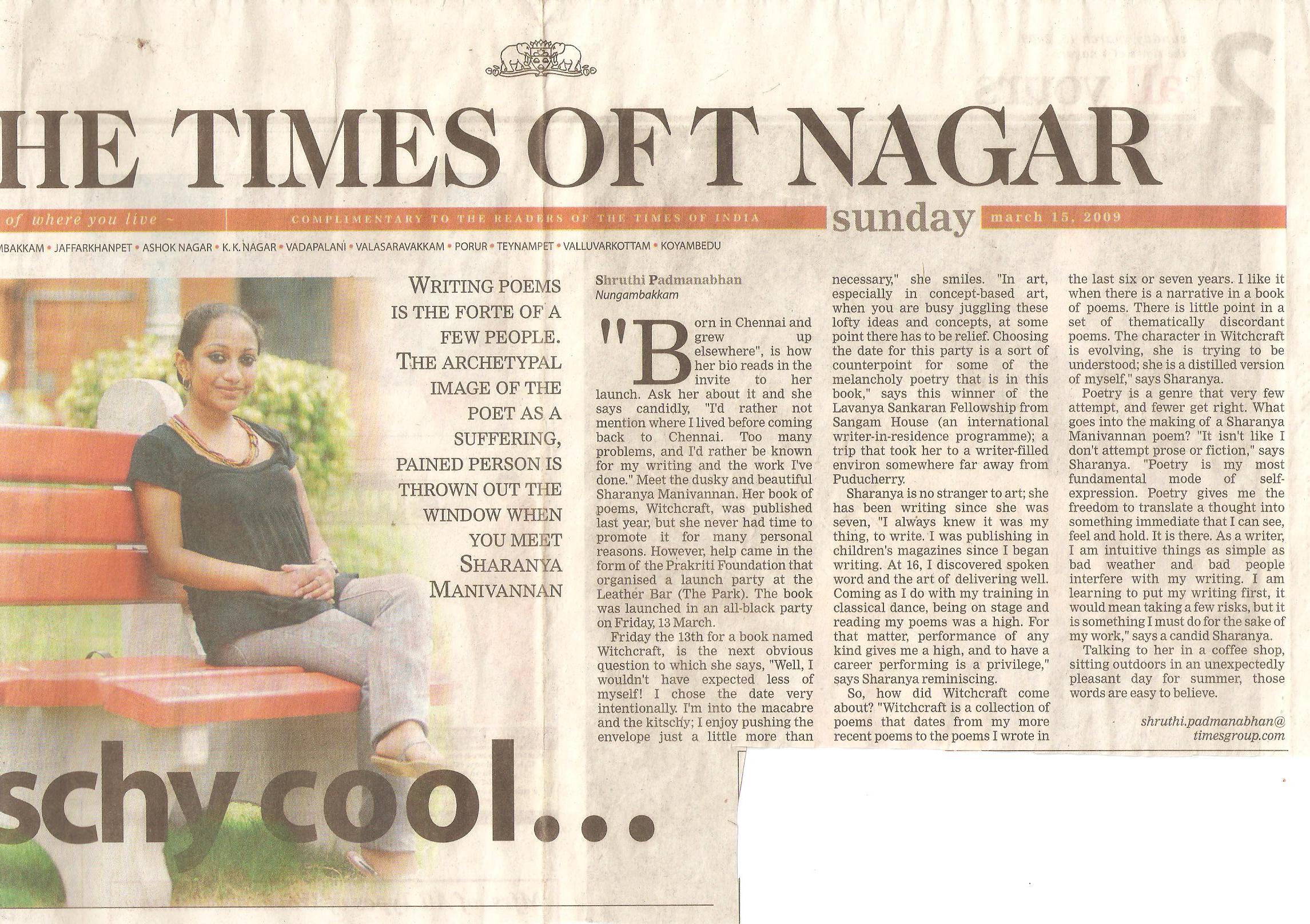
“Kitschy Cool”, Said TOI
Versions of this article ran back in March in three of Times of India‘s Chennai supplements. They weren’t available online, and I’m not very good when it comes to collecting or archiving press clippings, but I was given a copy at some point, and I’ve only just managed to scan it up. Here’s the version that ran on the front page of Times of T Nagar. To read, please click to enlarge.
The Venus Flytrap: The Maladjusted Medium
“These leaves are used in headache ointments,” she said, and handed me a few. They had a interesting, pleasantly medicinal smell. I asked her what the tree was called, but its name is the last thing I remember from that evening.
We were in the playground, waiting for the baby to tire herself out. The woman speaking was employed by my friend, for whom I was translating the conversation. She walked over and tore a bit of bark off the same tree. “This is used to make paper,” she said. “Where I come from, there’s nothing but these trees and maybe twenty houses, spread out far from each other.
“At night it’s pitch dark. By 6pm, my heart starts to palpitate. I can hardly sleep.”
“Didn’t you grow up there?” I asked. “How can you be so afraid? And what are you afraid of?”
“Ghosts,” she said. “I saw one when I was ten years old.”
Later, she would say that she didn’t normally tell people about these things. About how since she had seen that ghost, with its ghastly monkeylike face, she lived in nightly fear. About how some years after that, she developed the ability to channel deities, and exorcise the possessed – only in her case, it wasn’t so much an ability as an inability to resist being taken over. It always happened without her control, on two specific days of the week.
Later, I would also wonder why she had told this story at all – at 6pm on a Tuesday, no less.
It was the first her employer had heard of this side of her, and there were many questions. She carried on talking about her experience as a medium – but mostly, she talked about fear. Her fears seemed normal enough – fear of the dark, fear of spirits, fear of being in train stations at night, fears about negotiating life in this city as an unthreatening, working class woman.
At some point, she stopped me mid-translation. “I don’t want to talk now, I’m getting scared.” But it was too late. Even as we began to change the subject, she started to hyperventilate. Her slight body tensed and shuddered violently, her face contorted in anguish. I ran for the baby, thinking back on an incident from my own childhood in which a possessed woman had grabbed hold of me and flung me around like a crash test dummy. My friend put her arms around her until she calmed, sobbing. We left the playground as soon as we could.
There was only one thing about the possession that disturbed me, and disturbs me still: how a person of such power – a person who had the capacity to support her community as a healer – could have so little control over it. She was at the mercy of her own power. It had, in fact, turned on her.
And doesn’t this ring true for many of us? How easy it is to hide our own light, our own gifts, so as to get along with a hostile environment. But to get by on a mediocre life when one is meant for extraordinary things is to poison the self. On some level we are all maladjusted mediums. How many of the ghosts that besiege you are of your own killing?
An edited version appeared in The New Indian Express. “The Venus Flytrap” is my column in the Zeitgeist supplement. Previous columns can be found here.
The Venus Flytrap: Deactivation Drama
I feel inordinately smug when I tell people that I’ve deactivated my Facebook account. The expressions of shock that greet this statement are a testament to the social networking website’s sheer hold over contemporary living. Foraying into Internet hermitude is not just impressive, it’s downright inspiring, it seems: every time I’ve mentioned it I’ve been gawked at like I had just announced I was donating my left arm to science and my right to reinforce a coat hanger.
No surprise, because until certain security concerns reared their ugly heads, the thought of shutting down my account was utterly unimaginable. I couldn’t shake my fists at its time-wasting, stalking-encouraging and superficial-posturing qualities because I was too busy typing a new status update or textually tangoing in response to a friend’s photo. Facebook is the ultimate can’t-live-with-it-can’t-live-without-it paradox of these times.
The morning after my grand departure (and it is grand – in its typically manipulative way, among the rigmarole of confirmations the website presents includes showing you “friends” who might miss you), I woke to a flurry of emails from close friends – actual ones – regarding the departure in question. Nearly all had assumed I had deleted them.
Ah, that delicate thing that is defriending! If I’d just pruned my list instead of plucking my very presence out of the site, I wouldn’t have been deprived of its many benefits But as anyone who uses it will tell you, one of the great farces of social networking is the idea that it helps you form small social systems of your own choosing. Rather, you become connected to everyone you know – regardless of how you feel about them. Facebook has all the complications of real-life tensions, sugarcoated in cheery cybercivility. This was probably why the Superpoke application was invented, thereby simultaneously providing some space to vent within the system and introducing the word “defenestrate” into the common parlance.
I was able to clarify the situation to those who simply asked outright. But as weeks passed, I wondered if less forthcoming folks had taken offense, made assumptions, or otherwise overreacted to perceived defriending. Further complicating things was a loophole that sometimes showed my profile, along with a list of mutual friends – thus conveying the impression that the viewer was deleted, but all mutual friends remained intact. Unbeknownst to me, what decisions were being made – professionally, personally or politically! – based on a presumed snub? What wills was I being written out of, parties disinvited from (I can’t be phototagged anymore, which seems to be the point of most parties these days) and negotiations dropped from as I carried on obliviously in the post-Facebook world?
Social faux pas or not, how much healthier it felt to have my communications go from a superficial broadcast level to a meaningful personal one. Remember kids, stalking is no excuse for not saying hi.
But I write all this in the past tense, despite being still very much off-site, because I must admit there’s a chance that by the time you read this, I’d have reluctantly reactivated. Because when it comes down to it, a hiatus from Facebook is like an impulse wedding – it would be great if it works out, but it’s probably not going to last forever. Staying off Facebook is almost as much drama as being on it.
An edited version appeared in The New Indian Express. “The Venus Flytrap” is my column in the Zeitgeist supplement. Previous columns can be found here.
The Venus Flytrap: The Hum of Many Roads
Who knows what possesses us in those hours between departure and destination. We give ourselves over to it, the road trip, with a reverence we offer few other things, and perhaps because the road trip is so supremely demanding, supremely absorbing, supremely seductive, we cannot help but acquiesce.
Not all journeys are like this. They all have their thrills, their frustrations, but few bring us so casually close to epiphany the way the long drive does. In trains, the multitudes within oneself jostle with the multitudes outside it; the carriage is choked with impatient energies, even the lucky one by the window is pinned in by bars. Planes terrify in their absence of landscape, the disconcerting inability to sense a trajectory of movement. On motorcycles you may not speak to the person whose thumbs rest at your shoulder blades, or whose waist your arms encircle; it is too dangerous. We may walk, but neither for long nor fast enough. The reality of these methods disenchants their romance.
But the drive, for some or many reasons, continues to occupy a particular glamour not only in the imagination, but in the experiences that validate that ideal. In a time in which distant travel has become almost as nonchalant as commuting, the long drive retains some mysterious aspect. Stretched over an expanse of highway and hours, it carries the intensity of the epic.
There is a suspension of time, a transfiguration, unlike any other kind experienced in travel. The silences we fall into on a drive hold a certain tension. The songs we listen to take on the pathos of hosannas.
The road trip is dramatic: every landscape we enter is a looming one, suffused with evidence of a creative force, architectural or mystical (for at its core every road trip is a pilgrimage) that manifested what meets the eye. Therein lies its seductiveness. We cannot look away. We cannot choose to disengage. Even if we sleep our bodies continue to carry the hum of the road. It lulls and wakes us. It paces our dreams.
The road trip in its essence is romantic, and by this I mean not just what happens between people, though I know all too well what a road trip lends itself to – the ways it can free and frighten and surprise. It’s also romantic in the way in which all great things lend themselves to metaphors and the metaphysical. To be faced with the open road is like being faced with the sea.
In my body I carry not only the hum of many roads, but the knowledge that something about the mysterious allure of the road trip lies in its transformative, even cathartic, power. We leave behind. We put distance between. Every journey, even between the same points of departure and destination, is different, and so there can never really be a going back.
Some take trips to nowhere, but I don’t believe in nowheres, only elsewheres. And I know this as I have known every sob that has overcome me, every madness that has risen in me, every hand that has held mine in the transfigured time between origin and denouement: that elsewhere, that epiphany, can sometimes be the journey itself. What it did to us, and what it made us do.
An edited version appeared in The New Indian Express. “The Venus Flytrap” is my column in the Zeitgeist supplement. Previous columns can be found here.
Reading This Saturday
Asma and Manasi have been holding poetry meets at a private residence in Chennai for a few months now, and I’m happy to tell you that I’ll be coming out of my cave for the first time in six months for a reading this Saturday, October 3rd. I’ll be reading from new work, as well as selections from Witchcraft, and copies of the book will be available for purchase.
This reading series is a very informal and intimate one, so if you’d like to attend, please drop me an email and I’ll give you the address and other details.
The Venus Flytrap: Touché ‘Tache
When Salvador Dali appeared on the 1950’s American TV game show “What’s My Line”, in which a blindfolded panel deduced the professions of mystery guests based on a series of yes/no questions, he was correctly identified by a suggestion one panelist made to another: “ask if he could use his moustache to paint?”
Historically, moustaches symbolized both masculinity and various types of power in many cultures – from the warrior deity Parthasarathy (the only depiction of a Vishnu with whiskers), to Western intellectual elites from Nietzsche to Einstein, the examples are numerous. During the 20th century, they were sported by artists who represented a sort of hypervirility, including Freddy Mercury, Jimi Hendrix and Tom Selleck. The world’s most famous living lady with a beard, the striking circus artist and professor Jennifer Miller, wears hers proudly, saying, “It goes all the way back to Samson and his big mane of power. That’s why men don’t want women to have too much of it in too many places. So, here I am, a gal with a beard, prancing around the streets of New York.”
But does facial fuzz really have the kind of currency it used to? As one website put it, “moustaches are now the style equivalent of wearing a polyester leisure suit on your upper lip”.
It’s not that people don’t have moustaches anymore, or that those who possess them no longer take them seriously, as a walk down any Indian street will tell you – it’s that they’re no longer sexy in the popular imagination. Sure, a Johnny Depp goatee or some George Clooney scruff still warrants a second glance, but full-fledged whiskers are mostly the stuff of caricature.
In the past, emphasizing gender extremes, from rib-crushingly cinched waists in women to the bulging codpieces of Crete and medieval England, was fashionable. Today, trends veer toward something more androgynous – and bless androgyny for what how it frees us, but I wouldn’t mind being blessed, or rather brushed, with some serious bristles now and then! Has the fundamental sleaziness of the hairy face, with all it implies, lost its semi-subversive appeal? Look to typical old pop culture stereotypes: the baddie is bearded, the hero babyfaced. And who doesn’t secretly want the bad guy, with his swagger and his moustache twirl?
I don’t think I’ve ever actually wanted to have a moustache or beard, in spite of the many male accoutrements I have envied, so unlike Jennifer Miller, my contribution to a face fur revival is much smaller. I’ve invented an emoticon that hopefully conveys a sense of the yesteryear hotness of the whiskered man (or woman). I leave it to your imagination: :-{P.
The truth is, though, that my personal favourite story about facial hair relates to its absence. A Caucasian man, the type who probably thought it was enlightened of him to consider the question, once asked me how evil white people are portrayed in Indian comic books, given that villains are always shown to be dark-skinned. I thought it would be funny, because my sense of humour frequently sabotages my biological imperative and I liked him very much, to tell him that maybe they just had beards (like him). He showed up a day later, cleanly shaved. I could see his freshly smooth cheeks turn pink when I asked him why.
An edited version appeared in The New Indian Express. “The Venus Flytrap” is my column in the Zeitgeist supplement. Previous columns can be found here.
The City As Canvas
I have a long essay on the aesthetics of the city of Chennai in the current issue of Caravan magazine. Caravan is a journal of politics and culture and is available nationwide at good bookshops, and can also be read digitally here.
The Venus Flytrap: Original Instructions
In the small town of Gudalur, two and a half hours downhill from Ooty, there is a coalition of NGOs that, through serendipitous circumstances and sound intentions, run a school and a hospital for the tribal community. I’m visiting with my friend the American Badaga, tagging along on an Ooty-Gudalur-Coimbatore-Palani-Perumalmalai-Kodaikanal trip completed over just five nights, sleeping in a different place on each one. We’re there to look into alternative education systems; after the tribal school is an international school in the forest. Mostly, though, I’m there on impulse, just to get away.
The week before, I’d attended a lecture in Chennai by Vandana Shiva, the renowned physicist and activist. Dr. Shiva had spoken about the country’s agricultural crisis, encouraging the audience to “violate the contracts” that gave undue power to governments and organizations that contribute to the deterioration of the environment, and to suffering among the poor.
Yet, sitting by a window overlooking the filthy Cooum river later that rainy afternoon, coming down from the high that listening to an inspiring speaker brings, I was saddened to think that the only phrase that still haunted me was something said in passing as Shiva was introduced. Another world is possible. I so much wanted it to be.
It came to me again in Gudalur. I’d never expected that just a few days after the lecture, I would find myself reading on a rock under a tree on the far west of Tamil Nadu, wet earth under my bare feet, adivasi children singing nearby, a cow to my right and a chicken to my left. My troubles very, very far away.
I’m reading Cait Johnson, who posits that spirituality is essentially rooted in the elements, the same notion that had me head for the hills to hide among trees, and attend Shiva’s lecture. Whenever I lose my connection to my elementals, I seek to replenish them in nature. Johnson writes about “Original Instructions” – intuitive knowledge kept alive by people, like the adivasis, whose ways of life honour the sacred interconnectedness of all life.
Watching the good people of Gudalur – the teacher who speaks openly and without prejudice to a classroom about gay and transgender people, the Ayurvedic doctor seeking to both learn from and better equip traditional healers, the professionals who set up the Ashwini Hospital and Vidyodaya School and gradually ensured that autonomy over them returned to the adivasi community – my heart remembers its own Original Instructions.
Watching them, I remember that there are good people in the world, who do good work for its own sake. I had forgotten.
I have been heartsick for what feels like a long time, but isn’t. I have been disillusioned with my own journey. I have wanted to count to one hundred and bow out, like the poetess in Ana Enriqueta Terán’s mysterious poem. What I did because I thought it was in my blood, I’ve watched others do with a bloodthirst I cannot muster. I have felt time and again that I can barely co-exist in a world so cutthroat, let alone compete.
But this is what I know, after Gudalur: another world, in all the many variations Vandana Shiva may or may not have meant, is possible. In fact, it may already exist. All it takes is to get back there.
An edited version appeared in The New Indian Express. “The Venus Flytrap” is my column in the Zeitgeist supplement. Previous columns can be found here.
Rituals For Closure
A new sequence of poems – though not, I think, a poem in parts – has been published in the new issue of Danse Macabre. You can read “Rituals For Closure” here.
Mayda del Valle on Grandmothers, Spirituality, and Faith
Some of you know that I lost my grandmother last October. Fewer of you, I think, know what kind of rocky ride the almost-year since has been. What you’ve probably noticed either way is that I no longer blog unless it’s to archive my journalism work, link to press about me or to poems published, or to publicize my (very few) events. I’m not going to go into my disengagement with the online life any further right now, except to say that today I came across that most rare thing: something that makes me want to blog, that I simply must share.
I’d never heard of Mayda del Valle before, but I won’t forget her name now. Here she is at the White House with a searingly powerful performance of a poem that made me cry both times I watched it, for reasons too private and too sacred to discuss now.
If you’d like to read the poem, it’s here.
The Venus Flytrap: Dancing With Eyes Closed
Every day I read my cards. Every day, I draw them, decipher them, and am drawn back to them. And every day, I look up my horoscopes. For my sun sign, my rising sign, and the signs of those I care for. I read a whole bouquet – and I’m not the sort to pick the most optimistic one and go by it.
Scoff if you want, but I know I’m not the only one. The fear of the future and the desire to be reassured about it, or at least prepare for it, are intrinsic to human nature. Some people take out insurance, consult business projections, or discuss sports strategies ahead of the match. Others meditate for answers, speak to soothsayers, or watch for omens. There is no real difference in what motivates the desire to know, and to work ahead of foreseen outcomes. Is meteorology really more accurate than augury, just because it is a science? I can’t remember it ever raining when a weather forecaster declared that it would, against season. But I do remember watching a therukoothu dancer sing to the goddess for rain one afternoon, and have it come down – torrentially, unseasonally – that same deeply heartening evening.
But that doesn’t mean one is truer than the other, or that either one is true at all. I’m not here to argue about the soundness of the mystical arts, or to prove what I know empirically to be true in everyone else’s lives too. All I’m saying is that the need for reassurance is universal. Everybody looks for a guarantee, or at least a cushioning against disappointment. To expect something is to rob it of its power to surprise, and conversely, to deepen its delight with sweet anticipation. And most of all, I think we look for comfort, for evidence of the possibility of all things, however inconsistent with the cold realities we experience.
But the truth is, there is no map. There is no alignment so perfect that its choreography lets you dance with your eyes closed.
Of course, you may ask, is it really, freely, dancing at all if you believe in a design? How dare I believe myself truly engaged with the world, truly open to experience, if I want to know what lies two paces ahead, instead of just walking – or waltzing – into it?
The thing is, I have found that belief enriches my life far more than cynicism ever could. I am able to live more mindfully because I can trust there is a bigger picture. I’ve never believed in coincidences, only synchronicity. Sometimes I look at someone and see their whole lives in a moment. Sometimes I know I have travelled through time. Sometimes the universe opens up and the dots I connected reveal themselves to be constellations. And sometimes it doesn’t, oh but when it does…
And if there is no bigger picture? If I die and cease to exist, if I follow and cease to find? Who cares. Life is short either way, and I’d rather be delusional than deprive myself of enchantment at all.
I would rather see miracles everywhere, because I believe in them, than be unable to recognise all the ones before and within me, because I refuse to acknowledge their very existence.
An edited version appeared in The New Indian Express. “The Venus Flytrap” is my column in the Zeitgeist supplement. Previous columns can be found here.
 Sharanya Manivannan
You must be logged in to post a comment.