The spectacular Asia Writes Project has reprinted two poems from my 2008 collection, Witchcraft. You can read “Scratch” and “Kumpi (The Work Of The Oracle)” here.
The Venus Flytrap: These Unspeakable Things
In the two years I’ve been writing this column, I’ve tried to be honest. I’ve tried to share my life in ways that might be meaningful to strangers. I’ve written about things that might be controversial, if not in themselves then in their autobiographical quality – depression, death, violence, desire. While writers’ block might have resulted occasionally in pieces I can best defend by quoting Maugham – “Only a mediocre writer is always at his best” – never have I known exactly what I had to write about and yet felt so sickened, fearful or bereft at the thought.
How many ways can I tell you this story?
I can tell you the facts: two weeks ago, a close friend of mine was sedated, taken into custody on false claims, and detained in a mental ward where he was sexually abused and improperly diagnosed. I can tell you that this was orchestrated by collusion between his family (who had disowned him months earlier), the hospital, and the police. I can tell you, so that you don’t write to me with information that can’t be used, that this happened in another country, with a different set of laws.
I can tell you about the distance, about the bafflement and panic that ensues upon receiving an alarming text, from a number that cannot be reached afterward.
I can tell you again about human circuitry, the connectivity I always feel to my dearest ones, and how it came alive. I was the first person he texted with his last cents of phone credit – and the only one who came through. All the way from here, I tracked him down. The activist who advised him on his rights, the social worker whose care he is under now, the writer who helped him get down the unspeakable in a police report – every person came through me. (“You texted INDIA?” he was asked over and over, once he was released and seeking legal aid, and in his typically dramatic way, he said, “I was semi-sedated and even then I knew the best help I could find was half a world away, but the closest thing to home”.)
I can tell you about the complexity of emotions that come with being in a situation like this, struggling to protect someone very far away. The uncertainty over what to write – and whether to. The gratitude at the help that arrived. The dismay at how eager people are to turn a person into a poster boy. The outrage at Dr. Siras’s suicide, so closely timed to my friend’s own persecution, and for the same reasons why his family turned against him. The chills I still get thinking of how much hinged on me receiving that one text and taking it seriously. The disgust. The anger. The fear.
How many ways can I tell you this story? Trying to tell it at all cleaves me – do I conceal in poetry, rage in polemic, inform as a journalist, or tell it like I just have – a story about which I am only one part, one participant.
How many ways can I tell you this story? Is it enough to say: these unspeakable things are no story. This is reality. My friend has a witness to the world. There are others who have no such testimony.
An edited version appeared in The New Indian Express. “The Venus Flytrap” is my column in the Zeitgeist supplement. Previous columns can be found here.
Desperation As A Province Of The Female (Artist)
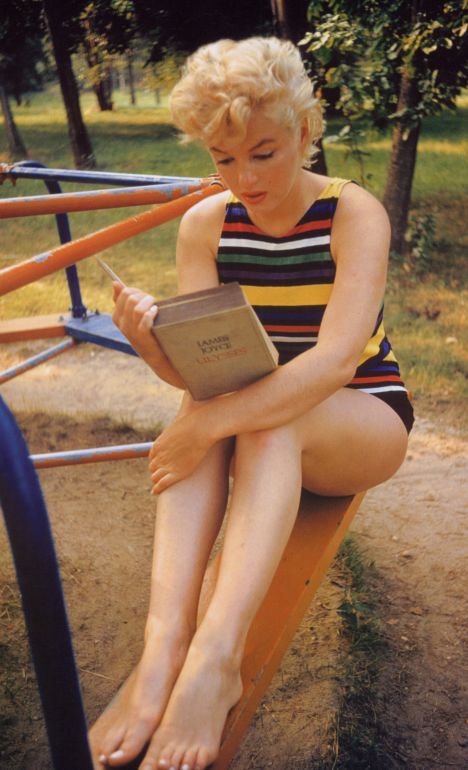
“There’s a beautiful photo of Marilyn reading James Joyce’s Ulysses. She liked Joyce and Dostoevsky and Rilke. Everyone made fun of that. Once, Marilyn was chucked into a loony bin, like Sylvia, like Mary McCarthy, like Carson McCullers, like apparently most women artists and icons. Marilyn and Sylvia and the others were always feeling lonely and unloved and un-rescued, to hear it told in history. They were mooning over sexy older men. Fame or beauty or poetry or brilliance or icon status never seemed to save them. Arthur Schlesinger described Marilyn as exquisite, beguiling, and desperate. Maybe I will someday come across an account of a straight male icon, a writer, a David Mamet or an Arthur Miller, or one of the ones who went nuts, a genius who shot himself or gassed himself, and it will describe him as “desperate.” But I doubt it.”
– Elizabeth Bachner in Bookslut
For Those Who Have Asked
There is only one video of me in the entire universe that I like. It was shot, handheld and without me noticing it, in April 2007 at No Black Tie, Kuala Lumpur. Some people lose count of their lovers — I lose count of the places I’ve read at, but count I did recently, and realised that in the past eight years or so, I have read at an approximate fifty venues. No Black Tie remains the one closest to my heart.
Now, in the years of the drought — I feel like a jaded thing, but once, I read in jazz bars. I could only afford rhinestones, but there were stars in my eyes.
(About the poem – here.)
The Venus Flytrap: Petty Change
I like auto drivers. I really do. I’ve met some very nice ones, and employ the services of the yellow brigade on an almost daily basis. Three years of quarrelling, fleecing and one slightly infamous incident with a live chicken in the backseat have neither made me learn how to drive nor kept me homebound unless chauffeured. (The bus? Another story.) I’ve long accepted that I live in a mafia town – and while I can ignore the sambhar mafia, the maami mafia, the bad restaurant music mafia, the Tambrahm Twitter mafia and various other such coteries, the auto mafia has, if not my loyalty, at least my cooperation.
But not without grumbling.
The trick to negotiating life in a mafia town is to claim the small victories. Particularly the hard-boiled ones. Those warm fuzzy moments when the auto driver bypasses the haggling repartee and accepts your first quote, or doesn’t charge you at all and attains moksha immediately are either (a) rare or (b) fantasies you invent to drown out his bitching. All that is just petty change. Fine if it suits you, but it’s fun to just let him keep it.
And let him have it, too. Some people enjoy the victories that end in a blaze of cussing, working out suppressed aggression, or working it up, so they stay edgy and cutthroat for the rest of their office hours. Some like a spot of intimidation, some rude mudras and grimacing perhaps – nothing like a shot of mock macho to start the day. For some, if it doesn’t end in a movie-style chase, it’s not even worth it.
Because, let’s face it, no one who can afford to take autos at all needs that ten rupees enough for that much drama. He knows it, and so do we. The time-waste tango takes two. All that effort for a matter of principle – wouldn’t it be interesting if we applied the same in situations with more at stake?
Personally, what I claim as a victory is having the last word. I have a standard line for when I’m refused the change I’m rightfully due. It loses its histrionic imperiousness in English, but retains its underlying intent to shame philosophically: “If you lie to and cheat people like this, the money you earn won’t stay in your hands”. And with that I saunter off on the moral high ground. My karmic smugness gets further boosted by giving the same amount I was ripped off to the next beggar I encounter.
In my imagination, the auto driver’s conscience is a prickly one. This isn’t wishful thinking. As I said, its bad apples aside, I like the auto mafia. They work hard, stay loyal to each other, have inspiringly syncretic dashboard pantheons – and no one else north of Pondicherry loves that yellow ochre as much as I and these guys do. In a city as harsh as Chennai, they are my intrepid navigators. Holidaying here once years ago, I looked over my photographs and noted how ubiquitous autorickshaws were, noting in a journal entry how they “enter frame after frame of my pictures like seashells caught in a net for fish”. Love it or loathe it, they are the city’s spine. Its ethos – ours – owes more to them than any small change can adequately convey.
An edited version appeared in The New Indian Express. “The Venus Flytrap” is my column in the Zeitgeist supplement. Previous columns can be found here.
The Venus Flytrap: Human Circuitry
At the same time that I was asleep and dreaming of a long drive along dirt roads looking for a temple, wondering why we could not just stop and worship at one of the many snake-hills we passed along the way, across the world, she was saying a prayer for me at the shrine of Marie Laveau, Voudou high priestess of New Orleans. A year later, someone else travels to Portugal, and does the same for me at the Jerónimos Monastery in Belem. Again, it is unasked for, unexpected, but welcome.
There are those who fill us at every moment that to think of them is only as natural as prayer. For some of my friends and I, what this usually means is to pray. But even those who don’t pray, invoke. Each time I find myself alone with a decanter I think of all those who should share it with me, and raise a toast. I have become a collector of objects that catch the eye only because they are weighted by their associations.
All nostalgics are masochists; we subject ourselves to the tyranny of memory and history and insist on the accompaniment of ghosts. Sometimes it is beautiful, as when across the breadth of the world, one connects and connects and lights up a web of human circuitry, each point of connection a live wire, always active.
As I was writing this column, a friend asked why I equated prayer with pervasive memory, because prayer is expectation. I realised that this is not how I pray, at least not most of the time. I ask, of course, but mostly what I do is receive. Not in the sense of getting what I hoped to, but in the sense of being constantly plugged in, engaged with the world, connecting. I am blessed with an incredibly rich life only because I am willing to receive it. My relationships are rewarding beyond measure. The only distances that matter are the ones we choose to place between ourselves.
I regularly experience synchronicity, and I think that this is because it is almost as though, from our respective locations, my dearest ones and I are tuned in to the same radio frequency. Someone will tell me she’s trying to find an image online to send me of what she wants to get tattooed: that same image will be on the tee shirt I wear at that very moment. I will send a text message and get a call back instantly – “You won’t believe it but it’s freezing and I am wearing a balaclava and six layers, but I suddenly had to speak to you, and just as I stood up to step out and call, there was your text.” But I do believe it. We could have gone months without contact. It doesn’t matter, it never does, because somewhere, on some profound level, we were connected.
And this is why, when I meet someone who refuses a connection, who reduces it to its most functional or profane terms, I am saddened. If we think again of prayer as a point of connection, as I do, then just as in my dream of snake-hills, some of us are looking for a place to pray, when everything around us is already a prayer in itself.
An edited version appeared in The New Indian Express. “The Venus Flytrap” is my column in the Zeitgeist supplement. Previous columns can be found here.
International Women’s Day Speech at Hyundai
I was invited to be the Chief Guest at the International Women’s Day celebrations at the Hyundai plant in Sriperumbudur today, and was asked to deliver a talk to their women employees. The text of the speech is below.
Good afternoon. It’s an honour and a pleasure to be invited to speak to you today.
International Women’s Day is many things – a cause for celebration, a reason to pause and re-evaluate, a remembrance, an inspiration, a time to honour loved and admired ones and in several countries – including China, Armenia, Russia, Azerbaijan, Belarus, Bulgaria, Kazakhstan, Macedonia, Madagascar, Mongolia, Tajikistan, Ukraine, Uzbekistan and Vietnam, but clearly not India! – a public holiday1. So I’d like to extend, first of all, a note of thanks to all of you for taking time out of your work schedules to come here, as well as to Hyundai, for inviting me to speak.
On this day, all over the world, we consider both the steps forward toward better lives for women that have been taken in recent times, as well as the progress still required. Necessarily, we name our enemies: patriarchal structures, perhaps, or more specifically, legislative and political decisions, corporate entities, criminal menaces, culture-based ignorance and economic disenfranchisement. They are all significant things, and I am not suggesting that they are not. But I have felt for a long time now that something else is at the heart of female disempowerment. Something that isn’t as easy to deconstruct or dismantle. Something that is difficult to even name, and at times feels bewilderingly counter-intuitive.
What, to me, is at the heart of female disempowerment is the profoundly painful fact of how women can be each others’ worst enemies.
One of the most famous things that former American Secretary of State Madeleine Albright has gone on record to say is “I think there is a special place in hell for women who don’t help other women.”2 A special place in hell – can you imagine what torment that would be, and how deeply wounded a person has to feel to condemn someone that way? When you think of what she said, that such a special place is reserved for women who don’t help other women – what associations come to mind? I don’t know about you, but my heart burns to remember the countless times I have been betrayed and even sabotaged by women I loved or looked up to – teachers, relatives, peers, friends and colleagues. Haven’t men done the same? Of course they have – but somehow, it stings worse coming from another woman, because of how deeply counter-intuitive it feels. This is the sort of heartburn that makes me think, yes, Albright was right – there is a place in hell for women who don’t help – who hurt – other women. There has to be. Even if there is no Hell – how could there not be such a place? How could such treachery be left without retribution?
There are big ways and little ways to this treachery. The little ways I hardly need to enumerate, because the best examples of these are empirical ones, and you know them in your own life. The big ways tend to be a matter of collusion: for instance, it may have been men who created archaic and repressive social codes, but is it not women who pass them on, who ensure that their families function within and continue to carry forward the same logic? To choose to not break a chain is to choose to propagate it.
We can begin by taking a look at the very fact of us all being in this room today. How did we get here? Each of us have overcome difficulties in our own lives, each of us has dared to dream, and fortunately, has been born in a time where we were able to pursue some if not all of these dreams. We have had access to resources and options which were denied to women of just a few generations ago – resources and options which are even denied to other women today, in this country and elsewhere. Some of us have endured bad luck, made bad decisions, or failed at things we tried our hands at – but we haven’t been ruined by these misfortunes. We have alternatives. We have second, third and ninety-third chances. We have more autonomy than our foremothers may have been able to imagine.
In short, we are all so lucky. And this is only because of the brave women and men who fought for certain rights and equality, who went against the tide of what was acceptable, who challenged the status quo, who refused to take as an answer that “that’s just how things are”. We are here because they did not think of themselves alone. They did not relegate their abilities to simply securing a better life for themselves, but put the vision of a better world above their own personal journeys, and in doing so secured a better life for millions.
I am asking you today if we too can demand a better explanation than “that’s just how things are”. I believe that as women, we are conditioned on a deeply embedded level to be wary of or threatened by, and consequently cruel toward, one another. Perhaps there are biological or evolutionary reasons for this. But I refuse to accept that we cannot evolve female rivalry out of our systems. Larger systems of power, yes, but more importantly, smaller microcosms of the same.
In our own lives, can we get over our mistrust of other women? Can we leave cliques and factions behind in our school years and embrace a greater loyalty? Can we see that another woman’s success need not necessarily mean our own failure? Can we cease to be judgmental or jealous? Can we cease to be threatened by other women, for reasons of our own insecurities, and can we stop acting out of that sense of fear?
Just as our palette of big life choices continues to expand the more society develops, I would like to think that in our day to day interactions, we should also become more mindful of how we choose to treat one another. Can we make choices that deprogramme the way we have learnt to feel about other women – learnt from all the ways we ourselves have been hurt – and choose to say, “This stops with me. What has been done to me by girls I went to school with, women in my extended family, superiors I worked under or any other situation, incident or environment that fostered in me a sense of female rivalry or mistrust will no longer control the way in which I respond to individuals now.” Will we choose to undermine other women, in ways big and small, or will we choose to embrace a less cynical view? Can we work together to create new environments in which all of us can feel free to meet our highest potential without being hindered by unhealthy competition?
You may be wondering why I have taken a less festive approach to International Women’s Day and am asking these potentially uncomfortable questions. I promise you I didn’t start out this cynical. In fact, I started out quite the opposite – if I could have had feminist slogans on my diapers, I would have! Throughout my teenage years I volunteered with women’s NGOs, and continue to do so in some capacity today. I was one of those girls who would rather have a tee-shirt that said “the revolution is my boyfriend” than have an actual human one. I think I limited my own literary forays for some years by refusing to read anything by authors I derogatorily labeled “dead white men”. I was proudly, radically, obviously and – I must admit, perhaps a little obnoxiously – feminist. And then the disillusionment set in.
At some point in my life as a young activist, I began to see that polemics and politics only go so far. How far does philosophy translate accurately into one’s practical realities? One’s fundamental humanity and compassion are all that really matter – it is of no consequence if this can be backed up by proselytizing or theory. You know how this works. I am almost certain that there is no one here today who would not name her grandmother, mother, aunt or sister as her personal inspiration – a woman who did not necessarily know of or say that she subscribed to theoretical ideals but nonetheless manifested the best of them in her life and across the lives of all she touched.
Today my feminism is nuanced by the understanding that as with all great adversaries, the most significant challenge to female empowerment comes from within. From within our ranks, from within our own hearts, from within our own inability to look beyond a reactionary and defensive stance.
But there is something else that also comes from within. And that is strength. Women have always regarded as being strong, and we are, but in modern times we are also powerful. I think of power as originating from an external source, from the validation of being in a certain position of influence. But strength has a far more esoteric source. It manipulates less, and moves more. There is a difference between strength and power – which do you operate from?
And I ask these uncomfortable questions not because I am above reproach but because I also deal with them in my day to day life and work. Sometimes, I frown on the actions of teenage girls because they do not seem as empowered as I was at their age. Or I might secretly judge someone of my generation for having had an arranged marriage, letting her in-laws dictate her career choices, or not realizing how beautiful she is because TV commercials tell her otherwise. But who am I, really, to judge? How would I know what those girls or women have been through and what has shaped their decisions? Why can’t I just respect that they are different, but no less equal? Concurrently, I struggle to undo and unlearn traumas imprinted on me because I am a certain kind of woman, born into a certain kind of culture, in a certain era. I struggle to not be manipulated into being pitted against other women in social and professional situations by those who know just how to push those buttons. I struggle to deal graciously with female associates who have backstabbed, cheated and even plagiarized me without having to descend to petty conflict that would only satisfy those who believe that women cannot evolve out of our habituated enmity. Because I believe we can.
As we celebrate International Women’s Day this year (and celebrate it we should!) let us also bear in mind that the struggle is far from over. Women’s empowerment should never be reduced to individual success stories. It should be about collective well-being. As long as women continue to operate from that deeply embedded place of suspicion and resentment, we will never be free. No matter what material, social or intellectual heights we scale, we will never be free unless we learn a new paradigm with which to see other women. With which to see ourselves.
There are two ways to light a second lamp: you can do so by snuffing out the first as you ignite the second, or you can allow the flame of one wick to touch another, and inspire its own flame. You are a luminous being. Be secure in this knowledge. Let your light illuminate as many lives as possible. It will not diminish your own.
I would like to end this talk with a quote from an anonymous source that I came across on the internet. I find it comforting – and I hope that you too will be inspired by it. “Blessed are the women, who have grown beyond their greed, and put an end to their hatred. They delight in the beauty of the way things are, and keep their hearts open, day and night. They are like beautiful trees planted on the banks of flowing rivers, which bear fruit when they are ready. Their leaves will not fall or wither, and everything they do will succeed.”3
Thank you.
(1) http://www.internationalwomensday.com/about.asp and http://forum.libr.dp.ua/viewtopic.php?f=17&t=175
The Venus Flytrap: My Bloody Valentine
There’s a story I like to tell about an incident that hasn’t happened yet, and to be realistic, might never actually occur. This may be my favourite, and most frequently contemplated, revenge fantasy, but it is also by far the most restrained one I could potentially imagine for this scenario. It puts me in an exuberant mood to describe its minutiae – who said what, who wore what, architectural detail, supporting characters, soundtrack and scenery. I love to see how my friends react as we reach the story’s singular defining triumph: the clip clop clip clop of my high heels as I walk away from the table into the afternoon light of a city straight out of a TV show.
My weapons are only words, and they are designed to leave incisions, but not casualties. I intend only to draw the curtains, not to draw blood. The most that is spilled are tears (not mine), and perhaps, for cinematic affectation, the contents of a fine-stemmed glass across a crisp tablecloth. The air ricochets, in that final frame, with the sound of stilettos, not bullets, and those stilettos themselves are deployed for no purposes sharper than style.
I am less tranquil, however, in art – both the art I consume and the art I create. “Not you too, Black Mamba!” I admonished the screen in the disappointing latter half of the Kill Bill diptych, as our Lady of Atonement herself mellowed out like the rest of us lily-livered mortals. Where was the gore and hunger of the first film? Give me blood and guts – literal and figurative – and righteous rage. And glory, in many spades. Do it with flair – do it like the merry murderesses in Chicago, cell-block-tangoing their way to fully, fabulously, deserved incarceration. The best vengeance is vicarious.
Violence enjoyed or expressed through art, indulged in imagination, or released in aggressive sport, is not senseless. If anything, it is sensible – even sensual. It’s a primal scream in a soundproof room. It’s also an indicator of one’s sanity or lack thereof. The sociopath is consumed by it – the sound-minded, as I said earlier, simply consume it. There is a delicious mercenary quality to brief immersion – by participating in a proxy ritual, be it armchair massacre or arm-wrestling, there is relief and satiation for that bloodthirst without anyone else having to suffer for it. Surrogate slaughter, if you will. It is singular obsession that is dangerous.
Perhaps this is why, for someone with such a taste for brutality, my own pet revenge fantasy is so decidedly sterile. No adrenaline, no deeply visceral satisfaction – but also no horrific aftermath, no guilt, no demons – at least, not new ones. What I want is closure. What I want is conversation. Neither are within my grasp for now, so I’ll take what I can get: staving off my madness, the madness we are all capable of, with another movie marathon, the violence of a Pollock, the brute force of the Bösendorfer in the Boys For Pele album, the drum dance, the deep laugh, the riot of my own angry paintbrushes, the pleasure in the way my own voice delivers a certain sequence of words into a microphone, the power to eviscerate a poem of its pretty so all that’s left is elemental, vital, staccato. Clip clop clip clop.
An edited version appeared in The New Indian Express. “The Venus Flytrap” is my column in the Zeitgeist supplement. Previous columns can be found here.
The Festival of Sacred Music, Thiruvayaru
It was my pleasure and privilege to travel with the Prakriti Foundation last year to their Festival of Sacred Music, and I am delighted to have been able to do the same again just this past weekend. This was published in today’s The New Indian Express.
The experience of travelling with the Prakriti Foundation to the Festival of Sacred Music at Thiruvayaru, now in its second year, is a multi-faceted one. The nights are electric with open air concerts in marvellous “found” locations in this muse-kissed small town; the days are filled with sightseeing to nearby monuments, discussions on aesthetic sensibility, genuine camaraderie and long scenic drives that cut through rural heartlands and Tamil sacred geography – the Cauvery river, the fields, the shrines in every grove.
This year’s Festival featured three incandescent concerts, beginning with Vidya Rao’s Hindustani thumri recital at the Husoor Palace. The soft-spoken Srimathi Rao shared an elegant series of thumris that spanned the gamut from Meera bhajans to Sufi poetry, taking pains to explain the lyrics to the audience. As with all the locations, the lighting and stage design was inspired, with diyas settled in the nooks of pigeon nesting towers.
The following night, contemporary-looking palm leaf floral arrangements hung upside down in the tent under which a jugalbandi showcasing the talents of Pandit Krishna Ram Choudary on shehnai and Pinnai Managar Shri. Dhakshinamurthi and K.M Uthirapathi on nadaswaram resounded at the Pushya Mahal Ghat. The competitive-collaborative dynamics of the jugalbandi format reached a crescendo with the solo performances by drummers on both sides, who stole the show with their prowess.
The Festival concluded on an incandescent note, with Aruna Sairam’s powerful voice rising under a glorious full moon at the Panchanatheeswara Temple. Srimathi Sairam selected her repertoire astutely, sharing both complex, rarely performed padams as well as livelier pieces chosen particularly for the many Carnatic music students in the audience. A certain darkness in her delivery greatly enhanced the phenomenal nature of this performance.
As with all Prakriti Foundation projects, the Festival of Sacred Music is founded on visionary principles: it is not kutcheris alone that are the objective, but also heritage preservation and rural tourism. To this end, Prakriti Foundation works in close collaboration with Dr Rama Kausalya’s Maribu Foundation and Indian National Trust for Art and Cultural Heritage (INTACH), taking as a fulcrum the revival of and renewed respect for both the sites and the ethos that made this part of Tamil Nadu so culturally affluent. It is a labour of love that has already been many years in the making and will require much effort yet – but some of its rewards are immediately evident. The concerts themselves, of course, but also the sense of magic that hangs in the air for the duration of the Festival. For the second year running, I looked up at the stars after dinner as friends of the Prakriti Foundation shared poetry and songs at the intimate Husoor Palace, and whispered a thank you to the muses that continue to kiss this ancient land.
The Venus Flytrap: Certain Completed Geometries
When I realised that my wallet had been stolen at a train station on my way back from a weekend in another city, my first thought was about my debit card, which a phone call quickly took care of. My second thought was about the currency it had held, which was also abated by the realization that I had – serendipitously – been unable to withdraw more than a small amount at the ATM the previous night, and what more, for reasons completely out of character, had stashed enough change in my pocket for a couple of teas and a plate of hot bhaji for the six hours ahead. My third thought, and the one that made my heart momentarily plunge the most, was about the talismans that wallet had held.
There had been two – both gifts. A Buddhist one for grief, given to me the night before the first anniversary of my grandmother’s death. And another one, which had been personally blessed by a deceased mystic, and which had come to me through a surreal collusion of dreams, magic space and psychic reciprocity. The second was profoundly sentimental; the first less so – but both were meaningful. What startled me was not that they were gone – but that they had gone at the same time.
I hadn’t always been this sort of person – the sort who wears, who keeps, who trusts. But ever since I became this sort of person, I’ve seen that the nature of talismans is to offer temporary protection. The nature of talismans, in essence, is to get lost. We ourselves grow too attached to them to let them go, let alone recognise that their work has been done. They must be wrenched from us in acts of fate, in seeming carelessness, and we must accept their disappearances as markers of certain completed geometries.
The carnelian stone I carried in my jeans pocket from one crucial meeting until I lost it somewhere in a flurry of hotel rooms, while the career catalysts it had accompanied culminated in certain profound and quantifiable rewards. The dead butterfly that simply vanished from my wardrobe upon my return from a shattering retreat. Time and again I have found them, recognized them as talismanic, and learned – after the initial sense of disappointment and shock – to acknowledge their departures as necessary closures.
What does this mean then, to lose these two amulets at once? One was for forgetting, the other for remembering. The first was to help with the surrender that bereavement demands, the other was the lamp left lit so I could find my way back to a place that in moments – in this day to day reality – seems sometimes to have been almost illusory.
I would like to think that perhaps I have finally learnt how to see in all sorts of darkness – that the heart has memorised the map, and neither torches nor known yet treacherous paths are necessary to return to or to honour that which has been lost.
What have I forgotten, and what have I remembered? With both of these talismans gone, I wonder now not just what has come to its denouement, but what I will find next. What will it see me through? And when it goes, what will I have learnt to see by then?
An edited version appeared in The New Indian Express. “The Venus Flytrap” is my column in the Zeitgeist supplement. Previous columns can be found here.
News and Poems
First, the poems.
“August, The Year After” is in issue 1.3 of White Whale Review, an online literary journal.
“Possession” is in Volume 7 of A Cafe in Space, a print journal on and inspired by Anais Nin, out February 21. Although I hadn’t written this piece with Nin in mind, she has been a big influence, and I was honoured that the editor solicited my work.
“Chennai” appeared in The Lit’s Muse quarterly, also a print journal, in November.
“Cassandra’s Ghazal” will appear is in the third issue of Clementine, a web journal of persona poetry and photography some time this month. I’ll update this link when it does. (updated)
The Poetry With Prakriti Festival has also just published its first anthology, a collection featuring work by poets who read in its 2007 and 2008 editions. I have three poems, “This Hummingbird Heart”, “How To Eat A Wolf” and “Frida to Sharanya” (all of which were in Witchcraft) in this book, which will be launched later this month.
And the news: I was shortlisted for a Toto Award in Creative Writing this year. I didn’t win, but I did have a nice weekend in Bangalore, attending the awards ceremony, hanging out and shopping, and just enjoying the little break. I also received a nice Special Jury Commendation, which reads as follows: “[her poems are] sensitive and insightful, with strong images and metaphors… moments of intense beauty… a lot of promise, a lot of passion”. The winners were playwrights Abhishek Majumdar and Ram Ganesh Kamatham; the other two shortlisted nominees (from 158 applicants) were Joppan George and Hemant Mohapatra. The Totos are given annually to Indian artists under 30 who show potential in creative writing, photography or music, in the memory of the late Toto Vellani.
On the flip side of the coin, I judged IIT Saarang’s poetry competition this year. I tell you, this side of the coin is far less stressful. Hehe. Can’t remember if I mentioned being a featured poet at the first Poetry With Prakriti Slam in December, but ditto – I wouldn’t have wanted to compete. I always balk at the thought.
I’ve becoming increasingly lazy about my blog, which explains why I’ve just collated all these new links and happenings into a single post instead of letting you know what’s new as I go along. The fanpage on Facebook gets updated more quickly, and most of what’s above has already been posted there. And then there is Twitter. I’ve been meaning to redesign the blog – perhaps that might motivate me about it again.
Finally, I’m always open to doing small readings, if I’m in your city, and interviews for your personal blogs. If you’d like to discuss either, please drop me a mail at sharanya(dot)manivannan(at)gmail.com(dot)com. I’m a little curmudgeonly, and if you just leave a comment or (god forbid) tweet at or Facebook me, I will probably ignore it.
The Venus Flytrap: Her Perfect Equal
At the beginning of her long affair with Harold Pinter, Antonia Fraser was warned by her brother, “You are a woman and a strong character yet you want your husband to be stronger. Women with strong characters who want to dominate are always fine because there are plenty of weak men around. Also plenty of strong men for weak women. But yours is a special problem.”
It is because of this special problem – this particular affliction of being an alpha female looking for neither her master nor her mutt but her perfect equal – that I reacted with a dismay not usually reserved for celebrity gossip at last week’s more plausible than usual reports that Brad Pitt and Angelina Jolie are separating. The end of this power pairing isn’t yet another Hollywood meltdown; to me, it will be the combustion of the only modern relationship paradigm that I find truly desirable.
In recent years, I’ve found myself drawn to Jolie, an unlikely role model – too famous, too contemporary to truly analyze, and hounded by public obsession and private demons both. I find something very inspiring in the way in which, as a woman of a highly dysfunctional nature, she has turned her life around without ever losing the essence of her idiosyncrasy. In creating her family, she has revitalized the idea of the matriarch, updating the archetype without losing its noble connotations. Her advocacy has helped people around the world, and her artistic body of work shimmers with a certain aptitude. But it is her partnership with Pitt that ties this all together – it is an alliance that subverts the notion that intense, eccentric women cannot be partnered, at least not in any significant non-disastrous fashion. Like Jolie herself, it originated in scandal and evolved into something admirable, intriguing and undeniably powerful.
There is a danger in suggesting this, because it is an admission that mating is important – a very conservative idea for some. But more draconian still is the denial of passion, devotion and basic need – these are human impulses, not just female ones. I am interested in the idea of romantic partnership as collaboration, and have long puzzled over why there are so few examples of successful pairings that involve an unusual, forceful woman.
I read somewhere once, “Who could Madonna possibly date? She’s Madonna. Jesus, maybe.” The punchline, years later, is that she did date a man named Jesus, but the underlying contention remains: a theoretically post-feminist society has come to accept many things, but the virago with a domiciliary instinct is not one of them. This is neither a fault of the movement nor of the establishments it challenges. The notion boggles our minds simply because there is no existing marital script, at least in the archives of the collective psyche, to offer a successful example of such a couple.
Brangelina is the closest we have ever come to it. I want them to stay together not because of any vicarious tabloid satisfaction, but because they represent to me a sort of hope, a trajectory upon which to chart my own path. Can a woman be mother, martyr, magnate, mad – and still have her mate? Like Jolie, I intend to have my cake and eat you too – and hers is the only recipe I know so far.
An edited version appeared in The New Indian Express. “The Venus Flytrap” is my column in the Zeitgeist supplement. Previous columns can be found here.
The Venus Flytrap: Dropping Names
Recently, a friend dropped me a note under a different name from the one I’d known him by for eleven years. I raised one culture-mulcher highbrow eyebrow at his new moniker and immediately called him out on it. As expected, the change had been a result of his moving to Australia, where – he said – his new buddies had rechristened him. I snorted privately and exhorted publicly: “Be proud of your polysyllabic name! Besides, Bobby doesn’t rhyme with Banana (while your real name does)”. Rhyme is important to me – in case I ever have to write a sonnet for an epitaph, I don’t want my options to be limited to hobby, lobby and (ahem) snobby. Banana, cabana and Hannah Montana lend themselves much better to eulogizing.
He had changed his name on all his social networking profiles, chat and email programmes. I found this annoying and somewhat regressive, but he insisted that letting one’s friends call you by nicknames is sweet. “Sure,” I acceded. “But you don’t see me changing my name to Ammamma Kitty”.
At this juncture I will confess to the following: I have a different legal name for reasons you can exaggerate in your imagination, once published an article under a pseudonym inspired by an alter-ego inspired by a plush toy, and yes, one of my friends calls me Ammamma. Many others do call me variations of Kitty (though not, you monkeys, the obvious synonym). Still, to my mind, none of these things are rooted in embarrassment, which is how I saw the friend-henceforth-known-as-Bobby’s choice. There is a long history of Asian people assimilating by taking on Western names – how many Tripurasundaris have become Tinas, and how many Mei Lings, Marilyns? Rueful, I considered how Bobby rhymed with Robby, a diminutive – in every sense – of Rabindranath.
No, the whole thing made me want to commit many cliché reactionary acts, like politicizing my sloth as a bed-in, wearing homespun khadi, piercing my other nostril and rereading Spivak (she of the ex-husband’s name). I was too lazy for all of this, though, and had evening plans that interfered with the bed-in, so I settled for clicking the “like” button on someone else’s snarky post to “Bobby P.” asking when he was going to cut a record and start a fragrance line. The view from my high horse was pretty great.
Of course, I was duly chastised. Later that day, I went out with an expat friend. We were the last to arrive, and a group of people I hadn’t met before were already there. “Hey everybody,” said my friend cheerily, and extended a hand in my direction. “This is Ranya”.
Then she turned to me and said, just as cheerily, “I’m so glad you texted earlier, because I spent ages online trying to remember how to pronounce your full name, but on my phone I have the ‘version for dummies’ saved!”. This was true. Ranya was the nickname I hadn’t needed to bring back to India, cases of extreme closeness or extreme mangling notwithstanding. Someone had given it to me back in school, when P. Diddy was still Puff (and still cool), Bobby still had a name that rhymed with Banana, and I – well, I was Ranya.
I did, however, at least already have one nostril pierced by then.
An edited version appeared in The New Indian Express. “The Venus Flytrap” is my column in the Zeitgeist supplement. Previous columns can be found here.
 Sharanya Manivannan