My essay, “The Aftermath, The Afterlife”, is in Killing The Buddha. You can read it here.
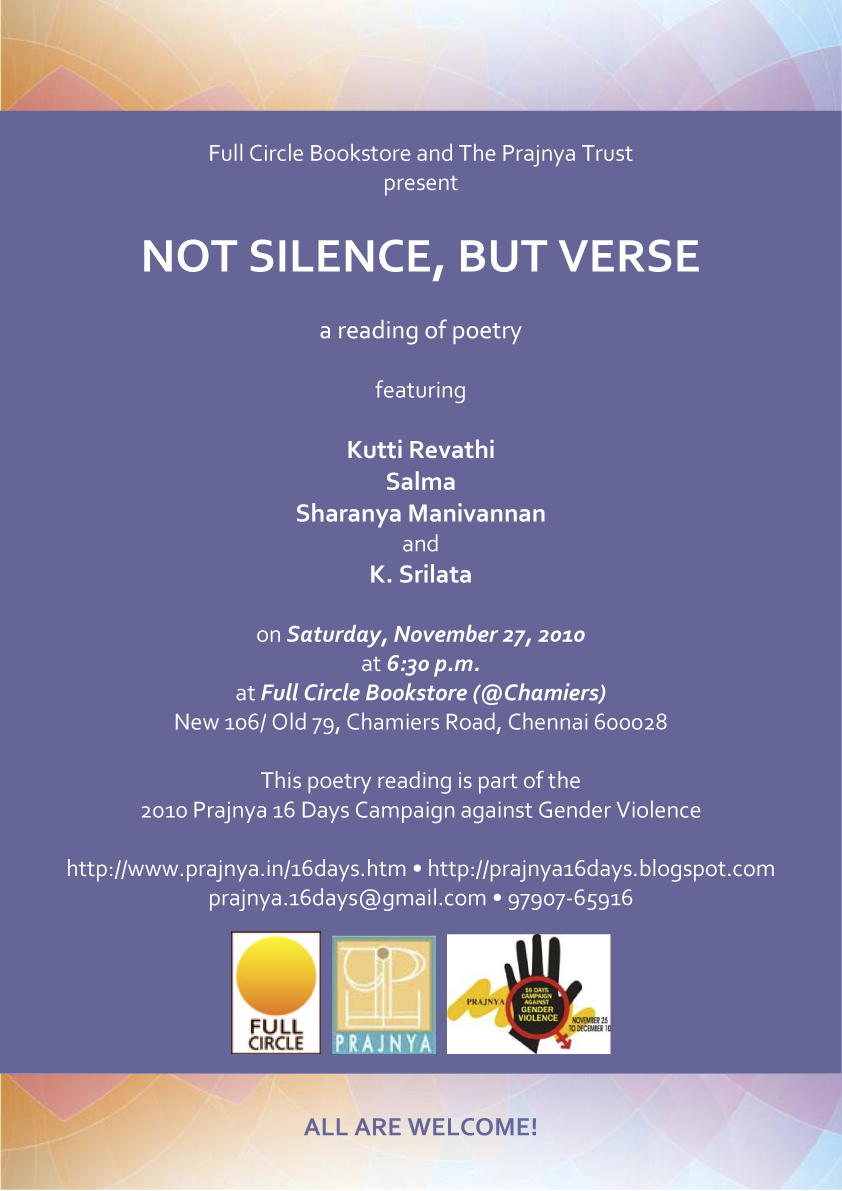
“Not Silence, But Verse” – Poetry Reading, Prajnya’s 16 Days Campaign
The Venus Flytrap: A Postcard, For You
When was the last time that the most urgent of my hopes was only that there will be bitter gourd for lunch? Because I am eating alone today, the meal is slow to come, and so I sit on the porch and look at the pepper-vined trees and ponder this until it does. There was no rain in the morning, and so the shrine visit – my most urgent hope otherwise – has been completed. It will be days before I have to think of anything else. It has been years since I have thought of nothing at all.
The food is ready. I’m disappointed – no batter-fried bitter gourd, my favourite, but there are long beans, to which I am allergic. Still, when I’m serving myself in the thatch-roofed hall, a downpour begins, and so I eat as slowly as I can, watching the earth become muddy, knowing that the sunken courtyard in the red house will fill a few inches, but dissipate by the time I return. I am here to fill my own well – but more than that, just to cleanse it, wash away all that was accumulated from everywhere but here.
So this is where I come to escape. At night, owls cry and a mad rooster from the poultry farm next door raises a ruckus. During the day, sunlight laces through leaves susurrous in the wind, and because the eight dogs know me well, I walk without fear. I find starfruit and mangosteen on the ground: echoes of my South East Asian childhood in the soil of South India. Corn grows nearby: a new experiment. There is a pool, another new thing, in which my friend threatens to skinnydip. I have a view from my window.
The memory of this place takes me a long way. I contain it the way some creatures contain water, subsisting on their interior resources long after their landscape has betrayed them.
Nearly everything I have written in the two years since I first began coming here has been a postcard – meant for one person, but sealed from no one’s eyes. But, dear reader, this is my week without letters. It is only for you that I reconnect to civilization at all. I intend to write nothing else, although tonight, in the town, I will read my poems to a few people. When I read them to my friend on the roof of this house a few evenings ago, I had looked up to see a faint rainbow in the west. I who have been led so wary by omens accepted it without suspicion.
And because it is you who is my intended now, I have wondered for days what to say to you. What can I tell you of the beauty of these present things, for which no description suffices? Snippets of conversation, an understated happiness that cannot really be imparted, of what use is all of this to you? Here, where I do not have to be who I am supposed to be, because I can be who I am, think of me today not as a witness but a well-wisher: wishing for you the same, a place so generous with its grace you can carry it back to wherever it is you must be, a deep source, a sweet scar.
An edited version appeared in The New Indian Express. “The Venus Flytrap” is my column in the Zeitgeist supplement. Previous columns can be found here.
A Poem in deuce coupe
A poem, “The Painted Boats“, in deuce coupe.
In other exciting news, two of my poems were shortlisted by Chad Sweeney for Asia Writes for Best of the Web 2010, and one was nominated. Read what Sweeney had to say here.
I know I have been silent; I surface slowly because I wouldn’t have it any other way.
Book Review: A Foreigner Carrying in the Crook of His Arm a Tiny Bomb by Amitava Kumar
The trouble with writing about war is that it’s almost impossible to do so without having to name an enemy, and some would argue, almost disingenuous not to. If taking the side of the terrorist, that vague yet absolutely damning term that has taken firm root in the world’s contemporary lexicon, is crude; then to take the side of any of the governments locking horns against this named but nebulous danger is equally reckless. In this lucid and well-researched enquiry into the American vendetta that in the decade since 9/11 has become a “global war on terror”, Amitava Kumar finds one way to approach this: from his position as an individual, he addresses the Other in the same way.
Two individuals in particular are at the centre of A Foreigner Carrying in the Crook of His Arm a Tiny Bomb. Both are men serving long-term prison sentences for the abetment of terrorist advances: Hemant Lakhani, a businessman and habitual braggart whose grandiose lies seal his fate, and Shahawar Matin Siraj, a dim-witted but almost sweetly devout young man. Both were coerced into planning terrorist attacks by paid informants. Neither, Kumar argues, would have gotten involved at all were it not for this coercion, not by radical factions but by the United States government itself. Not unlike the way in which funds that could have been used in the research and eradication of common diseases were diverted to tackle the spectral issue of biological warfare, the ordinary – if gullible – civilian becomes a target while the true progenitors of evil remain at large.
But sting operations are only the more dramatic manifestations of this: less dramatic, but pervasive, is the Islamophobia and general mistrust that had resulted in hundreds of people being taken into custody for transgressions no more serious than minor credit card fraud or having the wrong kind of name. One of the most terrifying examples enumerated in this book is that of Mohamed Yousry, a graduate student who had served as a translator in a court case, an act which later resulted in him being indicted on grounds of providing “material support to terrorists”. Neither his demonstrable lack of “suspicious” allegiance (a non-practicing Muslim with no ties to Islamic organisations, married to a Christian, raising his daughter in her mother’s faith) nor his outright condemnation of the accused he was translating for were enough to keep him from being scapegoated.
The most sinister layer to all of this is torture, as performed at Guantanamo Bay and Abu Ghraib. Here, again, the question of coercion arises: if not granted immunity (for operating under Presidential command) if not for having fallen in love with the wrong person (as Lynndie England, who emerged in shocking photographs holding a leash around a prisoner’s neck pleaded, citing her relationship with “the ringleader” of detainee abuse) – would those members of the military have committed those acts? One of the fundamental precepts this book posits is to consider power play and human psychology, difficult though it is to remain dispassionate.
The book’s most thought-provoking angle, however, deals not with the hapless but with those who make informed and conscious statements about the nature of anti-terrorism in the modern world: artists. Whether playing with shock or dealing with sentiment, the examples Kumar details are neither intellectual nor elitist responses, but a means of direct engagement. Conceptual artist Hasan Elahi’s daily web uploads detailing every aspect of his life becomes “a collaboration [with] the FBI” – by submitting himself willfully to the scrutiny of a surveillance state, he overwhelms it. Video art, installation and literature that deal with the reality of today’s world without necessarily fictionalising it are also explored: creativity as a feasible means of the reclamation of power, protest art in the age of advanced technology.
A Foreigner Carrying In The Crook of His Arm a Tiny Bomb is a valuable book, a nearly academic (and therefore highly meticulous) inquiry into anti-terrorism. In the past ten years, we have seen war through the eyes of artists and through the eyes of journalists, but Kumar’s middle ground brings something different to the discourse, and allows him to analyse both these responses as well.
Although Kumar also explores anti-terrorism in India, the book fares strongest when the focus in on America, and America’s effect on the world. His overarching argument is that the war in Iraq is “an elaborate and expensive distraction that hides from us the real crime” (of the war on terror). But while he presents this argument very successfully, the end of terrorism itself remains an open-ended question. This lack of didacticism, notable because it is quite rare in the work of political writers, is welcome. The question at the core of this text seems to be: if finger-pointing engenders and stokes conflict, where might we find ourselves if we stopped looking for easy answers?
An edited version appeared in this week’s The Sunday Guardian, New Delhi.
Book Review: Rock and Roll Jihad by Salman Ahmad
Salman Ahmad was born into a fairly charmed life: the son of a manager at Pakistan International Airlines, he travelled all over the world as a child, and migrated with his family to Tappan, New York, at the age of 12, where he discovered the world of concerts, liberal values, cross-cultural camaraderie and his own passion for music-making. So when he was sent back to Lahore in 1982 to pursue medical studies, the shock of dislocation was compounded by the shock of censorship and conservatism in an increasingly insular society. When the young Ahmad’s precious guitar is broken by a member of the self-proclaimed moral police, his destiny is sealed. He too becomes radicalized, but instead of retreating into bigotry and hatred, he accepts as his personal jihad the spreading of love and understanding, through the power of music.
Today, Salman Ahmad is known as Pakistan’s first real rock star, a musician who brought a message of hope to a politically complex part of the world with the bands Vital Signs and Junoon, and an ambassador for cultural relations whose work has dealt with repairing the divides between Islam and the West, and Pakistan and India. Rock and Roll Jihad, his memoir of his personal journey so far, is an inspiring account by a compassionate messenger of peace.
The book starts out a little awkwardly, peppered with too many parenthetical explanations – take this single line for an example, “Salman mian [young man], you want to become a mirasi [low-class musician]? Your parents have high expectations of you and you want to waste the rest of your life playing this tuntunna [gizmo]?” But as the greater ambition of this memoir – to be a reconciliatory and celebratory bridge between divides – becomes clear, this is forgiven for how helpful it might be for a young, international audience. Told in an easygoing style, brushes with glamour – like taking Mick Jagger to see dancing girls – and brushes with politics – like being banned by the government, and losing band members to ego clashes and religious fanaticism – sit comfortably with an abidingly deep spirituality.
Rock and Roll Jihad is recommended regardless of whether one is a fan of Salman Ahmad’s music – although the accompanying 12-track CD offers a bonus to anyone who is. Best suited for teenage readers, who might see in Ahmad a wonderful example of how rebellion and anger can be galvanized to heal, this simply-worded, tactfully passionate memoir is a stirring read.
Ahmad’s jihad is a beautiful one – inspired by the poets of the past and the peacemakers of the present, he sees himself and his work as a necessary voice in the greater struggle against forces of ignorance, prejudice and restriction. This book, peacefully narrated and with no hint of the ugly anger that colours the work of many activists, succeeds in spreading a message both in support of greater global harmony, and in encouraging the young to take heart as they pursue their dreams. Like all truly enlightened people, Ahmad leads by example.
An edited version appeared last week in EDEX, The New Indian Express.
Pondy Reading
I’m sorry for this being on such short notice, but I will be reading (possibly with percussion interludes) at Touchwood Studios/Bindaas Cafe, Needarajaprayar Street, Pondicherry, today at 6.30pm.
The Venus Flytrap: The Flower Power Party Guide
Everybody knows that spouses come to resemble each other, and if you’ve ever been bored on the Internet you’ve probably also seen that animals and the people who keep them share some similarities (or perhaps just a hairdresser). One expert usefully asserted that you could spot a hound owner from a mile away because they “look very doggy”.
But for company that neither vocalizes nor poops, you can’t go wrong with plants – and I have a feeling there’s a kind of foliage just for you. Recently, nodding obsequiously through a particularly boring conversation, I spaced out and thought of how the whiskers this woman was sprouting, elegant and sporadic as they were, were not unlike the bristles of a black bat flower.
Rewarded with a great solo party trick after years of deep poetic thoughts about trees and flowers, I suddenly enjoyed looking around the room. There were the clusters of weeds, the sycophants, all different variants: pretty and harmless dandelions, downright irksome poison ivy, and the honestly rather useful St. John’s wort and cannabis. The last one might have been more than a metaphorical sighting. Not that I could tell.
And that one over there – she surely grows bonsai; her soul itself seems corseted in a trellis. A little sad, a little less interesting than the bougainvillea and the pepper vines snaking their papery petals and heart-shaped leaves along the lengths of supportive spines. Not quite sycophants, those, just Sitas.
Hello, night-blooming cereus – why are you never as fun during the day? And over there’s a teetotaler, but you can’t be condescending to a Rose of Jericho, not when his sense of humour is even drier than his drought.
The cacti are actually a lot of fun: they’re a little prickly at first, but they really know how to hold their liquids. Anyone who vomits qualifies as a corpse flower, but only if they’re within smelling distance (otherwise, they may just be a different sort of plant entirely: the factory kind). Speaking of which – it’s also much easier to ignore the inebriated idiot taking off his shirt if you think of him as a deciduous tree.
Thankfully, though, there are other kinds: the banyan around whom the party inevitably congregates, the resilient olives (sometimes symbolically holding martinis) and maybe an ancient bristlecone pine or sequoia, still living it up and sharing everything they’ve seen along the way.
Including perhaps – through we’ll try not to stare – the cute little hothouse flower accidentally flashing her Georgia O’Keefe. A blush of shy mimosa pudicae, meanwhile, curl up and hide for shame.
I don’t know about you, but I always start the evening off as a narcissus. Vanity trumps misanthropy every time. Before the bloom wears off the rose, though, I’m preening with the lot of them. Sometimes I even get mistaken for celebrity flora, the kind mentioned in holy texts for example: sagacious bodhi trees and Lebanon cedars. I’m able to hang around only so long as they don’t realize that my own superstar qualities are fictional, and then I’m booted out along with the Faraway Tree and the Two Trees of Valinor.
And then there I’ll be, sulking and swilling something in the corner (and you know what my ultimate totem plant would have to be): trap-shut, thorny, digesting my findings.
An edited version appeared in The New Indian Express. “The Venus Flytrap” is my column in the Zeitgeist supplement. Previous columns can be found here.
Dead Centre
The 50 poems since Witchcraft was published two years ago are perfectly halved into two different manuscripts. Which means I am either halfway through or almost finished with them, depending on whether you take the view that it’s 30 poems or 50 that make a volume.
Maybe I could tell you more about them.
Bulletproof Offering
The part about this manuscript that is easy to talk about is its mythic element. Set in what is essentially the Jungian forest, the poems deal exclusively with this suffering, an anguish so deep that one can hardly keep from burning down the forest herself. The sufferers here are Sita and Lucifer. Sita spends most of her life in exile, in the wilderness — and at one point she is exiled in paradise, the most beautiful garden on earth. Lucifer, in the Persian myth of his fall from grace, is exiled from paradise for refusing to bow to any other than God. Both suffer because of an impossible devotion to their divine beloveds. Both are demoted divinities – Sita is named in the Rig Veda, which predates the story of Rama, not as the earth’s child but as a goddess of fertility and harvest in her own right, and Lucifer was the most exalted of the angels. Both enter the underworld, walking through fire.
At some point, perhaps when the book has come out, I would like to tell you about the odd cosmic synchronicity (and hilarity, a counterpoint to the cosmic heartbreak at the centre of all this) that helped my research. The Ramayana found me in multiple incarnations, in multiple moments, often in incredible scenarios. The motifs in the Sita poems are (naturally) of the earth, the trees, light and shadow, mirrors, and a mysterious place in the forest where she is loved and left behind. The Lucifer poems have a cosmic angle in the literal sense — Lucifer is the Latin for “lightbearer”, and is associated with Venus, the morning star, the planet of love. Before I began to work with this archetype, I had been pondering the pulsar, the dying star that emits a death song, imprinted in the universe for light years after And so the motifs in these poems are astronomical.
I tell people that Witchcraft is a very depressing book but many have told me they read it to cheer up (and as an aphrodisiac, in which case, happy to help and cheers). I think Bulletproof Offering is a very depressing book that is likely to do neither. But it means so much to me — these archetypes have been necessary for my very survival over the past two years, and I’m so attached I almost don’t want to finish the book and have to let them go.
Cadaver Exquisito
In the parlour game Exquisite Corpse (I prefer the European name for the working title, because the English one already belongs to a famous journal and many other things), a piece of paper is rotated around a room, and players take turns adding a new image or word to it without having seen the ones that came before. The simplest version might consist of three players, who divide a page into three and each draw a head, a torso and feet. The resulting creature might be grotesque or humourous — a cat’s face, a mermaid’s breasts, a chicken’s claws perhaps.
I’ve been consumed with the notion of dismemberment.
To have one’s feet in one location, one’s heart in another, and one’s ideas in a third is a sort of dismemberment. Having your life torn to pieces is another kind. Both inform this work. If Bulletproof Offering is the mythic, psychospiritual landscape I inhabit, then Cadaver Exquisito is its absolutely literal cousin, a purgatory I could pick out on a map. The soul a glass-stringed kite, tethered in this undergrowth, yearning for release. What you will read here are poems of the city, poems of inertia, poems of desperation and a displacement that cannot be romanticised (though, of course, I try a little).
~~
You may have seen a number of pieces from both books already, though some of what I think are the strongest poems have yet to find individual homes. At this time, neither collection has been committed to a publisher. I have yet to start my search, and I find the idea daunting. One of the only things I know for sure is that this time, I want to work with folks who have their distribution sorted out.
I feel very far removed from Witchcraft, and deeply immersed in these two manuscripts. I was confiding in a friend recently about the disconnect I feel from my readership, my uncertainty about whether my poems really have one, and he suggested that I do more to meet them halfway. So here I am, meeting you halfway, with my two halfway books, hopeful.
Madness Mandali’s Name Our Book Contest
I’m a contributor to this very interesting anthology of illustrated poetry – and they’re looking for a title for the collection. Have any ideas? You stand to win a free copy and and a poster!
The Venus Flytrap: Damsel In Dangerlok
Being of a consummately indolent species, and what more, having recently crossed into the zone of being over a quarter of a century old (and therefore prone to, and hopefully excused for, senility and imperiousness), I consider it a bit of an achievement to finish reading two books in a day. The two I read on that particular day were both autobiographical to some degree – one was candidly subtitled as a memoir, while the other carried all the markings of thinly-disguised non-fiction – but were diametrically opposed in the domestic lives of the women protagonists in question.
Isabel Allende, in The Sum Of Our Days, offered a relatively vanilla account of her matronly interference in bringing her “tribe”, her “people”, together over the course of a decade or so. Eunice De Souza, on the other hand – or more accurately, her alter-ego, Rina Ferreira – went about with parrots sitting on her head (there is proof of this elsewhere – a glorious photo of De Souza doing just this while smoking in her kitchen in her bathrobe exists) in Dangerlok, her scrumptious novel about a lecturing poet, single and past middle age, enjoying her solitude and flexing its margins as and when she pleases. There may have been some vanilla in this book, but it was probably infused in vodka.
I know who my tribe are, and I know them to be both a very small group and one that is widely dispersed. This is how I prefer it, although it helps to have a few dear ones within a reasonable radius. I feel the same way about my “people”, and by this I mean (see the earlier point about imperiousness first) my readers. Recently, I had to count the publications my stories and poems have appeared in and noted there were two dozen – half of which featured my work in the past fifteen months alone. What made me happiest was that if I made only one new reader as a result of each of those journals, that tallied up to enough. How many true readers can a poet have in her lifetime anyway? A colleague – or a comrade if you will – once told me that he placed the agreeable number at around twenty. That night, having taken my estimate (and a nightcap for good measure), I slept contentedly, assured my work in the world was plodding along as it should.
What occupies me more and more is not the question of whether to live alone or not, but how. I think my needs are relatively simple. A room to sleep in, a room to work in, a well-stocked fridge, some plants, unobtrusive neighbours (if any), and some sort of animal – either a cat with a sanguine personality or a small dog (I didn’t grow up with dogs and want one thanks to both an acquired affection and a need to compensate). Friends are always welcome but can’t borrow my books or trinkets. Nobody ever wakes me unless explicitly requested to.
How soon can I do this and how far away can I get? 25 and already a curmudgeon (but I will tell you this: I was never young). You can rest assured, though, there will be no parrots in my hair. Owls in a tree, though, if I can have that. And butterflies.
An edited version appeared in The New Indian Express. “The Venus Flytrap” is my column in the Zeitgeist supplement. Previous columns can be found here.
Book Review: Room by Emma Donoghue
Until he turns five, Jack lives in Room with Ma. When God’s yellow face looks in through Skylight, he counts one hundred cereal and eats it with Meltedy Spoon. Then he plays games, sings songs, and watches TV, and when God’s yellow face is gone from Skylight, he lies down inside Wardrobe and watches as Ma lets Old Nick through the door that only Old Nick knows how to open. Jack counts the creaks Old Nick makes in Bed before he finally falls asleep.
Then Jack turns five and Ma tells him that it isn’t true that he and she and Old Nick are the only people, and that some of the things he sees on TV are not make-believe, and that what is outside of Room is not Outer Space – it’s the rest of the world. Only, because he was born in Room (right on Rug), he has never had a chance to see it. And because Ma has lived in Room ever since the day Old Nick tricked her and stole her from her life, neither has she seen it herself in seven years. But now, because they can’t live like this forever, it’s time to find a way out of Room, and to a world that has no idea that Room, or Jack, exists.
Room is the story of a little boy’s world expanding, but in ways that bewilder him and shake to the core everything he has ever believed about what the world itself is. Told in Jack’s voice, Irish-Canadian Emma Donoghue’s gripping and deeply stirring novel is on the shortlist for this year’s Man Booker Prize. This is a story not about trauma and damage – Ma’s kidnapping at 19, subsequent rapes, and the consequences of her life in custody are dealt with only through Jack’s eyes. The child himself is both beloved and loving, and spared the knowledge of his unusual situation until such time that he might be able to reconcile it. What gives Room its power is how it disturbs the reader not by evoking shocking details of human life in captivity, but by turning the question more existentially to confinement, reorientation, and the multiplicity of reality.
Literature about children and adolescents with dysfunctional backgrounds is extensive, but Jack is unlike any other such character. Thoroughly endearing and possessed with a beatific disposition, with a gift for imagination and love that is almost heartbreaking in aptitude, he steals the heart and inspires more awe than pity. Ma, we understand as a complex adult – a teenager who found it within herself to nurture this incredible child under astonishing circumstances, but whose life before and after Room contain other facets. But Jack’s life began with Room. His very first encounter with the world Outside is in during their Great Escape, which he manages single-handedly, and which is the beginning of every challenge that comes as he adjusts to a world beyond his very paradigm of comprehension. That Donoghue has found a way to render a child character who is both innocent, who won’t cut his long hair in case he will lose his strength like Samson and thinks Dora the Explorer is his friend, and yet is so intrinsically heroic and inspiring, is a victory.
Room leaves the reader shaken – disgusted by the criminal nature of what was done to Ma and Jack, disturbed by what it might be like to undergo such an experience, uplifted by the wonder and testament that is Jack himself, and overflowing with admiration for Emma Donoghue’s ability to evoke all of the above. This is a fantastic book, recommended without reservation.
An edited version appeared in today’s The New Sunday Express.
 Sharanya Manivannan
You must be logged in to post a comment.