Book Review: Sensible Sensuality by Sarojini Sahoo

Two things inspire the reviewer when opening a collection of sociopolitical essays. The first is to find that the book begins on a note of such clarity, if not compassion, that one doesn’t immediately feel compelled to adopt an argumentative stance. The second is total battiness. Sarojini Sahoo’s Sensible Sensuality: A Collection of Essays on Sexuality, Femininity and Literature plonks itself firmly into the latter category. Take the glorious logical progression of its very first essay: the author begins by talking about how she used to bicycle as a child, makes a flippant aside about a friend (“Unfortunately he committed suicide. I really felt lonely as I had to go alone on my cycle.”), proceeds to entertain the query of a “Portuguese philosopher” who asks whether bicycling had an effect on her sexuality, actually uses the sentence “wearing or not wearing a bra may not refer to sexual orientation but to sexual behaviour” and finally paraphrases from the Brihadaranyakupanishad. All this in a chapter of just a dozen pages, entitled (of all things) “My Bicycle and Me”.

Sadly, the remaining twenty-six chapters in this bizarre collection of hopelessly outdated and incoherent musings don’t achieve such heights of hilarity as often. Yet one is equally grateful that the work does not rile – as strange as the writing is, it is also utterly inoffensive. At best, Sensible Sensuality reads like the work of a mediocre graduate student, eager to show off what she has read, carefully annotating each observation with a bibliographical note. In essence, even the book’s most cogent ideas are regurgitations with no original perspective or contribution. At the risk of responding to battiness with cattiness, it’s hard to see why Sarojini Sahoo is described as a distinguished feminist writer when this book, in totality, is simply a set of summarizations by a feminist reader.

It is not clear what “sensible sensuality” is, aside from an alliterative exercise. Sahoo’s politics are those of a typical armchair feminist: theoretically sound but without context, experience or ingenuity. For example, a strong sex-positive thread runs through the collection, but from the distance of analyzing mythologies and literary texts, both foreign and Indian. What sex-positivity means in contemporary society and as experienced in the private choices of women both here and elsewhere is not addressed. The closest Sahoo comes is a listing of the lives of public figures, including Kuntala Kumari Sabat, Amrita Pritam and Maitreya Devi. What impact, if any, a few sensationalist anomalies have on the daily experience of the ordinary Indian woman isn’t explored.

One essay in particular illustrates Sahoo’s disconnect from contemporary society to vivid effect: the entire chapter is a response to a blogger, Pragya Bhagat, whom the author claims had compared her, unfavourably, to her grandmother. However, a look at the offending blog post (helpfully provided in the bibliography, of course) reveals that on the contrary, Bhagat had merely written that both the politically-conscious Bhagat and her karva chauth-observing grandmother were both, in their own ways, feminists. There are two levels of delusion at work here: that Sahoo would misread something so perfectly affable, and that she would take it upon herself to include a riposte to a perceived slight on the Internet, of all places, in a book.

Sahoo makes frequent references through the collection to her own fiction – which may well be as groundbreaking as she suggests. But Sensible Sensuality is hardly representative of a lucid and interesting imagination. It is a collection that doesn’t manage to even speak for itself, let alone for any other work alluded to in its pages.

An edited version appeared in today’s The New Sunday Express.
A Recording of “Holding The Man”

Because I love you, here is a poem that (though a couple of years old) has never been published. In my voice.

I hope you will like it. It’s called “Holding The Man”, and it was partly inspired by a photograph by Leonard Freed (NSFW).


Guest Column: Sisterhood Is Complicated

I’ll have to begin this with a mea culpa.

There have been times when I’ve been a multiplier of gossip, a pronouncer of wicked words, a deliverer of the sharply-shredding gaze. And although I don’t think gender has anything to do with who constitutes one’s tribe, I’m still plagued with a little feminist guilt when the rage subsides and I realize its recipient has been of my own “kind”. Which is to say: another chick, another bachelorette, another girlfriend gone gaga. How strange that I can comfortably joke that one of my superpowers is emasculation, but feel such self-reproach when I turn my cruelty towards another woman.

I did this, in fact, not so long ago. The when and the why have (hopefully) sunk into irrelevance, but what I’ve continued to think about is a specific phrase I appended to one particular verbal defenestration. “Oh thank God I met you today,” I said to the other party, after a long tirade about a certain distressing damsel. “I needed to talk to a female friend today to restore my faith in the sisterhood.”

The Sisterhood.

What on earth does it mean, who gets admittance, and why does it sound so grandiose? In the United States some decades ago, sisterhood was radical and political – specifically, it was also (to quote from some book titles) Powerful, Global and Forever. But what does it mean to us, here, in these times? Female friendships are one thing but what about female community? In a country where the sexes still experience segregation in some quarters, i.e. that community can be forced rather than fall together organically, it’s a particularly interesting question.

The times I have most felt that sisterhood is important have been in times of its abject lack. For instance, I have longed for it when I felt betrayed by female peers who preferred stabbing me in the back and stepping on my shoulders to reveling in the creative synergy we could have had together. I have longed for it when I’ve felt ostracized. I’ve longed for it when I’ve seen other women enjoy it with an ease I did not share.

But sisterhood is complicated, like all good and grandiose things. Platonic relationships between women are the ultimate Longfellow’s little girl – when they’re bad they’re horrid, but when they’re good they’re very good indeed. There have certainly been times when I have genuinely had it, or something resembling the fuzzy, fierce emotions I associate with it. And in those times, I haven’t always been its perkiest cheerleader, much as I may have yearned or fought for it before. I’ve thrown in the towel (“I’m sick of these chicks and these straight boys. Where is my gay posse? Give me a boa and crown me empress among queens!”). I’ve been downright partial (too little energy for a bus across town to see a galpal, way too much enthusiasm for a bus across town to see a funbunny). I’ve taken it for granted, forgotten how special it is, traded it in, opted out, and generally been less than totally sisterly.

But then, think for a moment about what it actually means to have sisters or siblings. It means rivalry, it means responsibility, it means broken things and fisticuffs and conspiracy and tears and duplicity and loyalty and love. Love is complicated. Women are complicated. Family is complicated. Sisterhood is all of these – a little less on some days, a lot more on others. But always, somehow, worth the effort of finding out which.

An edited version appeared in Times of India (Chennai) today.

Book Review: Bhimayana by Durgabai Vyam, Subhash Vyam (illustrations) and Srividya Natarajan, S. Anand (text)

Midway through Bhimayana, the upper caste man whose complaint about not being able to find a job thanks to the quota system asks the woman who has engaged him in debate, “How come we don’t read about all this in our history books?” The question throws light on this graphic novel on the whole: a deeply polemic text in the guise of a beautiful comic book, its primary impetus is the construction of pedagogy. It’s tempting to forget this, and lose oneself in the many little joys that Gond tribal artists Durgabai and Subhash Vyam have brought to its pages – a water tank that grows eyes and becomes Ganesh-like on the next page, the assortment of animals and trees pretty as fabric prints, and the much-praised dispensing of the conventional panel/box format altogether. It’s tempting, but also difficult, because it’s not so much that Bhimayana tries to rectify history than that it tries to reinvent a decontextualised present. Its overarchingly simplistic, almost absolutely dichotomized narrative of heroes and villains may suit its physical form, but not its purposes.

The trouble begins with the nature of the discussion that leads into the story of Bhimrao Ambedkar. Rather than open with the iconic activist’s life itself, he is introduced to us via a difficult contemporary question: affirmative action policies. The setting is an Indian city of the present day, and the frustrated job-seeker and his bespectacled companion are waiting for a bus. One assumes that the target audience for this book is an Indian one, then, and that the practical complications of imagining an India free of the hideous hegemony of caste will be addressed satisfactorily.

This isn’t the case – by the end of the book, one is left not stirred by hope, but disturbed by the vocabulary of the struggle. This includes everything from the use of a phrase like “India’s hidden apartheid”, which suggests that casteism is an institutionalized, legally sanctified segregation in our country rather than a socially abetted one, to the vilification of Gandhi as someone who “could afford a first class ticket in a foreign country” without a counterpart explanation of how Ambedkar went from not being allowed to drink water at his school to studying at foreign universities.

And the explanation is necessary, as the book is clearly for a foreign audience, and while caste is an indubitably evil system, it plays out in Indian society in ways that are more complex than this book chooses to deal with. But this also makes it quite suitable for children, with its very basic writing, and an odd mix of occasional rhyme and incongruent speech patterns that does strike a charming and whimsical chord. The intriguing artwork, of course, is a major plus point.

But the ultimate lack of political sophistication when dealing with such loaded subject matter remains disturbing. Bhimayana’s end result contains just little too much vitriol, a little too much victim vogue. And just not enough vision to live up to the story of Ambedkar himself – a hero who deserves celebration not as a divisive force, but as an example for everybody. And therein lies its fundamental problem: it’s not enough to say that casteism exists and to recapitulate newspaper reports and statistics about this fact. The fact is not in doubt. The solution is. Bhimayana neither posits nor inspires one. Its methodology of hero-worship as a means of engendering change smacks of party propaganda, while missing in all of this is a sense of the one thing that will truly eradicate the problem in the long run: compassion, love and respect for all humanity.

An edited version appeared in today’s The New Sunday Express.
Hemant Mohapatra: Place and the Page

You won the 2010 Srinivas Rayaprol Prize, one of the very few accolades available for English poetry in India today, and it catapulted you out of obscurity. In some ways, this is a comment on the “low ceilings” of the Indian poetry scene, in which it’s difficult to get published, but relatively easy to ascend to celebrity. Can you say a little about this landscape itself, and the trajectories available to poets in India?

I am not a very prolific writer — I write in spurts, and take time with my pieces. I also publish very infrequently, but I don’t think it is difficult to get good poetry published in India, what with so many online and print magazines sprouting everywhere. Publishing a full-length book is another story I hear – no personal experience here either. The situation isn’t unique to the Indian literary scene, but poetry is especially marginalized in India (who can recall 5 contemporary Hindi poets under the age of 40?). Moreover, established literary journals are very risk-averse; I see the same 20-30 names whichever Indian lit-magazine I choose to read. Given this limited crowd, the path to ‘celebrity’ is short, and perhaps not as satisfying. We cannot expect to see these trajectories expand and diversify till we are ready to bring poetry into the mainstream academic curriculum.

Has your recent notability within India had an effect on your reception abroad?

Not really. Somehow, the Indian poetry scene seems disconnected from the rest of the world, though I’d like to see this change in my lifetime, and also participate in that process.

Can you comment about poetry in public spaces, and what role readings play in increasing the public appeal of poetry? On that note, is the public appeal of poetry important, or is it best left to flourish as a niche artform?

My goal, with my poetry, has always been to demystify the craft, and poetry in public places may play a role there. I don’t fully grasp the necessity of  poetry readings, but I can appreciate the curiosity of a reader to hear the poet’s take on his/her own piece. There is a need we all have to connect personally with artists that inspire us, and poetry readings achieve that.

Public appeal of poetry? Absolutely, but there is too much formalization, too much abstraction in much of modern poetry. Sure, a well-crafted, clever poem could be a thing of beauty, but if it doesn’t change me in any way then I am not interested. Poems are not puzzles to be solved; they work with insight, not cognition. As long as this is done right, whether poetry stays as a niche artform or not is of little concern to me.

I noticed that you rarely look up from your text, at the audience, when you read. Is the performative aspect of readings something you think about?

I am hardly the performance poet, preferring to focus on what I express on paper rather than on the stage. I read a lot of poetry to myself, out loud, but that is because I enjoy how a piece tightens or releases my breath; I am interested in exploring that. My early readings likely had a performance aspect: I would look at an audience member at just the right turn of phrase, at just the right moment and make her feel exactly what I wanted to. That sort of attitude can easily corrupt, so I backed off. I want to vanish and be unimportant during a reading, so if the audience stays engaged it is due to the poem not the poet.

You’re originally from Orissa, and are now based in Texas. You’ve also lived or travelled in a variety of other places, including Russia, South America and South East Asia? What impact has travel and geographic movement had on your poetry?

I am some sort of a ‘reverse traveler’. I don’t move around to get inspired, but the other way round. I hear or read about a particular place and that stays with me. A year or two later, if that memory hasn’t left, I start making plans. The sort of poetry I prefer to write cannot be written on a tourist visa, so I much prefer to stay at a place for a month or two at a time. It helps me find stories I would miss otherwise.

One of your significant poetic sequences is called “Letters From Exile”. Can you comment on exile as a concept – what does it mean to you, and in what sense do you approach this word?

I started writing the ‘Exile’ series in the early winter of 2005 at the end of a significant phase of my life. For me, it was an attempt to be inspired by absences and that attempt has spanned over 5 years. By exile, I do not mean just the physical but also the emotional distance I had to put between myself and my life to be able to write about things that interested me in a dispassionate, non-sentimental way. The distance was important to gain that vantage, that perspective.

As a pianist, what influence does music – composing, playing and listening – have on your poems?

Music is just another form of expression, another method of self-exploration. There are things I cannot express with poetry alone, so there is certainly an opportunity to merge both media — I haven’t been very successful at it so far, but I am trying. For example, right now I am working on a set of poems that will read in sync with a few Chopin nocturnes, the narrative, the punctuations, and line-breaks allowing the poems to ascend and descend with the music.

What about your day job as an engineer – does your job or your training have an influence as well?

Absolutely. I find what I do as an engineer very challenging and enjoyable. Also, it pays the bills, allows me to travel on whim, and to take creative risks. I know there are writers who are inspired by poverty, but not me.

You’ve said that as a confessional poet, you feel as if you are running out of material. But all artists, even those who don’t work in autobiographical modes, are limited by their experience and knowledge. What do you do you keep being inspired? Do you see yourself writing beyond the scope of your own life in future?

I don’t want poetry (or the writing of it) to interfere in the living of my life. I don’t do anything to ‘find’ inspiration, although poetry does present a very real and measurable way for me to assess myself. If I am uninspired, it shows. What I do with that knowledge is not always straight-forward. Writing fictional stories is not important to me, so I don’t think I will ever write beyond what I have known, felt, possessed, or lost.

An edited version appeared in today’s The Hindu Literary Review.

A Little News About The Venus Flytrap

Those of you who read The New Indian Express would have realised by now that the Zeitgeist supplement, in which my column (“The Venus Flytrap”) ran continuously for almost three years, has come to its end.

At the moment, I don’t know what the future of “The Venus Flytrap” might be. I’m very attached to the column and I’m hopeful that this is not the end of the road. This is just a note to thank all of you wonderful people who have read it, shared it, commented, or otherwise been a part of it. I hope you’ll continue to share my journey as I wait to see what’s around the next corner.

Reading at Spaces with Yalini Dream, Shailja Patel and Ramki Ramakrishnan Tomorrow

It’s an honour to be one of Yalini Dream’s special guest performers at her show at Spaces, Besant Nagar (1 Elliots Beach Road, Chennai) tomorrow. The show will start at 7pm, and will also feature Shailja Patel and Ramki Ramakrishnan (on veena). I will read for about five or ten minutes — my work is the least performative among tomorrow’s poets, so I hope you won’t mind me mellowing the evening out for a little bit!

I’m sorry this is both last minute and rushed and I haven’t provided all the relevant links – I encourage you to look up more details!

The Venus Flytrap: Doing The Sari

Dresses may come and dresses may go, but there’s nothing like a sari.

This isn’t the story of how I fell in love with a difficult garment. I’ve never struggled with the sari, not the way I struggled with the bindi (which you can see I’ve fully appropriated), not the way I struggled with dark skin or with dark moods, or anything else with a similar gravity, the congenital weight of things beyond one’s choice. No, there was never a time when I thought that the sari was anything but prime plumage. Watching women wind lengths of cloth around themselves was where I learnt the meaning of the word “covet”, the floreo of pleating fingers the thing that must have mesmerized me into dance. There is a photograph of me at about three years old, wearing a miniature approximation in yellow and green, a fake nose-ring, my grandmother’s wig and an aigrette of pink flowers. I am not cute, I am coy, guilefully aware; at this age more so than at any other, the sari’s magical transformative effects on my demeanour are evident. The image is nearly prophetic. Somewhere in my baby brain I had set my sights on what I would grow up to look like, and through tube tops and sundresses, through denim and leather, that was exactly where I wound up arriving. And I was born knowing the sari signified, above all else, arrival.

I fought to wear saris long before anyone thought I was ready for them, just as I had glued a faux diamond to my nostril for a whole year until I was allowed to pierce it at fourteen. In both cases, the redemption was instant: it was plain to see that my vanity did not dwarf me. Vindicated though I was, for a decade, I saved the sari for “special occasions”, motivated in most part by the time it took to drape one, and in some part by wiles: the knowledge that the garment conferred on me what I call deadliness – it (or I) could stop both hearts and traffic. I’m still careful about when I take it out of my arsenal, if only because in love and in war timing is everything, but I’ve also stopped treating it as sacrosanct. I suppose that happens once you discover how much more interesting it is to keep it on, while doing the thing that usually requires taking it all off.

Today I deal with my wardrobe, and by extension the world, with the maxim, “when in doubt, go with the sari”. There are sequin-strapped blouses for when upstaging the bride is the order of the day and demure, high-backed handloom weaves for when a disingenuous innocence needs to be affected. There are gloriously unaffordable inheritance silks, but these come with taboos: call me prudish, but there will be no kinky romps in anything that used to belong to my grandmother. For that: frivolous synthetics that fall easily, cling flirtatiously.

I know for some the sari connotes respect or codes of restriction. But more and more, this is what I suspect about the true nature of the sari’s timelessness. It has survived the ages because depending on the wearer, it may murmur or it may sing, but it always says the same thing: ravish me.

An edited version appeared in The New Indian Express. “The Venus Flytrap” is my column in the Zeitgeist supplement. Previous columns can be found here.

The Venus Flytrap: Unsentimental Fool

Sometime last year, after a lifetime of oversensitivity and a positively medieval sense of the tragic, I thought I had finally become unsentimental. Which meant, in optimistic terms, that my days of weeping in restaurants might finally have been put behind me. I was quite relieved about this. I had spoiled a lot of mascara crying over spilt milk.

I thought I had become unsentimental about, for instance, Leonard Cohen, the artist formerly known as my downfall. So what was I doing at four in the morning, at the end of December, riffling through page after page of Agha Shahid Ali’s collected works to correctly source the poem from which the line that had haunted me all that day had come from – just so I could put it in a letter? And not even a real letter, the kind that sensible people write in order to communicate, but one of those hopelessly twee things I’ve called a postcard: a poem not even sent to its intended, but left in the open (because actual communication would be, you know, too much for the nervous system).

I thought I was over Cohen, but he was in my subliminal impulses, as every thing that ever crosses one’s way becomes. And there I was, having perfectly internalized his mythology, playing it out without a thought.

In any case, I could not find the line anywhere in the book. “I’ve seen how things/ that seek their way find their void instead”. I fell asleep to the realization it wasn’t at all from Ali, but from Federico Garcia Lorca, a hero both of mine and – incidentally – Cohen’s. Fitting, considering that my new year’s resolution is to fully inculcate my complete demonic self, demonic the way Lorca meant it, which is to say – not so much to consume with a mad passion, but to once again also let myself be consumed, be possessed, to stop standing in the way of life, and love, and ferocious intensity.

Which, as you might correctly surmise, might just be a noble way of saying “start crying again in restaurants, if you like”. But it goes a little further than that. What I’ve learnt from my period of emotional austerity is that yes, unsentimentality is a survival mechanism and its opposite (intensity) is a choice – but to choose to live deeply doesn’t mean to choose to live without discretion. Too much contrived emotion only results in not knowing the difference between god and chemical – every sensation inducible, and hence inauthentic.

Maybe you’ll find what I say next more diffident than demonic, but I’ll say it anyway. Today I bought a gramophone, an impulse acquisition, right off the side of a street. An unthinkably romantic purchase if there ever was one, and one I would never have made ever before. I have neither vinyl nor space for décor – and for the longest time, too much drama about anything resembling a symbolic commitment. I have, however, finally found the space in my life again for a little tenderness, a little twinkling; and enough lines in my head, and enough groove in my body, to provide the music and lyrics – but only the kind that comes of its own volition, not the kind that’s just blank noise interfering in a dense, deliciously loaded silence.

An edited version appeared in The New Indian Express. “The Venus Flytrap” is my column in the Zeitgeist supplement. Previous columns can be found here.

January 2011 Events in Bangalore

I have two events in Bangalore this weekend.

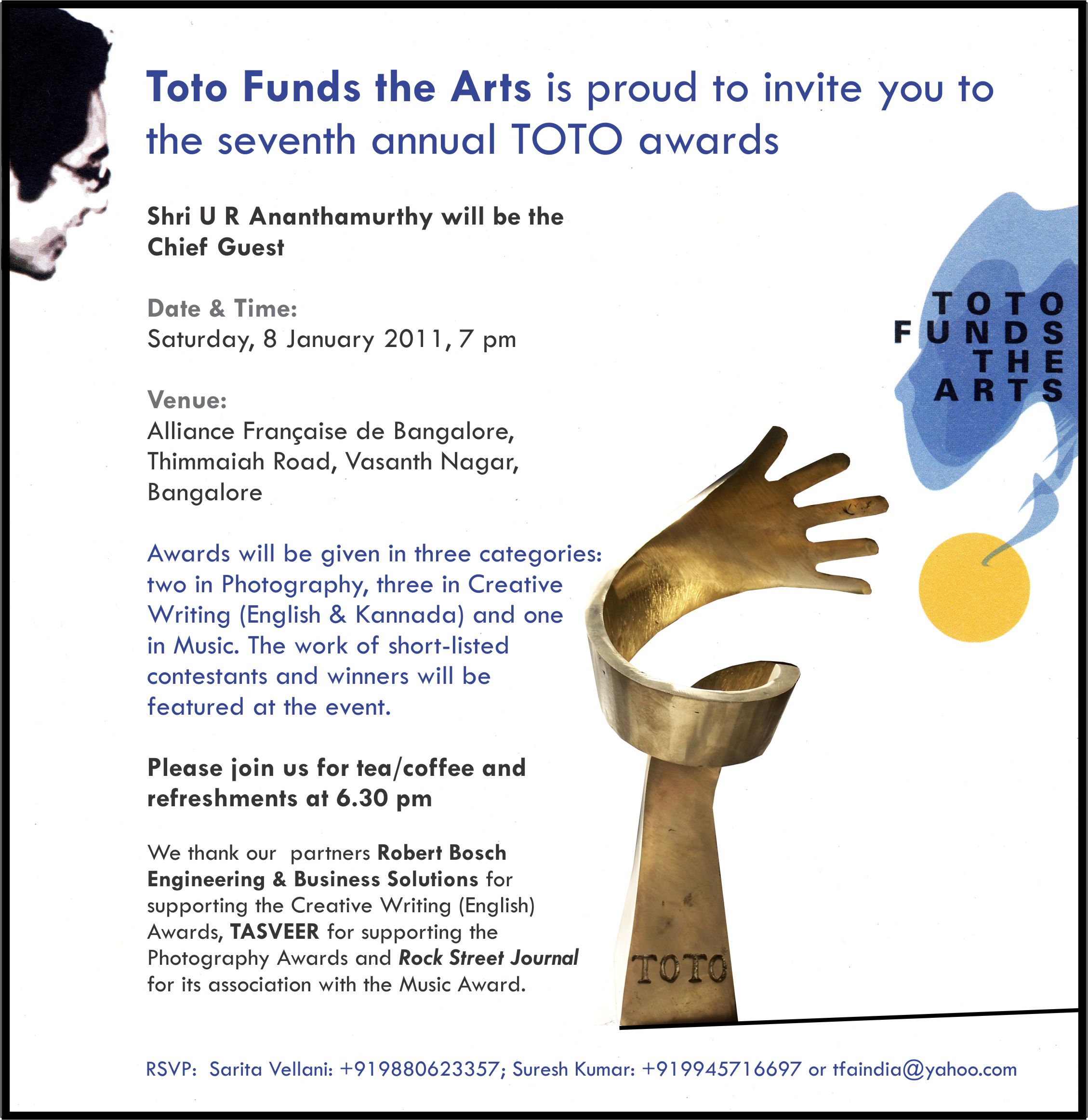
I’ll read briefly at the Toto Awards on Saturday the 8th, as I am shortlisted again this year. I have “always the bridesmaid” syndrome when it comes to this sort of thing, but we shall see… :)

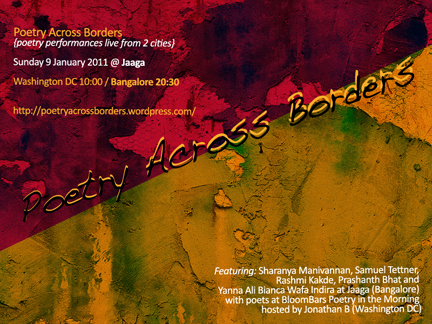
And on Sunday the 9th, I will read at Poetry Across Borders at Jaaga. Please do come.

Book Review: Beautiful Thing: Inside The Secret World Of Bombay’s Dance Bars by Sonia Faleiro

In August of 2005, the state of Maharashtra introduced a bill of law which put an estimated 75,000 women out of work.

Among these women was a 19 year-old named Leela – sharp-tongued, strong-willed and very “bootyful” – the star of suburban Mumbai’s Night Lovers dance bar, and the eponymous beautiful thing of this thought-provoking exposé. When we first meet Leela, she is trying to coax a sleeping customer out of her bed so she and Sonia Faleiro, at this time a reporter for a national news magazine, can chat. It’s January 2005 – just months later, the bill (which banned dance performances in all establishments rated three stars or below, thus forcing an entire service industry into unemployment or sex work) would be implemented.

Initially researching an article that would be axed, Faleiro was welcomed by Leela and her colleagues with an unusual trust, which later allowed her to document their world as it came to an unceremonious end. She is introduced as a friend to their clients, their families, and to members of all aspects of Mumbai’s underbelly. If there are any doubts about the author’s motives, they are quelled – few women in India today would choose to spend that much time in brothels and bars, fraternizing with both patrons and purveyors, sharing their rooms and their food, travelling with them and accompanying them to hospitals and hotels alike were it not for an emotional investment in those whose lives these are.

But to praise Faleiro for being intrepid enough to venture into this domain is to be all the more awed by the bar dancers themselves. Above all, Beautiful Thing is feminist commentary – by giving us an intimate view into their lives, this book has the capacity to change, or at least challenge, public perception about much-maligned sex workers and bargirls. Perhaps the most important stereotype that it dismantles is that they are people who operate from a position of disempowerment. On the contrary, many bar dancers rose out of sordid circumstances – Leela, for example, was pimped out by her father from a young age, offered for frequent rapes by policemen, abused to the point of being forced to eat her own vomit. Bar dancing bought freedom. Not only lucrative, it gave the women the option of not having to trade sexual favours for money. The nakhra, or artifice, of performance was enough to keep them desired, comfortable and fawned upon – but without necessarily having to service a customer. Unless one wanted to, or didn’t mind, or fell in love.

In other words, bar dancing allowed them to break the cycles of exploitation that trapped them within their societies and families, and gave them careers which made up in independence what was lacking in public respect – a level of independence often denied even to educated Indian women.

Out of the 75, 000 women who lost their careers when bar dancing was banned, Leela’s is only one story, and Faleiro paints her with such humour, chutzpah and empathy that it’s easy to see why the author herself was so mesmerized by her. Just as a bar dancer teases and tempts before getting down to business, we are first entertained by dramatic fisticuffs between Leela’s best friend Priya and the man-stealing, self-mutilating Barbie, and the demands of Leela’s difficult mother Apsara, before the book settles into its ultimately sobering effect. Faleiro charms us with Leela’s grit and glamour before taking us into the red light district of Kamatipura, then to the HIV wing of a hospital, and finally into the inhumanity of the ban itself. When we accompany the ladies to the beauty parlour before a birthday party, we have no idea how disturbed we will be by its end, the gathered weeping to a song from Umrao Jaan as in the near distance, a recently-castrated hijra moans in her bed.

Yet somehow, this glimpse into a subaltern reality seems insufficient by the book’s end. As compelling as Leela’s story is, there is the sense that Beautiful Thing could have had just a few more layers – the author says she conducted research and interviews for years, and one wishes more of this had been distilled into the work. But perhaps this is just the complaint of a reader who, captivated, wishes the book hadn’t ended so quickly. And that, then, would be Faleiro’s triumph: to have seared into our consciousnesses – and more importantly, our consciences – a Leela so forcefully alluring that we are dismayed to have to let her go. Is this the author’s nakhra, persuading us that what we have seen is just not enough, that there is even more beyond the screen?. And if it at all obliges us to not turn away from the corollaries of societal misogyny and look deeper into the misogyny itself, it would be proof supreme of Beautiful Thing’s importance.

An edited version appeared in today’s The Sunday Guardian, New Delhi.