The Heart

The heart, that wretched thing, that effigy to which we take all our torch songs, the ones we quote from endlessly, the ones we listen to furtively, with earphones. Here’s Neil Young searching, a miner for a heart of gold (but does he possess one himself – can he give the thing he wants to receive?). Here are the Backstreet Boys, aching with an agony both pure and puerile; let me show you the shape of my heart.

Show it to us then. Here’s Christ himself holding his sacred heart before his chest like an apple, blazing like original sin – here’s Hanuman, taking things a step further, literally tearing his chest open with his bare hands and revealing its contents. The gesture may be stylized, sanitized, but it’s immediately recognizable: who among us hasn’t done the same?

Inevitably, barbarism. “The heart is a lonely hunter,” wrote Carson McCullers. The heart hungers, like every hunter. And the hunter is always armed – but with what? Look at the tip of the vel, look at the shape of the space for the eyes and mouth on a barbute helmet.

Here you are with your heart a deflated balloon, an overflowing chalice, a reservoir.

Here I am with my current favourite metaphor: heart a mosaic, resurrected and re-resurrected, cannonball after cannonball. This is what it means to love someone to pieces – your own life turns to tesserae.

Here it is in nature: the original Valentine of the silphium seed. Here the procession of magenta lamprocapnos spectabili, here the swaying vine of cordate pepper leaves. The former are called bleeding-heart flowers, the latter cling and cling like nothing but a thing in love. (Here is U2’s heart as a bloom, shoot[ing] up from the stony ground).

Here is Poe’s tell-tale heart, pounding out justice. Here the I [heart] New York icon, so ubiquitous that the [heart] is now shorthand. In films, we’ve [heart]ed Huckabees, been “wild at heart”, and even sensed “the beat that my heart skipped”. Whose is the mighty heart about which Mariane Pearl wrote – her slayed husband’s, or her widowed own?

How many metaphors we find for a thing that is, itself, a metaphor – heart as the source of our joy, heart as the location of our ruin, heart as the centre of the world. The idea of the heart as a place – Elvis and Whitney Houston checked into the Heartbreak Hotel; the idea of the heart as a thing that be named and therefore contained – I’m gonna lock my heart and throw away the key crooned Billie Holiday (unchain my heart, countered Ray Charles). The metaphysical heart that has implied proxies in the corporeal realm: the left breast over which a palm is placed in promise or allegiance, the abstract seat of the anahata chakra.

“The heart has reasons that reason knows nothing of,” wrote Blaise Pascal. “The heart”, confirms the Bible, “is deceitful above all things, and desperately wicked: who can know it?” Not us, perhaps, but trust it we must – trickster, torturer, truth-teller.

The ancient Mesoamericans practiced heart-extraction because theirs was a passionate cosmos, it needed blood to keep going. We too need the heart to keep going, and so we follow it, appeasing its hungers, rearranging its disorders, in faith that it will lead us somewhere where we can be whole, pulsing with life, transfigured by love.

An edited version appeared in today’s Times of India, Chennai (World Heart Day supplement).
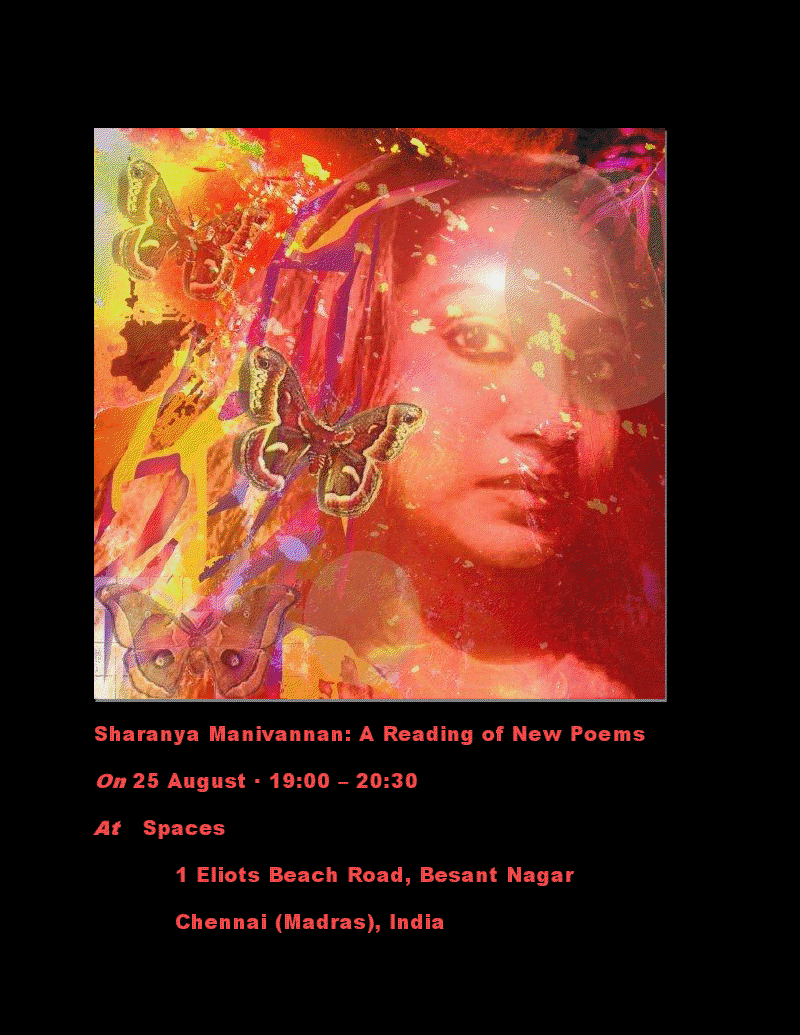
A Reading At IIT-Madras

I have a small poetry reading at IIT-Madras today, open to the public – do drop by if you can. It’s at 6pm; MRC, 4th Floor, Central Library.

Book Review: Women Awakened: Stories of Contemporary Spirituality in India by Swati Chopra

In traditional Hindu dharma, the seeker on the spiritual path – provided he is a man – has a clearly delineated chronological paradigm: he is an unmarried youth, a householder, a retiree in contemplation of hermitude, and finally, a renunciate. These stages of life, while restricted to those willing to fulfill their worldly duties before pursuing their inner calling, allow a space for devotion within the scope of society and even civilization. For the female seeker, however, no such prescribed model exists. Swati Chopra’s Women Awakened Stories of Contemporary Spirituality in India takes as its catalyst the practical difficulties of being female and spiritually predisposed within a patriarchal framework.

By interviewing or studying eight women who chose (or were chosen for, as it were) the ascetic life, Chopra explores the fundamentally transgressive stance that is the choice to break away from the designations and limitations of gender in the quest for God, presenting questions about threats to security along the mendicant path, rebellion against family, celibacy versus partnership, biological motherhood as opposed to “universal motherhood”, the place of femininity and emotionality, and being taken seriously once having entered the fold.

Most of these questions remain largely rhetorical. While the book begins on a peaceful, open note, as it progresses little emerges that is challenging or thought-provoking, and though each individual encountered is distinct in her own right, some chapters seem almost no different from others. The eight women mystics and seekers who are either personally interviewed, or whose work is discussed via their disciples are: Sri Anandamayi Ma, Sri Sarada Devi, Mata Nirmala Devi, Nani Ma, Jetsunma Tenzin Palmo, Mata Amritanandamayi, Ven. Khandro Rinpoche and Sadhvi Bhagwati. Although each of them has a journey worth learning from, or at least investigating, and weighty questions are put forward in all cases, one comes away with very little illumination. Even figures as extraordinarily enigmatic as Anandamayi Ma, or as much of a contemporary phenomenon as Mata Amritanandamayi (better known as Amma, the hugging saint) are inadequately considered: neither the nature of their appeal nor the intensity of their own encounters with the divine are conveyed memorably.

There are large gaps in inquiry – six of the women seekers, including two who are foreigners by birth (Nani Ma and Sadhvi Bhagwati), are essentially rooted within the Hindu religion, though they may follow or have originated guru-centric cults. Only the book’s last two chapters, which also happen to be its most comprehensive and insightful, are interviews with two Buddhist nuns, one of British origin and the other a Tibetan of a yogic lineage. But the lack of diversity otherwise is striking, considering the many narratives from other faiths that Chopra could also have included – in syncretic India, surely it would not have been impossible to find a Christian, Muslim, Jewish, Sikh or Jain perspective, and these are only taking into account major traditions.

It’s also particularly interesting that the question of women’s roles within the scriptures is grappled with only in the chapters relating to Buddhism, where questions about the Buddha’s alleged misgivings about opening the sangha to female novitiates as well as the problem of a prayer in which one asks to not be given rebirth as a woman (because only men can achieve enlightenment) are posed to Jetsunma Tenzin Palmo and Ven. Khandro Rinpoche. The texts of the Hindu religion, the focus of the remaining chapters, are not taken to task for the misogyny and other inequalities within them. Chopra’s rather beautiful evocation of the Devi Mahatmyam, though relevant and inspiring, presents only one perspective of the role of the female – divine and otherwise – in theological literature.

To the author’s credit, she maintains a very neutral tone throughout the book, almost as if her own narration is only incidental, and not integral to the heart of the matter at hand. Only once is a significant personal involvement encountered: when she attempts an Internet exercise proscribed by Mata Nirmala Devi and is unmoved by it, but by itself the episode says very little. While the lack of subjectivity, which could easily have manifested in proselytizing or argument, is refreshing, it also eventually becomes somewhat unexciting. Spiritual experience is profound in both its ecstasies and in the wretchedness of its longing – as the passionate Sri Ramakrishna, who emerges ironically as the bedrock of the chapter ostensibly about his partner, Sri Sarada Devi, illustrated. A little more sharing about Chopra’s own spiritual quest – as Carol Lee Flinders’ At The Root of This Longing: Reconciling A Spiritual Hunger and a Feminist Thirst, Margaret Starbird’s The Goddess in the Gospels: Reclaiming the Sacred Feminine or any of the numerous books of the past few decades that have explored a women-centric faith have done – could have enriched it by a great deal. Religion is structural, but spirituality is personal and individual. This is the book’s core message, but lost in its own telling.

 An edited version appeared in today’s The Sunday Guardian.

A Few Reviews

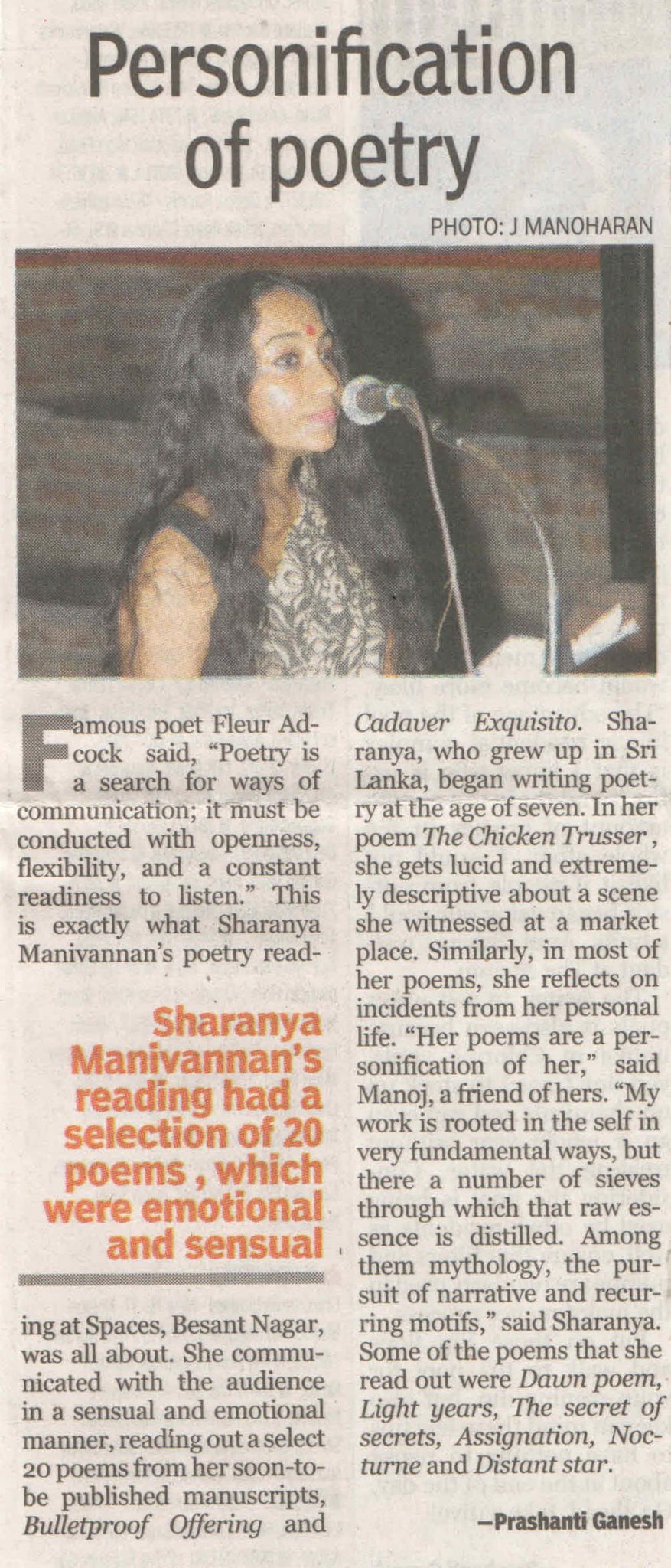
A few articles about the reading at Spaces last week.

Here’s one in The New Indian Express – the scan, and the text link.

Here’s a very thoughtful one at myLaw.net.

Thank you, everybody, who came or sent good wishes.

A Reading of New Work, In Chennai

Sharanya Manivannan’s first book of poetry, Witchcraft, was released in 2008. It was acclaimed in The Straits Times as “sensuous and spiritual, delicate and dangerous and as full as the moon reflected in a knife”. Since then, Sharanya has been working on two different manuscripts of poems. Bulletproof Offering, explores the impossible loves of Sita and Lucifer, the earth and the earthbound angel. Cadaver Exquisito takes as its central motifs dismemberment, grief and the sights, smells and scenes of the city of Chennai.

While some of the poems in these manuscripts have found homes in journals including Drunken Boat, Pratilipi, Dark Sky Magazine, The Nervous Breakdown and Superstition Review, many are yet unpublished — and most have never been shared with an audience.

You are warmly invited to an intimate evening of listening to new poems by Sharanya Manivannan.

The Tragic And Talented

Everybody dies. Of the many ways in which this can happen, the “tragic” death of a pop culture icon – inevitably attributed to a mixture of hedonism, extreme success and existential loneliness – is one of the least interesting, yet paradoxically, probably the most celebrated. When Amy Winehouse died last month, the same tired tropes were trotted out in the media and on public opinion aggregators like Twitter: that it came as a complete shock, that she was the victim of the paparazzi (or of a curse that affects 27-year old musicians) and of course, that her talent had gone to waste.

It’s the last of those statements that makes the least sense. Winehouse was known to the world first and foremost not because of her binge drinking but because of her work – her unmistakable contralto, her ironic (mostly self-penned) lyrics and the visual effects, such as the beehive wig and the winged eye makeup, which she cultivated during her healthier years. The rest of it came afterwards. The increasing disarray in which she appeared in candid photographs, for example, or the fact that she began to be booed offstage by her own fan following were because at one point she had been worth following at all.

So how could it be said that she wasted her talent, when her talent was observed and enjoyed at its height? What if there was little or nothing left in Winehouse, artistically speaking, beyond the body of work she had already produced by the time of her demise? The aftermath of such an event usually results in speculation that borders on the downright panegyrical, perhaps because it may come off as malicious to suggest otherwise. But the truth is, we don’t actually know what Winehouse might have cleaned up to become, or if she had been capable of cleaning up. But it must also be said – she owed no one else anything, but she owed it to herself to find out.

To say an artist has died “before their time” is to say that her or his death came unexpectedly, because of calamity or early disease. Consider just a couple of examples among other musicians. When Jeff Buckley drowned at 30 in 1997, he had only released his seminal Grace album, a work so remarkable that his cover of Leonard Cohen’s Hallelujah is more famous than the original. When Lhasa de Sela died of breast cancer in 2010, aged just 37, her three luminous multilingual albums were only one facet of a life that spanned richly varied experiences as a traveller, circus performer and human being. Her music was a vital part but not the only vital part of what she did.

Amy Winehouse, however, didn’t die suddenly or unexpectedly. Her own parents have told the press that they had been preparing for her death for four years; her father wrote a graveside eulogy for her in 2007, her mother picked out a cemetery plot in 2008. Make of this bizarre parental admission what you will, but Winehouse herself showed no outward signals of being in love with life – and living in celebrity-obsessed England, where her every move was documented, some semblance of a fighting spirit or joie de vivre would surely have come through if she had. She killed herself slowly with the kind of “reckless deliberation” – an oxymoron in any other case – that can only come from a person motivated by self-destruction.

The idea of the self-annihilating genius is a dangerous one. What is true is that mess and chaos are often intrinsic to art – at the risk of romanticizing it, a nod must still be given to the correlation between beauty and heartbreak. What is also true is that many great artists manage to extend their lives and works over a long trajectory while waging a constant struggle against their inner demons and external hardships. To raise a shot of tequila to Frida Kahlo on her birthday is to celebrate the life she fought tooth and nail to embrace despite physical ailments over which she had no control. To leave vodka bottles in memorial shrines outside Winehouse’s London house – as fans have done – is hardly a salute to triumph and passionate engagement. It’s a mockery of what was actually wasted: the choice to live and to give.

None of this is said with ill-will. Winehouse had real talent, she was unusual and she had a devil-may-care attitude which at first was deeply attractive (setting her apart from those who contrive their public images) but later revealed itself to be a complete lack of self-possession. If she managed to clean up her act without losing the essence of her gifts, she would likely have blossomed. The tragedy is not that she couldn’t fulfill her potential because she died. The tragedy is that she died because she lived not in pursuit of creation, but in pursuit of tragedy itself.

An edited version appeared in Times of India’s iDiva supplement today.

Walking The Talk

The first association that came to mind when I heard that New Delhi (in the footsteps of a successful public demonstration of the same name in Canada) would be holding a Slutwalk was: bra colour.

I wasn’t planning an outfit, right down to matching underthings, in order to participate in the said Slutwalk; the association came from having recalled a strange Facebook exercise in which women were encouraged to post the colours of their bras as their status messages. Doing so was expected to raise awareness about breast cancer, ironic considering that no explanation was to be given for the status – in fact, the whole thing was supposed to be kept secret from the male populace. Needless to say, it wasn’t a very successful effort.

The term “Slutwalk” seemed similarly counterproductive in an Indian setting: by the time we had all had our arguments about the word “slut”, who uses it here and when and why and if it accurately conveys what must be conveyed, the core message of the protest would have become secondary. The core message in this case being making public spaces safer for women, who risk violence and shaming on a daily basis just by virtue of being out of the home (violence and shaming within the home are invariably connected, but more difficult to tackle by way of event-based strategies). Indeed, this is what happened – privileged to the point of being exclusionary, the term was contextually meaningless, and altogether detracting and distracting.

The desi Slutwalk was renamed “Besharmi Morcha”, Hindi for “shameless protest”. Although the demonstration has yet to take place, tangled as it has become in a great deal of discussion and comparably little action, this is surely an improvement. Also, it sounds a lot like “besame mucho” (Spanish for “kiss me very much”), which is really rather nice.

Oops, did I just trivialize what some historically-clueless people have called the beginning of the women’s rights movement in India?

Lost in all this clatter about the semantically correct and the stylishly cool is the most pertinent question of all: can public demonstration actually galvanize change in today’s world?

Public assembly is believed to be so powerful a tool of political activism that governments are known to either enshrine or fear it. In the United States, freedom of assembly is protected within their Constitution as the very first amendment; in Malaysia, police have been arresting people for wearing yellow ahead of a protest on July 9 for which that colour has taken on totemic meaning. Since the beginning of the 20th century alone, numerous examples have attested to this power. Everything from the physically taxing Salt March to the bloody Tiananmen Square protests to the relatively rather relaxing Lennon-Ono bed-ins of the ‘60s show this to be true. Even the fun Pride Parades of today have their roots in the spontaneous, violent uprising known as Stonewall that took place 40 years ago in New York City.

Public assembly is immediate and visceral: emotions run high, there is excitement and electric tension, and in some cases things can become frighteningly unmanageable. They attract attention, they demand spontaneity, and they always contain some elements of risk. But they are only the most visible representation of a struggle, neither its cause nor its culmination. What happens at a protest itself is far less important than what happens the next day, and in all the days to come.

The Slutwalk also reminded me about a (possibly apocryphal) story about the Aurovillean Mother: that nearly a hundred years ago, she had organized for schoolgirls in Pondicherry to march around the town wearing comfortable shorts, an act of an unimaginable lack of decorum in that time. They were spat at and disparaged, but over time, the town became accepting of different modes of dress. It’s a difference that remains palpable even today, as any Chennaiite woman who heads south for the weekend knows.

At the time of this writing, Besharmi Morcha is indefinitely pending. There is no doubt that if it is to happen, it will garner enormous media attention, inspire a thousand more blog posts, and be the focal point of many discussions relating to gender issues for some time. Perhaps there will be provocative attire (the dress code of the original Slutwalk) on display, perhaps there won’t be. Perhaps the demonstration will be sedate, or perhaps it will be flamboyant.

None of that really matters. Count not the number of people who come to march, count not the number of people who turn up to gawk – count only, over time, the number of assaults and insults that are meted out on those same streets. Perhaps there won’t even be a correlation to the protest itself, but only to a larger framework of engagement and daily, reiterated revolution. But all that really matters is that that number dwindles, as far as it can possibly fall.

An edited version appeared in Times of India’s iDiva supplement today.