Launch of the Karadi Tales Audiobook, “A Quiet Courage”, Chennai

When I was living in Kuala Lumpur, my mother sent me a few books from India for my 21st birthday. One of them was “A Poem To Courage” by Manohar Devadoss – and I knew as soon as I saw the cover why she had chosen it. To my eye, and to hers, I resembled the woman in the line drawing on its cover. That woman was Mahema Devadoss.

The story of Mr. and Mrs. Devadoss is not unfamiliar to many in Chennai. Mr. Devadoss is a visually-impaired artist and author. Mrs. Devadoss became a quadriplegic following a car accident, but continued to draw and paint for several decades afterward.

It was truly meaningful for me to be asked to record the part of Mahema Devadoss in Karadi Tales’ new audiobook on the much-loved artist couple. “A Quiet Courage” will be launched in Chennai on August 7th.

mdd-1.jpg

Readings in London and Berlin This Week

London

I’ll be reading along with Raficq Abdulla, Stephen Watts, Al-Saddiq Al-Raddi, Fatieh Saudi and Ziba Karbassi with music by Kalia Baklitzanaki at the St. Ethelburga’s Centre for Reconcillation and Peace.

Friday July 20th, 7pm. Details here.

Berlin

I’ll be reading at the Tagore Centre, Embassy of India in Berlin. Embassy rules do not permit sales of books or other items, so you can get a copy of Witchcraft, if you wish, at a small afterparty (venue to be announced at the reading).

Tuesday July 24, 6pm. Details here.

Poetry Parnassus at Southbank Centre, London

Because artists live outside and among blurred borders, because artists make the world smaller, because artists are cultural cross-pollinators, I am delighted and honoured (first I was baffled, then I was honoured, and now I am delighted) to represent Malaysia, where I mostly grew up, at Southbank Centre’s Poetry Parnassus Festival, which is bringing together poets from all over the world.

Here is more about the festival. And here is an interview with me on my participation in the festival.

I am currently scheduled to read on June 29th between 4pm and 6.45pm at a free event called “This Is What The World Sounds Like” at Southbank Centre’s Clore Ballroom. The festival schedule is subject to change, but you can see what else is taking place here. If you’re able to catch it (maybe literally!), the Rain of Poems should be very cool to watch.

My book of poems, Witchcraft, is not available at the festival bookstore, so you can only purchase it from me directly. If you’re in London, I would love to see you at Poetry Parnassus. Please come, and tell your friends.

Book Review: Close, Too Close: The Tranquebar Book of Queer Erotica

We’ve come a long way since those anthologies from a dozen years ago, as groundbreaking as they were, consisting mostly of anonymous personal narratives of queer living and loving and very little creative writing of notable quality. That what we are seeing more and more of are stories that are not content to rest on the fact of their queerness alone reflects not only changing societal mores and a greater ease with that fact itself but also an attention to craft. While some of the pieces in Close, Too Close: The Tranquebar Book of Queer Erotica imply autobiographical inspiration, many are pseudonymous and most use the first-person narrator, every single one successfully makes the leap from being testimony to becoming fiction, allowing the reader in through an artistic aperture.

The term “queer”, though hotly contested, is an expansive one, the least descriptive and therefore most open of sexuality and gender identification categories, and this anthology certainly cuts across the spectrum, featuring everything from sex between two transmen in different stages of transitioning to sex between a gay man and his straight female friend.

These stories trade not in definitions but in desires, and offer a large array of them. Anirban Ghosh’s “Ark Erotica Endpapers”, which fill the inside covers of the collection, kick things off with a fantastic visual: the animals may have gone in two by two, but humans do it a little differently. Yes, there are pairings, like two mermaids coiled around each other (busty, though lacking in genitalia), but there also those content to watch, like a toothy chef with a hardly-subtle fish fetish, and a team of indeterminate dynamics. Midway through the book, Nilofar’s “Shadowboxer”, the only other visual offering, is powerful sequential art: a woman takes her own pleasure, her fat, blemished, oddly-tattooed body a locus of sensuality.

Compiled by Meenu and Shruti, first-name-only editors from an NGO background, a collection like this could be a self-conscious one, but self-consciousness and erotica hardly make a fiery marriage, and the anthology does well to avoid it. Its most political story works because the politics are not the point. Iravi’s “All In The Game” has a blindfolded participant being kissed and nuzzled by a succession of friends and made to guess who’s who. In guessing their identities, a mix not only of orientations and biological situations come up, but also ponderings on monogamy and other arrangements. There’s a twist in this story that is perfectly delivered, and drives home a message about bodies that pushes the inclusivity of this anthology past a new margin.

On the subject of bodies and back to the main premise of the anthology, there is much that titillates. Annie Dykstra’s women spy each other underwater and slip into a locker room shower together in “Pity That Blush”. D’Lo’s transman falls for the woman he has been assigned to board with on an exchange program and makes love to her – the verb deliberately chosen, for in contrast to the emotional cruelty of some of the casual sex stories this one is quite romantic. As for emotional cruelty and casual sex, Dykstra’s takes the lead, but L.R. Ellen’s “Conference Sex”, Nikhil Yadav’s “Upstairs, Downstairs” and Doabi’s “The Half Day” quickly follow – all are fun, but the last could have done without the rather forced recipe for rajma chawal. The biggest name in the collection, Devdutt Patnaik, spins a new myth about two young men who disguise themselves as newlyweds in order to collect a reward, only to have the gods take their artifice further than expected.  Michael Malik G. weaves a “meditation on [the] cock” of a gorgeous man on a houseboat in Kashmir, and Vinaya Nayak’s “Screwing With Excess” pokes a little fun at the adoring faghag – but ensures she is also pleasured.

There is an urgency to the best of these passages that illustrates quite perfectly the difference between beautiful writing about sex and sheer erotica. In the former, it is the way the phrase turns that matters. In the latter, if you’ll forgive my crudeness, it all comes down to whether or not the wrist turns away from turning the pages.

For proclivities that test the comfort zone a little, Satya’s “I Hate Wet Tissues” lightly brushes the subject of necrophilia, and Chicu’s “Soliloquy” attempts to both eroticize and find empowerment in the nasty experience of being molested on a bus. A couple of the stories fall short – Abeer Hoque’s “Jewel and the Boy” and Msbehave’s “Give Her A Shot” play with structures that suggest creativity but leave one stumped as to their purpose – but by and large, the book excites.

Close, Too Close is inclusive without losing sight of its purpose. It’s surprisingly well-written for a collection peppered with pseudonyms. It feels offbeat but not obscure. And most of all, when it’s hot, it’s very hot.

An edited version appeared in The Sunday Guardian.
Book Review: The Blaft Anthology of Tamil Pulp Fiction Vol. II (trans. Pritham Chakravarthy)

There’s a certain brand of Tamil kitsch that has been in style, both regionally and nationally (and beyond, in some cases), for a couple of years now that is fundamentally antithetical to America’s hipster subculture. Both phenomena can be read, at first glance, as based on revival or reappropriation of the “authentic” – making the obscure or the lowbrow populist trendy. But hipsterism is self-conscious, reliant on posturing said to be “ironic”. The beauty of The Blaft Anthology of Tamil Pulp Fiction Vol. II – a perfect example of contemporary Tam-kitsch – is that it contains no irony at all. It isn’t possible to enjoy these stories if there is a hesitation to enter their particular moralities or engage with their brassy sensibilities. Delightfully, however, they are so thrilling that it is very easy to.

The first volume in Blaft’s Tamil Pulp Fiction series carried seventeen pieces; while this one features only six, its stories are lengthier and by and large rewarding. The anthology kicks off on a spectacular note: Indra Soundar Rajan’s gripping novella “The Palace of Kottaipuram”. Originally serialized over 31 issues of Anantha Vikatan in 1990, this perfectly-paced mystery has all the elements of grandiose narrative. A royal lineage is thwarted by a curse dating to colonial times that avenges a raped tribal woman: all its male heirs die on or before their thirtieth birthdays, and its female ones do not survive infancy. The educated and urbane young prince Visu begins to believe in the curse after the death of his elder brother leaves him next in line, but his rational girlfriend Archana is not at all convinced that supernatural forces are at work…

The character of the intrepid female investigator is carried forward into “Highway 117”, the collection’s only major non-prose offering and its weakest link. Written by Pushpa Thangadorai and illustrated by Jeyaraj, its promising storyline – of Karate Kavitha, who pursues a temple-plunderer along a train route with her handsome sidekick Umesh – doesn’t translate well into the form. The illustrations are uninspiring, and seem mainly to serve the sequence in which the heroine, tied up in a chair with her blouse torn open to reveal her breasts, delivers a series of karate kicks to her assailant. Even this, unfortunately, isn’t done with particular panache. To this end, in terms of visual mediums, the lurid magazine and book covers – full of fanged creatures, sexy women and other titillations – and vintage advertisements which intersperse the stories are far more interesting and striking. The covers from the 1960s and 1970s are colourful, expressive and arguably even objects of a certain beauty – by contrast, the four covers featured from the 1990s seem markedly depleted in taste or attractiveness; no comment is offered on why, but one assumes they are representative of the aesthetic of that era.

Indumathi’s “Hold On A Minute, I’m In The Middle Of A Murder” suffers a little bit for its melodrama, but has enough bloodshed and black magic (“gained in the forests of Iran and Iraq”, no less) to entertain. The occupants and staff of a mental hospital come under the influence of spirit possession, vendettas beyond the grave, and a hodgepodge of faith systems that incorporate everything from Christian-Satanic binaries to Tantric rituals.

Two brilliant stories follow in this predominantly horror-based anthology: M.K. Narayanan’s “The Bungalow By The River” and Rajesh Kumar’s “Hello, Good Dead Morning!”. The first is a ghost story set in Malaysia, and successfully evokes, without literary pretensions, a milieu and society that might be lesser-known among local readers of Tamil pulp fiction, and is more convincing both in its gore and supernatural themes than Indumathi’s piece. Kumar’s police mystery set in Coimbatore, meanwhile, contains a twist which – although translator Pritham Chakravathy and editor Rakesh Khanna say might be familiar – is quite ingenious to those who do not regularly consume crime or mystery fiction.

Both these stories are racy by the standards of the eras they describe: in the first, an “adamant” young woman consents to staying overnight on holiday with her fiancé, in the second, a jeans-clad, moped-riding woman and her friends watch pornography together in the mid-80s. The latter story in particular is traditionally problematic when it comes to that old bugbear: the desirous female (and her inevitable punishment), but pulp is hardly the place to expect otherwise. For those overly concerned, however, the anthology’s final piece, Resakee’s “Sacrilege To Love”, offers some minor consolation: it has two alternative endings, one for “diehard romantics”, and the other for those who, disgusted by the chauvinism displayed by all its male leads, might root for an offbeat happily-never-after.

There are two ways to read pulp: you can read it incredulously, lamenting the cause of beautifully-turned prose and rolling your eyes at all the rolling heads. Or you can read it without any self-consciousness, giving in to all its gaudy, gory glory. There’s really only one good way to do it though, and that way, The Blaft Anthology of Tamil Pulp Fiction Vol. II is an absolute treat.

An edited version appeared in The Sunday Guardian.

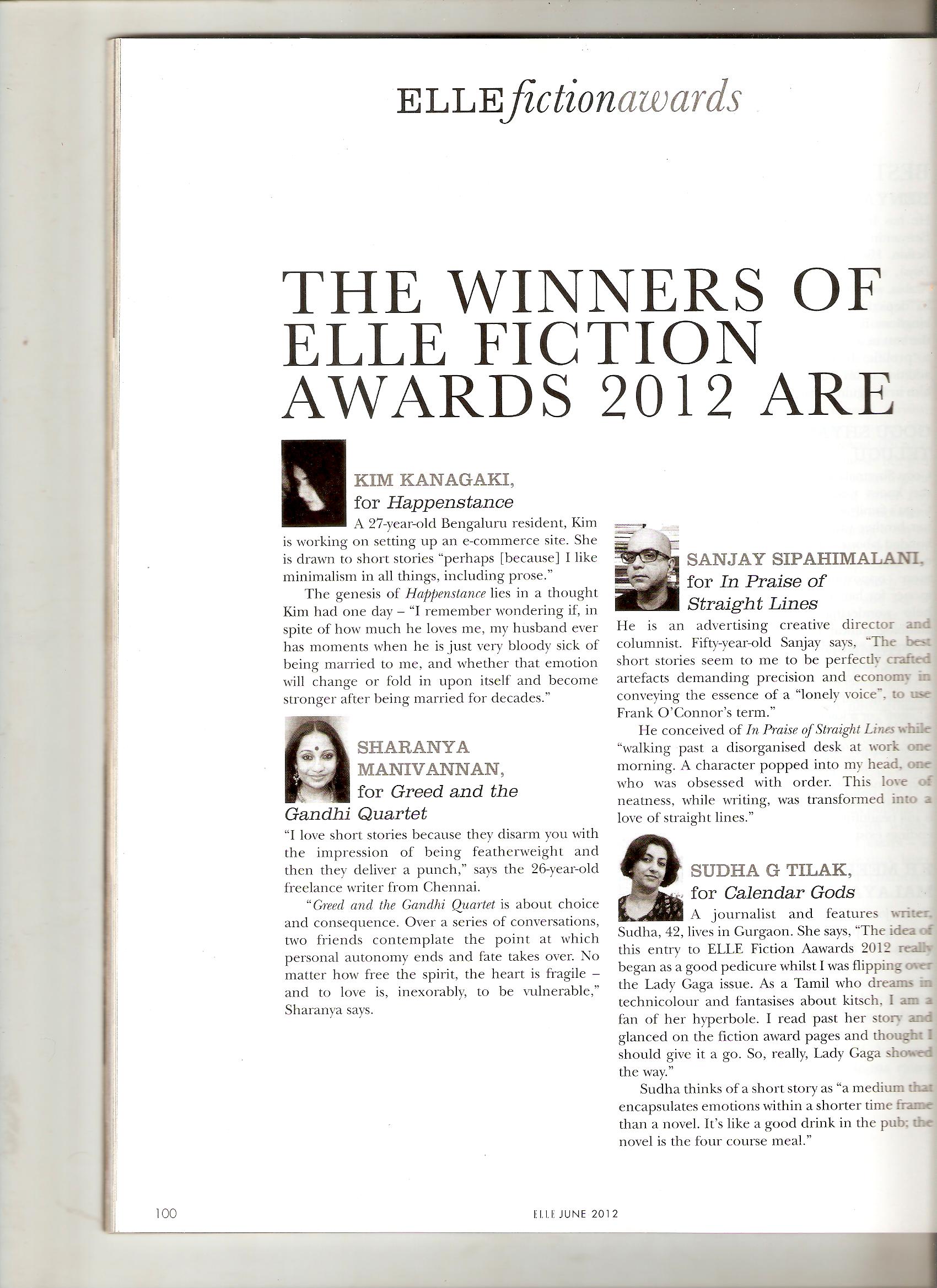
Elle Fiction Award 2012

Happy to share that my short story, “Greed and the Gandhi Quartet” has received an Elle Fiction Award 2012 from Elle (India).

The story has not yet been published, but the magazine featured a short genesis of each winner. Here’s a scan of the page that includes mine.

TOI iDiva: Supermomhood

Sometimes institutions get torn down only to be replaced by ones that look a little better, but work just like the old thing. This is why, theoretically and superficially, it’s very easy to say that the average Indian woman of the urban middle class is emancipated. She probably works, and certainly has tertiary education. But the bondage continues: she is expected to bear children, that too specifically in the context of wedlock. Worse, she is expected to want to.

The idea of motherhood is replete with myths. “Mothers are inherently compassionate”. “Mother knows best”. “Womanhood is unfulfilled until one becomes a mother”. In Tamil, there is this frankly shocking proverb: “No chick ever dies from a hen stepping on it”. Oedipus would be put to shame by the extent to which we elevate the mother figure. Like all deeply chauvinistic disguises, it reduces through its elevations, stripping the individual of personal traits, making choices for her and blindly forgiving her personal failings. Children suffer for this, as do their makers.

If we are truly to support or celebrate mothers, it is not in glorifying them but in humanizing them that we can best do this. The Supermom idea is dangerous and must be retired: it is a human body that nourishes a child and gives it life, it is a human heart that loves it. All Supermomhood means, in actual terms, is that women must not only work outside the home, bringing back a salary that subsidizes its management, but must also maintain their traditional responsibilities. The question to ask is: if women have adapted to the pressures of earning wages, have their partners also adapted to the pressures of running a household?

Who makes the meals? Who makes the beds? Who does the laundry? Who monitors the homework? Who does the grocery shopping? Who cleans the dishes? If a child falls ill, who takes the day off from work? How many of these questions were answered with “the mother”?

Some will cheerfully dismiss this maintaining of two parallel careers (only one of which is paid for) as evidence of incredible fortitude. Or more condescendingly yet, that “it’s all for the children”.

Maybe it is. In some cases, surely it is. But not enough to justify such an unequal distribution of responsibility.

Until fatherhood is understood to be co-parenting – and not just a contribution by way of sperm, legitimacy, school fees, a certain kind of love (but not as hallowed as maternal love) and the occasional humiliating consent letter because society does not trust the single woman – the lot of the mother will not change. She will remain both sacred cow and beast of burden.

And for the lot of the mother to change, so must the lot of the woman. Imagine how different things might be if motherhood was not a default expectation, but a conscientious and deliberate decision. Not everyone is cut out for caregiving. Not everyone would, if truly left to their own choices, desire it. Social acceptance of the choice not to have offspring, irrespective of whether or not one is in a relationship (and irrespective of whether or not that relationship is marriage), might be the first step in minimizing family dysfunction. Unhappy people raise unhappy people. And children, who do not choose the roles they are born into, deserve better than that.

An edited version appeared in iDiva (Chennai), The Times of India on Friday.

Book Review: Fish In A Dwindling Lake by Ambai (C.S. Lakshmi, trans. Lakshmi Holmström)

On the cover of Fish in a Dwindling Lake is this image: two women, their backs turned, look out onto a body of water. They must, we intuit, be silent. We know this because we know that in the presence of that which moves us, words only come later. This is the same poignance that this collection of eleven stories imbues.

For nearly four decades, Ambai’s writings have stirred her original Tamil readership with their forthright engagement with gender, particularly womanhood. In this, her third collection in English, translated by Lakshmi Holmström, her protagonists are held together by the reiteration of a single notion – “journey”.

Most are aged or aging but remain travellers: pilgrims, commuters, chaperones, vacationers, passengers. As with all voyages, it is encounters with strangers that teach them both about themselves and the world. In “Journey 5” two women holiday in Pondicherry with the intent of drinking wine, and find themselves partaking of a feast in the home of elderly strangers in a de facto relationship. In “Journey 7”, an unsuspecting Nani-Mausi at a train station finds herself escorting a runaway for whom leaving her husband may or may not be a kind of theatrical ritual.

Although others are set in places including Mumbai and Imphal, the most memorable stories evoke a deeply Tamil milieu, both in descriptive ambience and identifiable morality codes. One returns again and again to the stunning opening piece, “Journey 4”, in which a pregnant woman tells a stranger a shocking family secret, standing by the Kanyakumari shore. In, “One Thousand Words, A Life”, pregnant women again are its central characters: the tribulations of giving birth in a village during WWII leads into the heartbreak that “history is made up of so many silences”. In “The Calf That Frolicked In The Hall”, the collection’s third outstanding piece, the literary culture of Tamil Nadu in the ‘70s, when the anger of young men was considered glamorous, is both nostalgized and taken to task.

But the compassion of the author’s voice extends to men, particularly in “Kailasam”, in which thwarted male desire is treated with a complexity that only a feminism that has been steeped in actual human engagement, not just political rhetoric, would allow. Similarly in “Journey 9”, in which a gigolo is subject to brutality by a group of female clients, and washes his wounds in the home of a kindly woman who once declined his services.

The motif of water – still and flowing – emerges often, and evinces a series of nuanced tellings of what it means to inhabit a body that ultimately will return to the elements. A man falls or drowns himself in a well, another in a lake, a woman imagines carrying the tides home in a pot to her beloved, another has a refrigerator that forms mysterious shivalingam ice stalagmites.

Ambai’s work carries such power because it is neither sterile nor sensationalist, both things that writing that takes the body as an axis has the danger of becoming. In Fish in a Dwindling Lake there is a profundity and subtlety that could easily be attributed to age, but more importantly and less facetiously, to empathy. Like the young woman in the indelible “Journey 4”, like the nondescript women on the book’s cover, we simply watch for a long time, too stirred to speak.

An edited version appeared in The Hindustan Times.

A Poem In Mandala Journal

The Exodus issue of Mandala Journal contains a poem, “Carceral“, which is part of one of my longterm works in progress, an installation called “The Country of Intangibles”.

Also, the Kiski Kahani (300 Ramayanas and Counting) project has republished my ars poetica on Sita/Lucifer/Bulletproof Offering, which first appeared in the March 2012 issue of Kindle Magazine.

A Story In Pure Slush

I’ve got a frivolous, frothy (and hopefully fun) story in Pure Slush‘s India issue called “Gigolo Maami”, and you can read it here.

I also answered their Hue Questionnaire here.

An Essay in Kindle

I wrote an ars poetica of sorts about the Bulletproof Offering manuscript, “Sita as Lucifer”, for the March issue of Kindle Magazine. The formatting and asterisk breaks are off/gone, but you can read it here.

And yes, the words and lipstick print on the cover of the issue are also moi!

Book Review: The Man Who Would Be Queen: Autobiographical Fictions by Hoshang Merchant

As one less famous homosexual complained about another recently, “He does no justice to the adjective gay!” If a grievance can be leveled against this memoir by India’s most famous homosexual (and that happens to be the preferred self-descriptive noun in this book), it is that it is rather lacking in gaiety indeed. Hoshang Merchant’s The Man Who Would Be Queen: Autobiographical Fictions is romantic, lyrical, vivid, but also, above all, sad.

In an almost stream-of-conscious style, Merchant chronicles some of the highlights of sixty years of his resolutely interesting life: beginning with his first memory of his mother (“I believe Mother-rule is the root of male homosexuality,” a small literary journal quoted him as saying last year) and ending with his current situation as a professor who “fathers” – as the author bio says – “his books, his students and a young friend”. The almost staccato impressionism with which he renders his childhood and adolescence does not belie their darknesses. His wealthy family is rife with dysfunction: his father’s infidelity, his parents’ eventual divorce, a sister who tries to shoot herself, and even an almost unspeakable incident in which the author shakes his mother, causing her to fall and break her hip, after which he attempts suicide. Merchant left India at the age of twenty, a year before his mother died, and it’s impossible not to sense the mourning in the two decades he spent abroad.

But those decades, in the USA and in particular in the Middle East, are the stuff of legend. “Sex is a way to sainthood,” he quotes his icon and penpal Anaïs Nin more than once – and Merchant certainly attempts canonization. In California, “a retired army man bent again and again to kiss a herpes sore on my inner thigh”. In Netanya, he enjoys a sexual encounter on a nude beach with a “Venus with a penis”, cheered on by onlookers. In a cemetery near the Dead Sea, which he notes as the site of the ancient Sodom, he watches as “people made love athwart graves”. Ironically, it’s in details like these that the pigeonholing of this book as the autobiography of a gay man is overshadowed by its importance as the autobiography of a poet.

Merchant is the author of twenty books of poems and the editor of a seminal anthology of gay Indian literature, and while the trajectory of his literary career finds surprisingly little mention in these pages, the celebrity accrued through it precedes this memoir. For those seeking arty scandals and name-dropping, however, this book contains quite little of either. “Gossip had become aesthetic,” he writes of a time in his life during which he is accused by a lover of using their affair for the poetry it inspires. Perhaps the experience chastised the author just a little too much.

Although the vast majority of other people who populate this book are barely sketches (with the exception of his vicious stepmother and perhaps some other relatives, it’s difficult to imagine anyone taking umbrage at what is revealed), what emerges is a well-rounded, often searingly honest image of Merchant himself as a person, rather than as a persona. Demanding diva? Homosexual paragon? His time in Palestine nuances both perceptions. At one point, he worked as a toilet cleaner and garbage picker. At another, he converted to Islam to marry his sweetheart, a woman named Yasmin.

His difficult time in Iraq, where he faced an especially rough amount of discrimination, is covered in the memoir through a series of letters; it is as though the experience was too painful to revisit in new writings. But it is where the book ends, in the author’s present-day life in Hyderabad, which is most depressing. Merchant eschewed his inheritance, gave away numerous personal items, and chose to live in an attic costing only Rs700 in monthly rent, with few belongings. Are these the choices of someone in the pursuit of austerity, or of attention? There’s a vulnerability in these pages that is deeply convincing of the former, yet also results in the latter. Either which way, the image of a celebrated artist living in relative penury in his old age is discomfiting.

But then, The Man Who Would Be Queen is the memoir of a true bohème, and perhaps a poet must be indulged his melancholies. In the end, as much as one wishes for more delicious wickedness in the recounting of the past, or a less sombre depiction of the present, the author is brave enough to feign neither. Merchant writes that (Tennessee) “Williams’ autobiography catalogues the decay of an aging queen. It is a sad spectacle”. Merchant’s own is sad, but at least it is no spectacle.

An edited version appeared in The Sunday Guardian.

A Poem In The Nervous Breakdown And A Recent Talk

A poem, “Light Years“, is on The Nervous Breakdown.

Last April, The Nervous Breakdown published another poem of mine, called “Secret Theatres“, and that poem was a finalist in this year’s 3 Quarks Daily Prize. They also published this self-interview.

Finally, I delivered a talk on March 10 at the Madras Management Association’s Women Managers’ Convention 2012. I thought for a long time about whether or not to post the link to the recording, as what I spoke about is so personal and the Internet is a vastly different space from any kind of event. I decided last night (after watching Brené Brown’s new TED talk on Shame and thinking about her previous one on Vulnerability) that I would post it, wrote out reasons I planned to share with you, and then accidentally deleted the whole screed. And that – overriding my own self-sabotage – finally became the best reason to do so. Here it is, in the segment “Business Session 1: Women On A Mission”.