The inaugural issue of Mojave River Review carries two of my poems – “Madrigal With His Mouth As Crown-of-Christ” and “The Mirror-Tree (Love Poem In Turquoise and Silver)”. Read them here.
Two Poems In Far Enough East
The first anniversary issue of Far Enough East carries two of my poems – “Aubade With Cannonball Flower” and “Monkeyshine”. Read them here.
Not Somewhere Else But Here: A Contemporary Anthology of Women & Place
My story, “Nine Postcards From The Pondicherry Border”, which first appeared in Flycatcher and the Best of the Net anthology, is in Sundress Publications’ Not Somewhere Else But Here: A Contemporary Anthology of Women & Place. You can pre-order it here.
Review Of One Part Woman by Perumal Murugan
Distance allows us to be dismissive of the lives of other people, to filter their narratives down to a few essential keynotes and tragedies. In One Part Woman, translated into English three years after its Tamil original garnered widespread acclaim, Perumal Murugan turns an intimate, crystalline gaze on a married couple in interior Tamil Nadu. It is a gaze that lays bare the intricacies of their story, culminating in a heart-wrenching denouement that allows no room for apathy.
Kali and Ponna, land-owning farmers in Thiruchengode, enjoy a completely happy marriage on all counts but one. Despite over a dozen years together, they are yet to have children. Theirs is a sexually-charged and mutually fulfilling relationship; it is neither for lack of effort nor of intent that they are unable to conceive. The couple perform countless acts of penance, entreating various deities – among them the half-male, half-female god on the hill attended by a Brahmin priest and the tribal goddess Pavatha of the same hill, to whom blood sacrifices are made. Ponna weeps at the onset of every menstrual period. Neither love nor their thriving land is enough to keep at bay the despair of being without offspring in their community. They are constantly on the receiving end of disparagement from the people around them: Kali’s sexual potency is the subject of sly and open taunts, while every slip or argument Ponna has with another is turned on her using her childlessness as an indication of her character or capabilities.
The disparagement arrives in wounded, less unkind guises too – particularly from their mothers, who tell stories of hereditary curses that could explain their misfortune and sing dirges lamenting the couple’s barrenness. Eventually, the two women decide that there may be only one way. Every year, on the fourteenth day of the chariot festival to the androgynous deity on the hill, the rules of all marital contracts are relaxed. Any man is allowed to lie with any woman – a tradition acknowledged as being a socially and divinely sanctioned method of conceiving should a husband be sterile. Ponna’s mother and mother-in-law, in the hope that it is Kali who is the cause of their infertility, suggest the solution of sending her to participate. The resulting anxieties and attendant manipulations challenge the marriage, and alter its course.
One Part Woman is a powerful rendering of an entire milieu which is certainly still in existence, which it engages with insightfully. The author handles myriad complexities with an enviable sophistication, creating an evocative, even haunting, work.
The novel is also acutely sensitive in its approach toward gender and sexuality and humane in its treatment of longing. While fundamentally an emotional work, driven by personal desires and losses, it also unsettles the reader with what it frankly reveals about simplistic ideas about progressiveness. The society in which the book is set in is permissive in ways that the urban middle-class in the same state at large is not, even though known markers of suppression, such as caste laws, hold sway. But, here as elsewhere, the true hindrances to happiness and progress come in much more personal forms.
Murugan’s writing is taut and suspenseful, particularly as the book progresses towards its climax. At a slim 230 pages, the novel moves quickly, but with such a finely-wrought intensity that tension remains high right up to the final paragraph. Aniruddhan Vasudevan’s translation deserves mention – the language is crisp, retaining local flavour without jarring, and often lyrical. Highly recommended.
An edited version appeared in The Hindu Business Line.
Fiction in Kindle
Kindle Magazine has published an excerpt from my novelette “Afternoon Sex” in their Food issue. The entire story appeared in issue 14 of Hobart, which can be purchased here.
In a nice full circle vis-à-vis reprints, The Body Narratives has also republished my essay on the (round) belly as a marker of beauty, which first appeared in Kindle.
Flash Fiction In Spry
A Desktop Wallpaper Poem
This is so cool (I hope you think so too): Issue Magazine has turned my little poem from Witchcraft, “Mamihlapinatapai”, about the near-untranslatable Yahgun word from Tierra del Fuego, into desktop wallpaper!
Recent Interviews: Janice Pariat and Christine Chareyon
The French pianist Christine Chareyon brought “‘Un Argentin A Paris”, a six-city tour of the compositions of Astor Piazzolla, to India earlier this year. Here‘s my interview with her for The Hindu Business Line.
I also interviewed the author Janice Pariat in the run-up to the announcement of the Shakti Bhatt Prize, for which her short story collection Boats on Land was nominated. You can read it here in The Sunday Guardian.
A Poem In Cordite
A poem, “Southern Cross“, appears in the Gondwanaland issue of Cordite.
A Poem In The Lake And Its Coda
A Poem In Heron Tree
Heron Tree has published my sestina, “Two Names”, and you can read it here.
A Poem In Kindle
Kindle has reprinted my poem, “The Chicken Trusser“, which first appeared in Dark Sky Magazine in April 2011.
“My City”, For India Today‘s Simply Chennai
I saw the most beautiful bull a few days ago. Its hump was covered in a fabric of sea green sequins, its horns unpainted, and a dark, intense-eyed man held its tether. They were attempting to cross a curving one-way main road at the end of July, half a year away from the harvest festivals.
I see myself as a manqué, with my folders of unfinished endeavors, rare dehiscences of poems and stories that sometimes make solo forays into the world yet remain uncollated. Abandoned by the muse, I have been forced to abandon my manuscripts. But among the five (yes, five) of them, the only one I suspect I may yet realistically finish is the one full of poems about Chennai. This is the place where I can encounter a beautiful bull for a few seconds and never find an explanation for why it was there. This is also the place where I have seen bouquets of live chickens hanging upside down from the handles of a motorbike, kids in a slum swinging in their mothers’ sarees on the day before laundry day, Narikuravar children performing balancing acts on the pavement while their parents sold beads below them. The city where the perigee moon rose out of the sea with false auspiciousness en route to an assignation, where I once spontaneously poured palmfuls of roses the colour of live coals into the ocean because that was the kind of evening it was – a confluence of sea and flowers and my need for a ritual. Where, with uncanny correlation, fortune-tellers routinely tell me I am the kind of woman who should have been born a man. Where the rooftops are made for kissing and the roads for the psychopompic dappan koothu. Where disputed art deco houses still hold court as the streets around them change. Where I can take a walk before the rain and come back with my braid blessed by at least three types of blossom or leaf: and the miracle of being able to name some, and the miracle of being able to learn about the others.
Despite all else, these are moments of inexplicable wonder.
I recently read an interview with the author Tash Aw, in which he said that the city in which one struggles in their 20’s is the one that becomes important to them. Chennai is certainly mine. My struggle, I mean to say, but listen to how it comes out sounding anyway – it is mine.
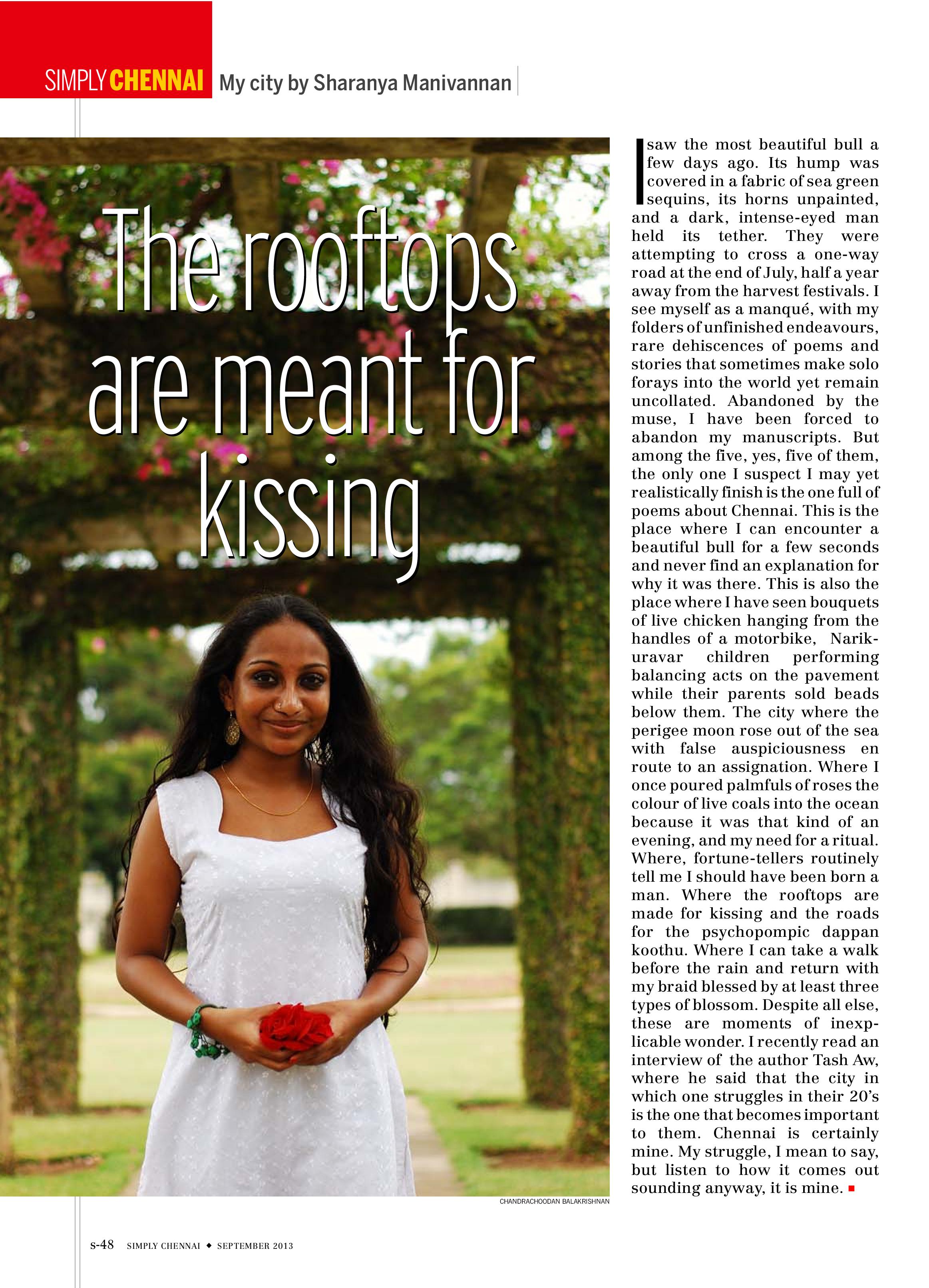
This appeared in India Today’s Simply Chennai supplement for their 8th anniversary issue.
 Sharanya Manivannan
You must be logged in to post a comment.