The Venus Flytrap: On The Sexism Of The Iconic Marriage Proposal

Borrowed largely from Hollywood, thoroughly supported by the wedding industry complex, and encouraged by the pressure and appeal of social media (“She said yes!”), the proposal has gained popularity as a nuptial rite of its own. Both in love marriages and modern arranged marriages with their tinny gloss of long engagements and staged meet-cutes, this gesture – often described as romantic – signifies a certain threshold in a relationship. Given the highly public nature of most marriage rituals, that a private novelty has gradually come to be included among Indian customs is a nice thing. Only, as we move away – as we must, if we believe in a better world – from traditional circumscriptions on marriage, it’s worth thinking about which notions of romance are worth preserving and appropriating.

The thing about the iconic wedding proposal – a ring, a bended knee, four scripted words – is that it is almost without exception, in heteroromantic contexts, performed by the man.

This would be okay if a proposal was just a loving gesture, and not a watershed moment which advances the status of a romantic relationship. Neither is it a request, because what comes after the famed question is an equally scripted reaction: surprise, excitement, and invariably, acceptance. The words “will you marry me?” sound like they are asking for permission, but in practice they are giving it. The surprise element is a decoy, unless the supplicant is truly clueless as to what the response will be (in which case, I hope there’s a sympathetic refund available for that bling). In the version of the script that we have all subconsciously downloaded, the woman has waited for it, and the man has decided on its timing. It was her waiting that was the true petition; he simply offers his agreement through the enactment of asking.

Marriage is patriarchal – but surely love is not so pathetic?

Sometimes a woman must say no, because that is her true answer. Sometimes a woman must pose the question herself, because she must pursue what she desires, and she need not wait for anyone’s validation of the same.

But more than either of those subversions, I like the idea of the decision to marry being a matter of consultation, a series of increasingly confident discussions. I fail to understand how one person asking a life-altering question and the other shifting quickly from astonishment to certainty inspires any trust in that couple’s ability to articulate, negotiate, and make choices together.

We haven’t evolved marriage out of our worldviews yet, and perhaps we don’t need to. But we do need to keep evolving its workings, questioning it as an institution and contextualising it in ways that emphasise individual wholeness and challenge structural inequalities, as expressed in misogyny, casteism, colourism, homophobia and other chauvinisms.

Let’s begin by falling in love. Let’s begin by being honest. Let’s do boring things like talking about whether or not to get married and radical things like changing the problematic verses and actions in the ceremonies. Indian marriage has so far been about social legitimacy, not about togetherness. Let’s begin by rewriting that script. Or better yet, let’s begin with no script at all.

An edited version appeared in The New Indian Express on April 7th. “The Venus Flytrap” appears on Thursdays in Chennai’s City Express supplement.
The Venus Flytrap: It Takes A Long Time To Grow An Old Friend

Once upon a time, I was in a little coterie with B and C (let’s call me A, then). There was also D, but D – well – was eventually a complete D to all of us, if you know what I mean. I became, separately, very close to both B and C. Adult life meant we all saw less of one another than we had when we first met. But I stayed in regular contact with them both, and they would each ask me about the other. “I miss B,” C would emoji me now and then, and because I missed B too I’d concur. But I didn’t know that where I only meant I would like to see B more frequently, C meant something else altogether.

No, this isn’t a case of B – C = exam (love)failure. That’s a topic for another set of initial-based pseudonyms! So one weekend, I suggested something logical. Given that B and I meet often, and C and I meet often, why didn’t we all just meet together?

Except that the day came and I flaked out. Sunday-slumped, I told B I wasn’t going to make it. I didn’t bother to tell C, thinking that they’d enjoy being together after such a long time and my absence might help them reconnect. But when C asked me where I was and I flippantly said, “oh yeah, didn’t B tell you I’m not coming?” I wasn’t prepared for the earful I received.

“I thought you’d like hanging out, considering how you’re always telling me you miss B,” I defended myself. “I had no idea that some other dynamic existed.”

I insisted that they meet, and C reported back to me. It turned out that B + C – A equalled shallow conversation, inability to share, and a total lack of meaningful exchange. “We talked about work,” shrugged C. “Office stuff.”

“Why didn’t you talk about the H situation or the O revelation or the X confession?”

“You weren’t there, na,” came the reply. “So how?”

How had I wound up being the proxy through whom two good friends conducted a non-friendship with one another? One devoid of acrimony or issues, but equally devoid of value?

In adult life, we often create ties knowing that they are water-soluble. Part of this no doubt comes from the heartbreak of watching seemingly close friendships dissolve like confectionery in the palm. But another part comes from sheer self-involvement, which can reflect as much in busyness as in laziness.

Not every relationship will weather everything. But those that do have one thing in common: investment. This is why I have what I have, separately, with B and C. In our respective friendships, we chose and keep choosing to put in the work of love.

It takes a long time to grow an old friend. Fleeting connections may be water-soluble, but friendships are like plants. They need to be watered. They thrive on things like dialogue, time, vulnerability, support, laughter and secrets. They cannot rest on proxies like alcohol, location, alumni reunions, or even a common companion. One doesn’t need a garden, just a windowsill of soothing, well-rooted green.

An edited version appeared in The New Indian Express on March 31st. “The Venus Flytrap” appears on Thursdays in Chennai’s City Express supplement.

The Venus Flytrap: Old Gods And New Ones

I’m often asked how I reconcile my irreverent delight in multiple mythologies with my, well, devotion. How can I say that Rama is a terrible husband, but still murmur a couplet from the Vishnu Sahasranamam to soothe my weary nerves? How can I light candles in churches, wishfully say “Inshallah” and also chant in Sanskrit? The answer is that I see story, history and spirit as distinct threads. Braided together, they make an ethos, one way to absorb and encounter. To be a human reaching for the divine is to have the humility to know that only by holding those threads as distinct in the mind can the braid then be experienced in polyphonic fullness, through the heart.

We have the capacity to accommodate variations, unpredictability and what might appear to be inconsistencies. In forests, I rustle with the thought of the Rig-Vedic Aranyani; pining, I reach for the Inuit Sedna: when I sense the feline mystique, I remember the Egyptian lioness Sekhmet. If a story soothes my heart, is it not a prayer too?

New deities are constantly being made, just as old ones are being retired (have you read American Gods, Neil Gaiman’s unputdownable novel about what happened to the figures of European folk religions, gradually forgotten by migrants to North America?). It’s fascinating how, on a national stage, the latest expression of patriotism is to pledge allegiance to one such new deity, an artistic creation of late 19th century Bengal.

So Bharat Mata’s official temple, which contains not an idol but a map of India, is one kind of religious expansion. There are of course shrines to film stars and politicians, replete with garlands and aartis. There are also those which emerge from organic impulses, rooted in faith and incident, such as two dog temples in Karnataka built in 2008 and 2009, respectively – in Channapatna, the canine is worshipped as an animal familiar of the village goddess; in Ranebennur is a temple to a pet that’s said to have miraculous posthumous powers.  The Bullet Banna temple in Rajasthan, which sprang up in 1988, has an interesting origin: a rider was killed one night, and no matter how many times the police took his bike to the station, it kept mysteriously reappearing at the site of the accident. The idol in the shrine is the bike itself.

In the 1970s, a Hindi film called Jai Santoshi Ma popularised a new myth about a daughter of Ganesha. Until the film’s popularity had women all over the country undertaking new fasting rituals, the spot of what became the “ancient” Santoshi Ma temple in Jodhpur had been a shrine to the folk deity Lal Sagar ki Mata. Presiding deities are replaced, subsumed, emerge elsewhere, become obsolete, turn into cult figures. This happens both naturally and through imposition.

Spiritual practice is not monolithic – as lived belief, it is constantly enriched and complicated by many sources. It is porous, subjective, disorganised. When we streamline it, let be strictly defined, and – most importantly – limit the rights of others to pursue it in their personal ways, we lose more than just entwined stories and manifold possibilities. We lose spirit itself.

An edited version appeared in The New Indian Express on March 24th. “The Venus Flytrap” appears on Thursdays in Chennai’s City Express supplement.

The Venus Flytrap: The Casual Casteism Of The Term ‘TamBrahm’

It was a night like so many others in my mid-twenties. My friends were already at the dimly-lit club, along with a very young couple, new to the clique. I was the last to arrive, and much inebriation had already taken place. “You must be a Tam-Brahm too, right?” asked the cheerful girl, shortly after we’d been introduced. Before I could launch into the response that my friends could expect of me, her boyfriend piped up: “No, she’s not. Brahmins don’t keep names like Manivannan.”

This is true – my surname comes from the Tamil bhakti movement; it’s in the verses of the Azhwars, including the foxy and mysterious Andal’s. Do I like my father’s name? Sure, I do. Am I proud of it? No, because pride is about achievement. I did nothing to achieve a poetic surname, just as my companions that evening had done nothing (not even karmically!) to be ranked upper caste. I was struck that a young person in a casual, urban social setting, that too in a state of intoxication, had maintained such a sound grip on how to peg people quickly. And the infuriating, ugly question thus raised: what could my caste background possibly mean to that setting?

Don’t get me wrong, it was a nice evening. But it was also an encounter that in many ways exemplified how caste still holds its gridlock in the minds of otherwise cosmopolitan – and even very lovely – people. I was raised abroad, of mixed heritage and caste-oblivious; I never encountered it as a personal marker until I tried to apply to college in India, at almost 20. This too was a privilege. Once I moved to Chennai, I found that almost all my friends came from atop the caste pyramid. This was not incidental: it spoke to the fact that the artsy, alternative, more affluent circles (what a Venn diagram; why aren’t our associations more diverse?) that I moved in were thus dominated. I was among the very few odd ones out, and was made, suddenly, very aware. Even if I hadn’t chosen to educate myself, there were countless slips, suggestions and jabs that reinforced the need.

I can relate several more of them to prove my point, but instead I’ll make a request: it’s time to retire the term “Tam-Brahm”. Don’t try to make a horrible thing sound hip. That it rhymes doesn’t make the history – or the present – it references any cooler, or more palatable.

When you sit with me – or to put a fine point on it, anyone who is not like you – in a conversation and cavalierly place the words “Tam-Brahm” on the table, it is more than just an uncomfortable allusion. It is a subtle act of aggression. Through this ID, what you make clear to me (perhaps unconsciously) are your rank in a hierarchy versus mine, your defensiveness about the caste system, your negating of centuries of violence, oppression and inhumanity, and most of all, your unapologetic embrace of all the same.

Casteism will not die until caste does. And you are so much more than what your ancestors did to other people – including, perhaps, to mine.

An edited version appeared in The New Indian Express on March 17th. “The Venus Flytrap” appears on Thursdays in Chennai’s City Express supplement.

The Venus Flytrap: Not This, Not This | This Too, This Too

There’s a love that looks like no love you’ve ever seen. And on some days, and certain nights, you can almost convince yourself that it looks for you, too.

Almost. The deeper you travel into a life of your own design, the further away the mirage of a co-sojourner appears. There is no one who falls asleep thinking of you. The face you see when you wake up is your own, in a mirror, all evanesced dreamscapes and smudged kohl.

But you must indulge it, a little dulcet speculation. You parse the present as though it already comprises kernels of a different future. Everything that has happened to you has happened in the absence of the one who loves you, who does not know it yet, whom you contain no memory of. The world appears less maimed through this awareness, this version of the story in which there is someone you would walk through the rain to meet, had you only known how to reach their door.

What you do contain, positively, is wisdom. It beams in you like a blacklight tattoo when you need it most. Like that night when you came home after seeing someone so perfect you could have sworn you wrote them into being, but you couldn’t sleep, and not because you’d been hit by lightning. There you were, your palm on your chest at 2am, breathing deeply, sitting still and listening to your heart. How it wouldn’t stop saying, “neti, neti.” Not this, not this.

“Not never, but not now,” you explained to those who were dismayed. But even then, you knew.

A seer tells you to say affirmations to draw love into your life. A priest prescribes garlanded circumambulations. A doctor puts you on multi-vitamin supplements so your hair might stop falling out and you’ll have the energy to go dancing. A friend downloads another app into your phone. You’ll do some or all or none of these.

But mostly you’ll just do what you have to do. You’ll return to the poems, and when the wish to mouth their magic into someone’s ear becomes too much, you will go to Rilke’s “You Who Never Arrived”. You don’t cry like you used to, emotion billowing from you as unmistakably as a bullfrog’s throat. Your sorrow gets mistaken for anger. Your strength for coldness. Your grace for forgetting. Now your tears are scant and taste like tea steeped far too long.

And the flights of speculation too grow fewer, which is why you notice them, lift them to the light in curiosity. There is nothing to anticipate. Days and nights of lacklustre certainty. And it’s you who must tell your heart, this time: “Iti, iti”. This too, this too. Even this. This with its saudades. This with its cosmic signs that anagram to red herrings. This with its gambles made on someone else’s loaded dice (but you’ll make them anyway). “Heads you win, tails I’m lost” – that country ballad by Jewel you’re surprised to remember, so many years later. This now, this here, this always – with its almosts that only almost count.

An edited version appeared in The New Indian Express on March 10th. “The Venus Flytrap” appears on Thursdays in Chennai’s City Express supplement.

The Venus Flytrap: When The Devadasis Were Virgins

Aruna Sairam shuffled onto my playlist with a song of a longing devadasi, and I called a friend who knew it well. He had the original Telugu text of Paiyyada, while I pored over an English translation. Together, we transliterated: ‘The one who rested his head on the fabric over my breast is embittered by me – aiyo…” At the end of our spontaneous cultural salon, he mentioned another Kshetrayya padam, one in which the raconteur says frankly to the deity Konkaneswara that it will cost a hundred gold coins just to enter her house, and three crore to kiss her.

The poem reminded me of one of my favourite devadasi songs in Tamil, which goes – “kathavai saathadi / kaasilathavan kadavul aanalum, kathavai saathadi”. “Shut the door, girl – if he’s empty-handed, even if he’s god himself, shut the door!”

When Rukmini Devi Arundale appeared on a Google doodle last week, it was the devadasis I thought of again. In the 1930’s, Arundale appropriated the devadasi dance known as sadir, angularised its sensuality, censored its eros and turned it into the caste-privileged form renamed as Bharatanatyam. This was part of a larger project of erasing their matrilineal, woman-centred culture, which had garnered disrepute (it came to be banned all over India). This should be widely-known, and isn’t, because of the sheer domination of one narrative over another. Before their fall from grace, devadasi women from as early as 8th century were known as: dancers, musicians, multi-linguists, land-owners, endowers of public infrastructure, impresarios, polymaths and poets. Today, they are dismissed as sex workers.

We forget them both: the mid-20th century devadasi in a system of ruin and abuse, and the medieval devadasi whose empowerment and erudition remains beyond what many women enjoy today.

I’ve also been reading about the Asur people of Jharkhand and West Bengal. I heard about them just a few days ago, when their traditional telling of the epic battle between Durga, my beloved goddess, and the buffalo Mahishasura, whom the Asurs trace their lineage to, became the stuff of headlines. A fascinating alternative rendering, not unlike how Ravana has the sympathies of Tamil people.

But I’m not convinced that the story we’re being told is the one the Asurs themselves tell. When the word “prostitute” was raised in reference to Durga, as a means of literally demonising those with this belief, I wondered – what if the original word was “apsara” (like the transgendered Mohini, who used her seductive charms on asuras too, before she bedded Shiva). What if, indeed, the word was something like “devadasi”? And if it was “sex worker” – well, as a woman who happens to be Hindu, I am frankly more offended by misogyny than blasphemy.

Another mythological word we misunderstand is “virgin”. It means a sovereign woman or goddess, by no means devoid of sexuality, and in complete control of her own. Hence, unmarried. Like a devadasi was, except to her god and her art.

Myths are full of history, and history is full of myths. We can love their messy richness, and if we must sieve them of anything, let’s sieve the manipulations that serve only their blinkered tellers.

An edited version appeared in The New Indian Express on March 3rd. “The Venus Flytrap” appears on Thursdays in Chennai’s City Express supplement.

“Karaikal Ammaiyar And Her Closet Of Adornments”

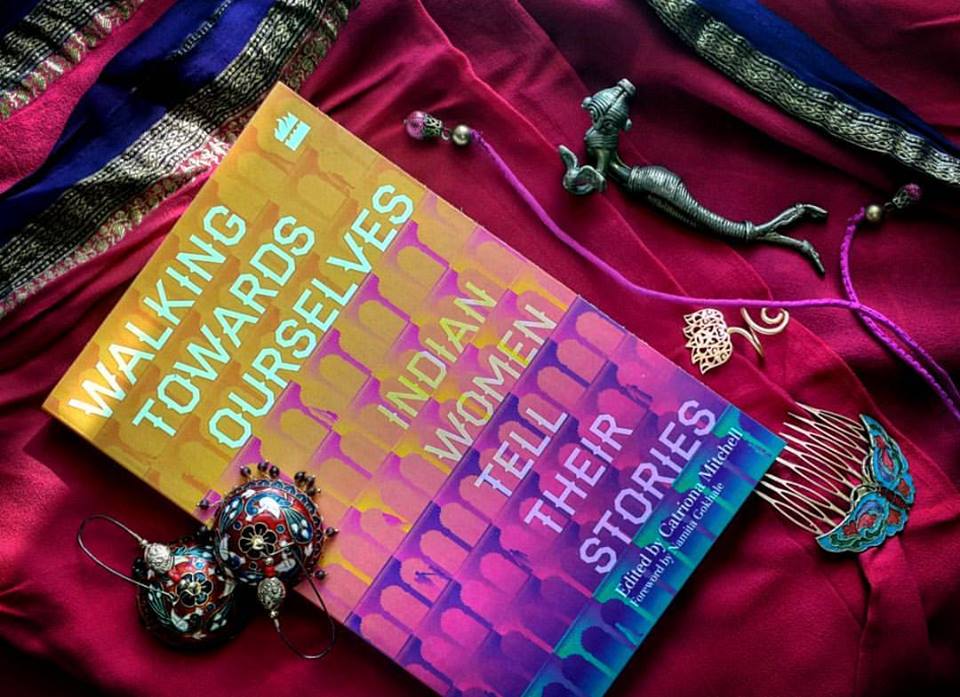
I’m so very delighted that my essay on femininity, fashion and exile, “Karaikal Ammaiyar And Her Closet Of Adornments”, from the anthology Walking Towards Ourselves: Indian Women Tell Their Stories (HarperCollins India/Hardie Grant Australia), has been republished in The Ladies Finger. I hope you’ll enjoy reading it.

The Venus Flytrap: Dialogue Is Protest

Many years ago, I was playing with a then 6-year old cousin of mine when for reasons I cannot remember, the second World War came up. What I do remember, however, is having to sit him down and as gently as possible explain some of the human costs of that era. I remember him quietly and seriously absorbing what I was telling him, wrapping his understanding of the world around this difficult, new information.

You already know this difficult information. You encountered it in your textbooks, as my cousin did eventually, because your textbooks included it. Textbooks do not include everything. And while it is easy to look at streamlined history in hindsight, it is not easy to watch it unfold or to prod at silences and erasures. So we look away, convinced we are not a part of what proceeds. And by doing so, we become complicit.

Recently, I’ve found myself doing for adults what I had to do for my cousin as a child. I’ve had to ask them to join the dots and consider how their personal experiences of gender, caste, language, race and other defining barriers are connected to the way power is structured, formally and informally. And to ask them what they mean, when they repeat what they’ve heard elsewhere. I’ve even had to ask them a question that makes me feel ashamed to have to put to any person who has gone to school: do you read before forming opinions; and what do you read?

In doing so, I’ve laid my own principles open to interrogation. I’ve laid myself open to hostility. I am tired, I am frightened, but my conscience demands that I engage. What motivates me to have these dialogues is not the need to impose my perspective, but the bleak awareness that alternate perspectives are rarely provided with compassion, without resorting to belittling. This is true for all sides.

Which is why, as much as possible, what I try to do is ask.

If you are worried about fundamental freedoms, you probably feel cornered of late. You don’t have to march at a protest or be active on social media to feel the corrosion even in your personal interactions. ‘Are we really so few – those of us who care?’ you wonder. Maybe. But couldn’t it be that people don’t care mainly because they don’t know?

The resistance is not to an open mind, but to that profoundly scary step of leaving a comfort zone of distraction and denial.

How did you develop your views? For instance, for myself, I know that having felt like, and been, an outsider from childhood is probably why I gravitate toward the underdog. Let’s think about how people come to social consciousness, and make it easier for them, rather than simply attacking their ignorance.

It is true that propaganda is, sadly, more effective than conversation. Fear and laziness allow for that. But my belief is this: instead of shouting back at structures from an ivory tower of our own, let’s talk. If it’s people we’re fighting for, it is people we must talk to.

An edited version appeared in The New Indian Express on February 25th. “The Venus Flytrap” appears on Thursdays in Chennai’s City Express supplement.

The Venus Flytrap: Wild Song

Sometimes the forest stretches her limbs, lets loose her hair so its tendrils unfurl – a little like territory flags, but those are human contrivances – into the places in our lives where we have forgotten her.

She reminds us. She asks that we watch, and that we listen for her. On certain city roads, there is an even keen of insect sounds that surrounds us for exactly as long as we ride under an arbour of embracing branches. Then we re-enter the sunlight and that forest essence vanishes.

Do you hold your breath under that canopy cover? Do you slow down?

So I both wonder and don’t have to wonder what he’s thinking, the leopard who was caught in a Bengaluru school last week. He was tranquilised and captured, and has since fled his cage again. He is at loose in the Bannerghatta National Park, his habitat, as I write this. It takes only minimal empathy to imagine why he might abhor his cell. Around the city, there other sightings. What could they be: tricks of the eye, wishful mirages, or truly: animals of the wild, wandering?

The forest seeps into civilisation in ways brutal and beautiful. Sometimes, both at once. In Munnar, mountain elephants stumble onto highways, lumber into jeeps and onto people. In the Sundarbans, tigers whose ecosystems are ravaged by natural upheaval seek human meat. Meanwhile, at the BRT Tiger Reserve in Karnataka, where Soligas live alongside them as per longstanding tradition, the tiger population doubled between 2010 and 2014, and no animal-people conflicts occurred. In times of disaster, there are rumours circulated about beasts escaping captivity: about disintegrated walls at Vandalur Zoo during the recent floods, for instance.

Tell me who among these is most brutal: the lost one, the lacking one, or the liar?

So one reads about these leopards, at a safe distance admittedly, and watches and wonders a little more.

Sometimes, I sit with people and sense the sea in them calling. Or the mountains, or the starlight. Or once in a while, in the aura of a particularly battle-weary individual, the desert. Most of all, though, it’s the sea – biologically, our bodies are made almost entirely of water. A sun-kissed beach and a cliff-jagged coast will each offer a different conversation, but it is nourishment just the same.

The forest calls to me often, and even if I no longer chase its song, I know its resonance. Amidst the vehicle horns of the city and its bandage of artificial light, I seek it. And in doing so, invoke it.

I am waiting for April, when a particular jacaranda tree will empurple my daily route. I am waiting for a dark crow taking shelter among tamarind pods on a day of rain. But most of all, I am waiting for escape: for the helix of a montane highway, for the bite of clear cold air, for a place where I can sink my feet into the lush red earth and know it to be a homecoming.

An edited version appeared in The New Indian Express on February 18th. “The Venus Flytrap” appears on Thursdays in Chennai’s City Express supplement.

The Venus Flytrap: A Candlelight Dinner With A Difference

“No, I won’t write about Valentine’s Day!” I texted my friend back, when he suggested the topic. I’d barely hit Send on my next line – “V-Day is vaandi-day only” when I remembered that for several years as a politically-aware young adult, I had refused to acknowledge the romantic festival because I believed so strongly in another V-Day.

V was for Vagina. V was for Violence. V-Day was the global movement founded in 1998 by playwright Eve Ensler (who created The Vagina Monologues) to fight violence against women. February 14th is where you’ll find it on the calendar, and it began as a series of fundraising performances of the play, and expanded to include a variety of artistic and political forms of grassroots engagements worldwide, all of which confront and try to change the disgraceful UN statistic that 1 in 3 women will be beaten or raped in her lifetime.

I couldn’t ever observe Valentine’s Day, knowing that it is in intimate relationships that this abuse is most pervasive.

“Do I write too much about women?” I started texting my friend, and once again I corrected myself: I realised that when we talk of violence against women, or any form of gender-based violence, we need to stop calling it a ‘women’s issue’. If anything, it’s more of men’s issue. It’s an issue of toxic masculinity, of what happens to men in any society that demands that they be unemotional, aggressive and authoritative. Women aren’t the problem. Men aren’t the problem. Patriarchy is.

I had never stopped believing in its principles, so why had I somehow forgotten about this other V-Day? It was probably because once I moved to India, I discovered that Valentine’s Day itself is subversive. To declare romantic interest or sexual involvement under the hostile watch of right-wing ideologies and discriminatory constraints is itself a radical, and therefore dangerous, act. Every year, couples are attacked, forcibly married or forcibly separated, by powers-that-be that do not recognise the power of love.

Don’t get me wrong – it’s probably healthy to crinkle one’s nose at least a little at saccharine hormonal garblings and socially-pressured exhibitions of rosy veneers. But let’s not forget that to feel love and not be ashamed of it is a human right. And before we celebrate it, let us first demand and exercise that right. It belongs to people of all genders, across all castes and communities, and of any sexual orientation.

So if you’ve got a candlelight dinner planned this weekend, why not bring that awareness to the table? Light at least one candle in memory of someone killed for falling in love with someone of a different religion, or someone driven to suicide because they were bullied for being gay, or even an ancestor of your own who was forced into an arranged marriage while the heart longed for deeper companionship. And maybe light another candle for the other V-Day: in memory of a woman lost to violence in a bond where there should have been love. Bring the revolution to the table, let it illuminate the conversation, and see if it doesn’t change your relationship for the better too.

An edited version appeared in The New Indian Express on February 11th. “The Venus Flytrap” appears on Thursdays in Chennai’s City Express supplement.

The Venus Flytrap: Dear Mrs. XOX…

The other day, I received an email that could have been a threat, a case of mistaken identity, a prank, or a strategy by some slick operator. The sender warned me to stay away from their boyfriend – let’s call him Mr. XOX. They’d even created an email address expressly for this purpose – “Mrs. XOX” was their chosen pseudonym. Considering that I don’t know anyone by that name, I had no initial clue what to make of this.

Bizarrely enough (and this is where the slick operator suspicion comes in), Mrs. XOX told me, in explicit terms, that women crave her boyfriend due his impressive appendage. She also told me to delete a particular number (which, of course, I never had to begin with). Yup, my poison penpal gave me the phone number of a well-endowed man.

First, I laughed. And then, just in case this sender was real, I felt very sorry for anyone who’s been driven to such insecurity in a relationship.

So, Mrs. XOX, if you’re reading this – I want you to know first of all that I don’t know and have never met your boyfriend. I’d never want to meet him either, because something tells me he doesn’t treat you right. And I don’t like to be around those who disrespect women.

Maybe you’ve written to me because your boyfriend put the idea into your head that he’s involved with a stranger. This tactic is called gaslighting. It’s when someone controls you by convincing you of a false reality, wearing away at your reason and intuition, until you can no longer trust yourself. As a result, you become paranoid and are driven to extreme behaviours. Gaslighting is one of the most common tactics of emotional abuse.

I want you to know, Mrs. XOX, that emotional abuse is abuse. Don’t be afraid to call it by its name. It happens to the best of us.

You’re not crazy. You’re not possessive. You’re not desperate. These may be words you have been called. But they are not who you are, they are just the effects of this abuse.

But those harsh words are not what other women are either. If he has cheated on you, remember – that was his decision. The fault is entirely his and you can blame no one else. If he has made you hate and punish other women, he has made you hate and punish yourself. You must look squarely at him and see him for who he is. And then, freed of the need to possess or belong to him, begin the process of rebuilding who you are.

Most of all, Mrs. XOX, I want you to know that I don’t mean to insult your intelligence. You probably know all of these things already. I’m only here to remind you: you deserve so much better. This is not what love is supposed to feel like.

Maybe you’re Mrs. XOX. Or maybe you’re someone like her – pushed beyond your pain threshold out of love. My wish for you is this: walk away. You will heal. You won’t need to be Mrs. XOX when you can truly be your own person.

An edited version appeared in The New Indian Express on February 4th. “The Venus Flytrap” appears on Thursdays in Chennai’s City Express supplement.

The Venus Flytrap: #SorryNotSorry? #NotOkay.

Over the weekend, I strapped on a pair of red stilettos for a poetry reading organised by the feminist think-tank Prajnya. The theme of the event was “Zero Apologies”, and the poets shared writing in Tamil and English about being forthright, without fear. For me, I find that the first line of apology begins at appearance. I enjoy clothing, ornamentation and maquillage – but my enjoyment of the same is where external judgement of me also begins. It’s a topic I explore at greater length in an essay in a new book called Walking Towards Ourselves: Indian Women Tell Their Stories, but for now, suffice to say: I wasn’t sorry at all for the thigh-high slit in the skirt I wore that evening, and I laughed off the fact that my gorgeous shoes were falling apart even as I stood in them.

What an empowering thing it is to stop apologising for being ourselves.

But even as I said yes to “Zero Apologies”, and was delighted to express none whatsoever, something lingered in my mind and it wasn’t just good manners. While preparing for the poetry recital and finding poems that suited the subject, I found myself thinking not only about when we should never apologise, but also about when we really should.

‘Sorry’ is a beautiful word. We say it both as a habit and as a force of conditioning that makes us downplay ourselves, but swallow it at the moments it is made for. We apologise, unnecessarily, for our necklines, our ambitions, our tears, our uncertainties, our emotions. We say the word for all the wrong things, but we’re miserly with it when we’re actually wrong.

I thought back to a few recent instances when I have said it and meant it, a strong word used to keep small lapses small. Once, when I didn’t make it to a dear one’s special occasion; once, when I apologised on behalf of someone I felt responsible for; more than once, when busyness or hunger made me snappy. And I thought further back into the past, to times when my apologies were insufficient. Because sometimes ‘sorry’ is just a placeholder, a way to salve things so they can be worked on slowly. When you have caused damage to another, you cannot justify having done so. You can only say, unequivocally, that you will try better. And then do.

Only in its most routine or manipulative deliveries is ‘sorry’ anything other than a starting point. Because, by itself, it’s never enough. It’s only the key to rebuilding, not an end to itself – and this is where we falter. We misunderstand both apology and forgiveness, centring them on incidents and not on understanding.

I will never apologise for being strong, dedicated, principled or flamboyant. But I will apologise for my blind spots, misreadings, temper and wickedness, should I have the clarity to see them, even if only much later.

And call me old-fashioned, but the one thing that I most believe no one should ever apologise for having or expecting? Good manners!

An edited version appeared in The New Indian Express on January 28th. “The Venus Flytrap” appears on Thursdays in Chennai’s City Express supplement.

Walking Towards Ourselves: Indian Women Tell Their Stories

In “Karaikal Ammaiyar And Her Closet Of Adornments”, I write about personal style as a mode of self-expression, and self-concealment. I write about the pleasure of the perfect drape, the passion of red lipstick, and the heartache of living in a time when beauty and power cannot always co-exist. This essay is in the new anthology Walking Towards Ourselves: Indian Women Tell Their Stories, edited by Catriona Mitchell. The book is out now from HarperCollins in India, and Hardie Grant in Australia/the UK shortly.

karaikalammaiyaradornments