The Venus Flytrap: Worn On The Sleeve

There’s a scene in the heart-wrenching 2008 film Frozen River, in which two impoverished women who smuggle people across the US-Canada border bring a dead baby back to the parents it was separated from. One of them drives, instructing the other to hold the baby close to her body so that the corpse will not be cold when they hand it to the mother. Something miraculous happens, somewhere between the warmth of the jacket the child is wrapped in, the skin it is close to, and perhaps the familiar sound of a heartbeat.

For some reason, news of US First Lady Melania Trump travelling to and from a child detention centre wearing a jacket with the words “I really don’t care, do u?” (sic) reminded me of this movie, and this scene in particular. It does not matter that she reportedly didn’t wear it inside the centre, one of several where children separated from their families at the US-Mexico border have been detained. Many of those children don’t understand English. Some of us, watching, do. And we do care, but the message wasn’t for us, either.

Some style statements are literal. Propaganda through fashion – and specifically, through styles created by private manufacturers not directly affiliated to governments – is not just for those in the public eye, as Ms. Trump’s own $39 Zara jacket is an example of.

During World War II, textiles with lively prints were produced in the US and UK with concealed messages. An attractive red dress with black and white patterns donated to the FIDM Museum, Los Angeles, sewn in the 1940s, says in reversed writing: “There’ll Always Be An England”. Its wearer would be able to read the text when examining herself closely in the mirror, but would likely walk by countless people who did not catch its hidden message. In Japan at the same time, omoshirogara kimonos, depicting scenes of war and victory, were worn privately. The fabric was sometimes used as the inner lining of kimonos worn outside. India’s khadi movement was a public display of political sentiments. Charles Dickens’ novel The Tale of Two Cities features tricoteuses, women who knitted the names of those sent to the guillotine into their purls. Historically, women in the spectator seats of executions were indeed known to knit. Among their goods was the Phrygian cap, which unlike a crown was a symbol of democracy.

Zara didn’t just make a random jacket put to strategic use, for in the recent past it has also used anti-Semitic and white nationalist motifs on clothing. Neither did Ms. Trump, whose image is carefully crafted, just throw on an outfit. It’s the kind of thing an obnoxious teen might wear to dinner with his parents, except that on her and on this occasion it was more like Cruella de Ville’s Dalmatian fur coat.

Here’s a tiny consolation: in 2017, Turkish shoppers discovered notes sewn into Zara attire by unpaid workers hired by a factory which also made Mango and Next products. These notes brought attention to their plight, shared by workers worldwide. Some opinions are worn on the sleeve; but some truths are sewn into the seams.

An edited version appeared in The New Indian Express on June 28th 2018. “The Venus Flytrap” appears on Thursdays in Chennai’s City Express supplement.
The Venus Flytrap: Kilaeua and Kahlo

It’s said there’s “nothing special” about the tiny green stones that appear to be raining from the sky in Hawaii – fragments of the mineral olivine, spewed in the lava from the ferociously erupting Kilaeua volcano. Even peridot, the gemstone that can be found in the mineral, isn’t considered precious because it’s relatively common. But it looks like it’d be beautiful cascading from an ear, and be comforting to hold, like any quartz. Most of all, looking at pictures of olivine, I wonder how it might catch the light. Why is it not special?

Kilaeua is the goddess Pele, who created the Hawaiian archipelago, and I’d seen her picture too. This deity of fire makes her presence known on camera, and there are several images of a womanly form emerging from the point where lava spills into the ocean, or rising in the glow from a crater. Sometimes, a face in seen in plumes, or the lava takes the shape of other body parts.

I listened to the musician Kekuhi Kealiʻikanakaʻole speaking about Pele and her present activity on Hawaii Public Radio. She says that beyond all human imagery, Pele is quintessentially the magma itself.

Kekuhi describes a profound relationship with “the Tutu”, as Pele is respectfully known, deeply connected to her body. The word she uses is “enlivening”. Her body and mind are enlivened by volcanic activity. This is more than intuition – it is connection. She expects Pele to shake, rather than predicts this. Beautifully, she tells her listeners that happening before their eyes are the kinds of events that inspired the myths themselves. “Write it down!” she insists, for they will become new songs, new dances and new chants.

Some nights ago I woke with a melancholy that made me obsess over a quote widely attributed to Frida Kahlo. I searched through a book of her letters and couldn’t find it. Then, I discovered those words weren’t hers at all, but the Mexican poet Estefania Mitre’s. Here they are: “You deserve a love that wants you dishevelled, with everything and all the reasons that wake you up in haste, with everything and the demons that won’t let you sleep. You deserve a love that makes you feel secure, able to devour the world when it walks with you, that feels your embraces are perfect for its skin. You deserve a love that wants to dance with you, that goes to paradise every time it looks into your eyes and never gets tired of studying your expressions. You deserve a love that listens when you sing, that supports your ridiculousness, that respects your freedom; that accompanies you when you fly and isn’t afraid to fall. You deserve a love that takes away the lies and brings you illusion, coffee, and poetry.”

Were the words less powerful to me because Frida’s force of character was not behind them? For a moment, yes. But then would olivine, barely a gemstone, also be less pretty if it wasn’t a symbol of Pele’s grace? That night, I let those often-stolen words comfort me, for they too felt like a small crystal on the skin, they too caught the light.

An edited version appeared in The New Indian Express on June 21st 2018. “The Venus Flytrap” appears on Thursdays in Chennai’s City Express supplement.

The Venus Flytrap: Don’t Compromise

Nearly a decade ago, I took some of the worst advice I’ve ever received. It was in the form of this unforgettable, but retrospectively mystifying, line – “You have to decide – do you want to be a full woman or a writer?” The person who said it was encouraging me to quit my job and be footloose and foolish, both nice and sometimes rewarding things for a young person to be. It was superficial advice without logistical backing, conveyed by someone not only with tremendous privilege, but who knew exactly what the effect on a vulnerable, hopeful person would be. It was cruel advice designed to ensnare: I would either choose “writer”, and suffer without grounding, or choose “full woman”, and simply leave the playing field. Either way, very little art would be made.

She knew I’d choose “writer”. I was fortunate to eventually be able to walk back some of my choices, and recoup some losses. But to this day, I’ve no idea what was meant by “full woman”, but an old note I found trying to work it out begins on an eerie and absolutely revealing line. “I don’t believe in sisterhood.” Certainly, the advice-giver wasn’t a fan of other women. So when she told me that it was alright to be financially dependent for the sake of art, what she was really saying was that it should not be possible for women to have full lives.

While I was still young enough to be living out that advice with relatively little consequence (there’s a finite period of time during which you can still do this; the trouble is that once you’re in the hold of that floating life, you won’t recognise when its expiry date has passed until your life blows up), I received completely contradictory guidance from someone who had equally wanted to ensure that I wouldn’t make art. She was not as eloquent as the earlier advisor, which is why only one line remains in memory – “You were younger then. You’re a woman now.” Funnily enough, this advice too had to do with being a woman. The advice was to “choose” to compromise making art for the sake of the security of a full-time job, and to also give up any hope of leaving a situation that did not feel like home. I was a little older, true, and so I recognised: the advice-giver, stuck in a painful place of not being creative, just wanted company.

These two encounters were far from the only ways in which people I’d cared about or respected tried to thwart my growth as an artist. They are good examples, though. The first encounter was with someone powerful, the second with someone who was also struggling artistically. Both harboured bitterness. They are also archetypal, and many promising artists meet them in the forms of mentors and friends along the way. They may be gatekeepers, artists or peers. Such an influence is partly why so many promising artists also disappear. When they offer you a trap that implies that making art is a sacrifice, self-indulgent or an obligation, remember: it’s not, and you don’t have to choose.

An edited version appeared in The New Indian Express on June 14th 2018. “The Venus Flytrap” appears on Thursdays in Chennai’s City Express supplement.

The Venus Flytrap: In Defense Of The 13th Fairy

Some time ago, I’d been travelling in a rather boring but reasonably picturesque small town which thanks to its appearance in a few films had started to gain the attention of honeymooners. Labouring under the impression that someone who had broken the heart of one of my loved ones had taken his parentally-ordained bride to this town, I spent my time there quite pleased that it had little to offer (unless you have very special company, in which case every place is Paris anyway). Taking in the relative lack of charm, I looked forward to presenting proof of the heartbreaker’s ambivalence towards his own honeymoon.

Imagine my shock when I returned from that trip to find this loved one was getting re-engaged, to a person she’d been unceremoniously dis-engaged from once already. As for the unimaginative honeymooner – in one of those juicy jinxed nuptial details, he came along with his spouse to the re-engagement function, held recently. Oh, and it turned out they hadn’t even been to that cinema-friendly location. That was a mishearing repeated to me. They’d been somewhere much lovelier, with a name that was almost a homonym. Oh, whatever – I’d quite liked that dull little town in the end.

I wasn’t introduced to the heartbreaker at the re-engagement, but I should have been, given that I was once again playing my esteemed role of “always the 13th fairy and never the bride”. As a fellow disruptor, he could have been my sidekick. If I could resist kicking him, that is.

In fairy tales, the 13th fairy is the one who, deeply miffed that she hasn’t been asked to attend the naming ceremony, coronation or wedding, shows up anyway (wearing brocade and bright burgundy lips, naturally) and pronounces a delicious curse that sets the ball rolling for the rest of the story. Drama! She might be the black sheep of the family or the goddess Eris of the golden apple, but if it wasn’t for her there’d be no one to blame but poor decisions and basic incompatibility. Oops.

No one crashed the event. We’d all been politely, obligatorily and cordially invited. But trust me not to bite my tongue. Before, after (and in what might have been whispers if those in earshot hadn’t laughed – during).

See, I think the 13th fairy gets a bad rep. What’s the backstory? Was she not invited because she knew the bride embezzled money from her friend’s start-up to pay for her dowry, or because she knew the dowry-guzzling groom was still seeing his ex? Because the families involved were too busy trying to sabotage each other to be concerned with etiquette? Because there was a hierarchy involved and she was all about subverting the dominant paradigm? Or maybe because she was the only one who – engine running on the getaway car – would look her betrothed loved one in the eye and ask, “Are you truly sure you want this?”

That’s not a curse – that’s compassion. Fairytales conveniently end on the wedding, remember? Given the state of the institution of marriage, historically and in modernity, I don’t mind being the 13th fairy. Somebody’s got to be.

An edited version appeared in The New Indian Express on June 7th 2018. “The Venus Flytrap” appears on Thursdays in Chennai’s City Express supplement.

The Venus Flytrap: Sri Lankan Saudade

Because I am almost never in Sri Lanka, but my heart – like the south-seeking gaze of Vishnu-Ranganatha, who was also meant to live on the island but doesn’t – is always turned in that direction, I obsessively watch the Instastories of a friend of mine. A few seconds of tuk-tuk sounds accompanying the sights of a backstreet of Colombo. Rain dripping off low-hanging leaves on trees by the Kallady lagoon. Sun-kissed beach tides. Sights that have precise impacts in places in this unhomed heart of mine. Like me, she is diasporic Tamil, with some metaphysical umbilical cord rooted in the dust or immersed in the waters of Batticaloa. And she is leaving the country for a while – which means I am going to be deprived of my vicarious living for a while too.

I was supposed to have gone to see her before she leaves, but I’d been foolish. I’d been swayed by a sort of empty promise and not made independent plans in time. How am I going to get by without her daily glimpses? Ridiculously, I’m so sad that she tried to console me. But, as I said to her – “Maybe to be an island girl is to always have a little sadness”.

The Portuguese and Galician word saudade captures that emotion – a word often described as untranslatable, but with equivalents in many languages. Missingness in English, hüzün in Turkish, Sehnsucht in German, keurium in Korean and natsukashii in Japanese are among some – all conveying a certain wistful melancholy. Saudade is also a musical undertone, most famously evoked by the Cape Verdean singer Cesaria Evora (another island girl – or most accurately, a woman of many isles). What would the Tamil word be?

Without boring him with the backstory, I asked the translator Chenthil Nathan. He gave me the beautiful ulluthal – to think back. The word reminded me of ulloli – inner light. The last time I was in Batticaloa, I’d stood in my ancestral temple with my heart sinking to hear Sanskrit hymns. Just six months earlier, the prayers had been in Tamil. The native religion and culture are disappearing – no, they are being disappeared, in favour of the monolithic. I ached, and actually prayed to hear Tamil – and then I did. As the priest and the crowd moved away, a woman’s soft voice rose in song. I found its source, and sat down to listen. Quietly, she was singing to our goddess from a booklet. I brought that booklet back with me. It was called Ulloli.

Then, Chenthil remembered and gave me what he called “a poetic phrase” – nanavidai thoythal, or soaking in dreams or memories. I asked him if he had found the word in a specific text. His answer brightened this un-homed heart of mine: “I read it first in a Jeyamohan essay. Most Sri Lankan writers use the phrase. S. Ponnudurai wrote a book with the same title. So I assume the phrase came from Sri Lankan Tamils. Thinking now, it is natural the Lankan immigrants formed a word for nostalgia.” Indeed. A word, a way of life, some moments that disappear like Instastories, some yearnings held steady, some meanings reclaimed.

An edited version appeared in The New Indian Express on May 31st 2018. “The Venus Flytrap” appears on Thursdays in Chennai’s City Express supplement.

The Venus Flytrap: … And Clap At The End Of Your Lonely Performance

Everything moves too quickly, and my worries pulse through me continuously, undercurrents to my every action. I gift myself inaction every day through a practice of stillness: watching the light seeping out of the sky, spilling on leaves. That was where the message from my friend Arjun Chaudhuri found me. Our conversation ended with him sending me an emoji of a peach hibiscus. I was sitting on a damaru-shaped stool of rope and rattan, a real peach hibiscus in bloom before me. I’d been watching it when he’d texted. I held my phone up to take a picture of it for him, pixel to petal. In return, a sound note – him in a voice he called broken (it was not) – singing a Bengali poem from hundreds of years ago. Translate it for me, I demanded. And he did: “Ever blissful Kali, charmer of Mahakala, you dance on your own, and sing on your own, and clap at the end of your lonely performance.”

If I call myself unbroken – do I mean as yet, or do I mean that the shattering has been reversed? He called his voice broken, while my hearing could only sense repair.

You don’t know how much I resist them, these pithy ways of understanding life through idleness. But still they come to me, every day, soothing me in this practice of stillness and watching. Do you know that you can only smell petrichor – the scent of water mingling with dry earth, often called the scent of rain – in your potted plants if you don’t water them well? You can’t have both, you see: the pretty word and the lush garden. Not in our sun-scorched climate, our stormless lives. Some days you get to be the poet wearing flowers from her own garden in her long, loose hair. Most days, though, you only get to wait, to water and wish them into bloom.

I probably will not be here much longer, in this particular home with its particular view. I cannot untwine my creepers and take them with me, unless I cut them down to a carry-able size. And can I bear to take a few, and not others? To watch plants thrive is also to sometimes watch them wilt, and die, and because of this I see no reason to not simply start over somewhere else.

This week I’ve been reading about Pawnee White Eagle Corn, a crop that was revived from near extinction. When the Pawnee Nation were exiled within the United States in the 1870s, 50 kernels of their sacred corn – white, with a purple smudge that looks like plumage – were safeguarded and passed down through generations. It has now been carefully, successfully, recultivated.

Why meditate today on the flower that blooms but a day and not the seed that carries its quintessence through centuries? This is why I love my practice of watching and stillness so much. It allows me to take whatever I need at any time: mixed metaphors, mixed blessings, prosperity and decay. Radiance, or resilience, or both. My heart whispers clearly to itself, looking at my plants. And sometimes, across distances, someone sings to me.

An edited version appeared in The New Indian Express on May 24th 2018. “The Venus Flytrap” appears on Thursdays in Chennai’s City Express supplement.

The Venus Flytrap: Highways On The Heart’s Journey

There are two places on the Chennai-Dindivanam highway where the road curves alongside a wall of sheer rock, the side of a hillock cut down to make room for traffic. Once, a long time ago, driving during a thunderstorm at night, I rested my arm on the windowsill and woke from my sleep just enough to notice the jagged rock, painted with graffiti, and the lightning that illuminated it. I smiled, just then, that night, for the day we had just enjoyed in a town to the south. My oldest friend, her cousin and I. The memory came back to me again a few days ago, driving down that highway and back by daylight. And in the way that memory sieves and keeps the oddest things: I remembered how in years past, the radio signal would turn to static along that wall of stone, and noticed how it did not this time.

Why did some part of me wait to see that rock face as though it was someone I knew? I realised this only as we passed by it, and I felt for some strange reason something resembling joy. How is it that the memory of joy becomes joy itself?

We shared another highway and several long roads together a few months ago, my oldest friend and I, this time with her child. Another adventure, short but intense, sealed permanently in the heart. We weren’t even sure if we would go until we were already gone, the three of us squeezed into a single overnight train berth because not all our seats had been confirmed. I told her I was chasing a vision, and she indulged me. We hired a car and put more miles of roads into our memories. What will we remember when we talk or think of that trip, further into the future? A scattering of sacred places, a grove we drove into without entering the mountains it lay beneath, confidences exchanged, reasons for laughter, a meal, a moment which contained tears, a strange choice?

Not even a fortnight later, I found myself on the other side of that mountain range, on a completely different journey. What will come back to me from that trip, years from now? Ensconced in that travelling was a brush – not unlike driving past that stony hillock on another road – with a place in which I had once sat and watched the rain drip from the eaves of a cottage in a forest and knew with certainty that I had not finished missing someone who had long left me behind. Why did I remember that moment, so much later, in the same way I remember smiling through slumber on a storm-drenched highway, driving back from a reprieve on some distant Sunday? And what will I come to remember of what has just come to pass?

The spaces between journeys are long, for me, but I carry them far and further. Not to keep their memories alive, but to give myself life – so I am nourished always by the knowledge of what I’ve felt, what I’ve wagered, what I’ve been given, and what I’ve made with it.

An edited version appeared in The New Indian Express on May 17th 2018. “The Venus Flytrap” appears on Thursdays in Chennai’s City Express supplement.

The Venus Flytrap: Charismatic Abusers

The mistake we make when thinking about charismatic and powerful abusers is to assume that their charisma and power come from their talent. That the sheer force of their brilliance makes them irresistible. This is why we ask questions about what to do with their art, whether it is necessary to boycott their work, whether it is fair to teach it to facilitate discussion or if that time is better spent on the under-rated (a category that overlaps with the abused). And we fixate on the one or three (or sixty-something) cases we get the identifying details of, as though they are the whole story. They are not. Because the secret to why charismatic and powerful abusers get away with what they do for decades, rising in the ranks, is that they are devious. Their abuses extend beyond the professional into the realm of the intimate. They weaponize the most beautiful thing of all: love, or more accurately, its possibility.

Beneath every list of allegations is something else, something far more nebulous – a collection, large or little, of broken hearts. There’s no chance that a perpetrator in the workplace (be that a studio or a boardroom) has not also behaved reprehensibly in his private life. That the ongoing, worldwide revelations about sexual harassment have begun to include abuse (particularly but not exclusively emotional abuse) in relationships delineates this.

This is only partially about author Alisa Valdes writing about how, 22 years ago when neither of them had established their careers, she dated Junot Diaz – and he treated her very badly. I’m thinking of the women who contacted Valdes to say he’d done the same to them. I’m thinking about how we aren’t entitled to any of their stories – but also of how many of them would certainly have been storytellers, and we’ll never hear of them, because they had to swallow their truths and stay in the shadows. I’m thinking, actually, about my own JDs. That archetype: the charismatic person (usually male) you fall in love with, whose overtures you consent to, whose maltreatment you don’t know what to name, the ghost of which lingers for a long time.

Many years before someone I knew, had liked and respected, and now know to be a perpetrator was outed, I read a book of stories by someone who’d loved him and saw her hurt spilled all across its pages. I knew of their history as we all know things, in our small-minded, wide-mouthed spaces. But not everyone gets to alchemise what happened, into art or into anything. If we manage to, we’re still harrowed by a lack of acknowledgement of abuse of that nature, which operates under the false promise of love. But it’s so gauche in these circles to speak of love.

We’re all fooled – as their audiences, as their friends, and even as spectators to their exploits. By charm, not by talent. It’s important to recognise this, because it helps those they fooled with greater repercussions. The ones who encountered their ugliness in the workplace, of course, but equally the ones who were overpowered in seemingly romantic configurations – and then dismantled, invisibly, from within.

An edited version appeared in The New Indian Express on May 10th 2018. “The Venus Flytrap” appears on Thursdays in Chennai’s City Express supplement.

The Venus Flytrap: A Wish On A Coffee Bean

My friend and I made wishes on coffee beans and planted them – buried them, actually. We gave our wishes to the earth, hers into hallowed ground and mine in potted jasmine. We took photos of each other first, before we parted, each holding our kalpa-beans, and exchanged promises to check on each other on the dates by which we had decided our wishes would be granted. We were playing with the universe. On the morning on which we’d made this pact of aspiration, I had just made manifest a cherished dream of mine. And so, slaked of desire, I went for the whimsical. Perhaps I wasn’t playing with the universe so much as teasing it, saying: “I will ask for the thing I cannot have, and you will withhold it from me, or you will humble me by giving it to me. I will either be sanctimonious or I’ll be sweetly surprised. I don’t mind either.”

I set a short deadline, while my friend – more sincere than I in her entreaty – set a realistic one. And I waited. No, I didn’t. That’s a lie. I just watched. Today, on the day I write this, she will reach out to me with a question. And my answer is ready: “Nothing.”

Nothing granted, everything ventured. It is sanctimonious that I am today.

What I did in those weeks of watching was to watch myself as much as I watched what transpired, the things that held tendrils of possibility that I would indeed be humbled by the universe’s willingness to listen. I watched myself considering the relationship between desire and actualisation. And I watched myself wanting – this is true. And I allowed for and enjoyed the surprises that visited me, but without pausing to ask if they were correlated to a wish made on a coffee bean in a convoluted way – by naming something so deeply desired but already assumed to be unviable.

Here is the secret of why I am not sad, not on this un-disappointing deadline day and not even on the nights when I trace and retrace the question of how I became this person who writes so often of terror but so little of love. It is because it takes not much for me to feel fulfilled. I wasn’t always like this, but I learned (in the only, never easy, way that one can learn these things). I don’t think I can say it better than these lines from a story I wrote once: “So I began to adore simply, not loudly, and always in the awareness that those like me must live like flowering trees. We are who we are, prosperously or otherwise. And our lives are crowned, now and then, with moments of exaltation—each held and breathed in deeply, and then let go.”

I neglected to mention – those were roasted coffee beans. They won’t sprout. The exercise of placing them into earth was only to say, “Even against all contrary evidence, I choose to believe. I choose to ask again, even if I’ve been denied before.” We already chose happiness long ago; so every ritual that reminds us is a pleasure.

An edited version appeared in The New Indian Express on May 3rd 2018. “The Venus Flytrap” appears on Thursdays in Chennai’s City Express supplement.

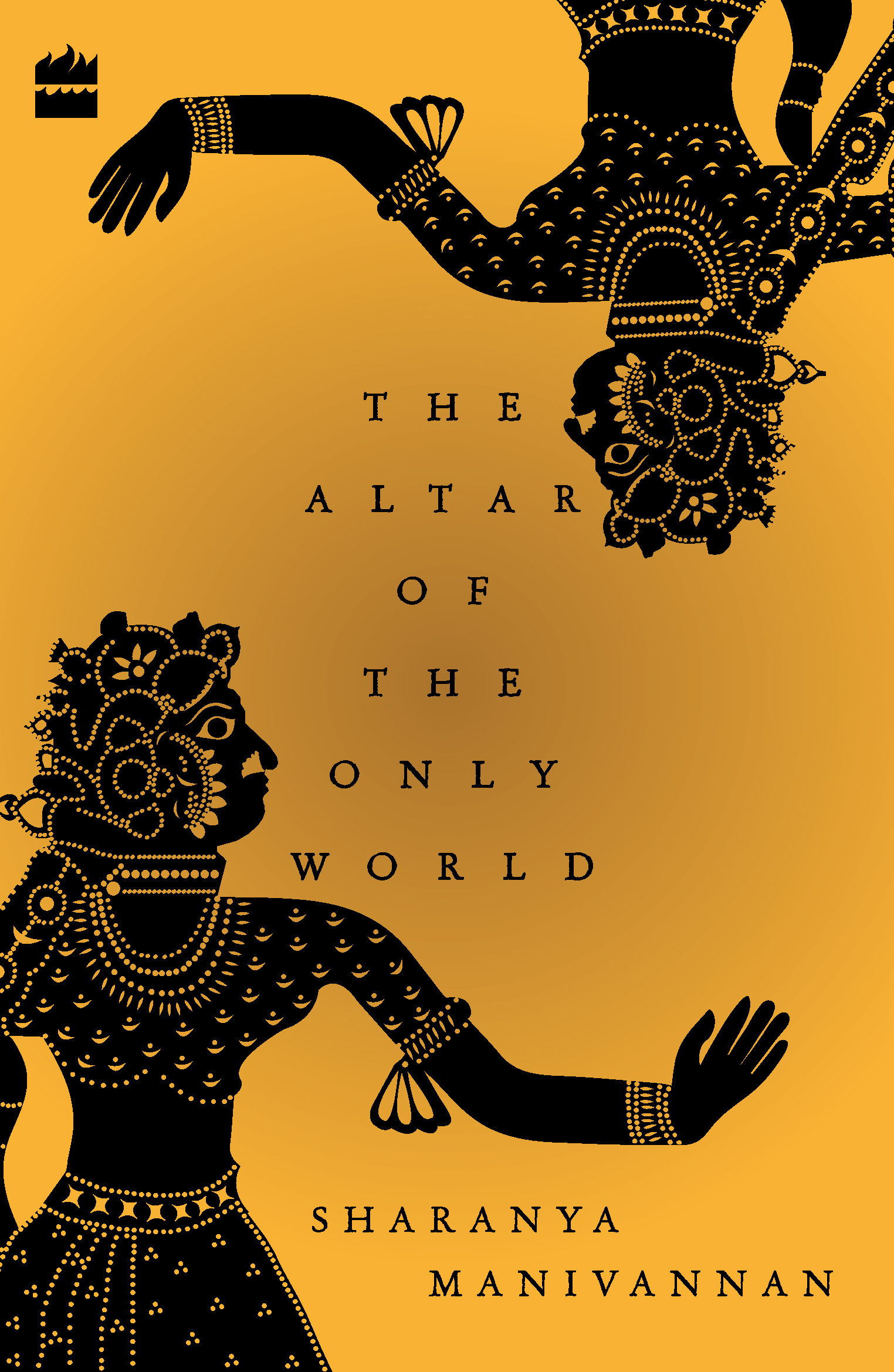
~ THE ALTAR OF THE ONLY WORLD ~

Sita in a forest, loved and left behind, looks towards the night sky and sees Lucifer’s fall from grace. Inanna enters the underworld, holding her heart before her like a torch. It is not easy to bear the weight of light; wilderness takes time to turn into sanctuary. These are poems of exile, resurrection, impossible love, lasting redemption – and above all else, the many meanings of grace.

“Sharanya’s poems are, in her own phrase, a form of phosphorescence – glowing in darkness, simmering with wonder, mythic in resonance, boldly embodied, hence surprisingly spiritful, even spiritual in the finest sense of the word. They are also skeptical and reflective, tempering and enhancing the glowing flame. Riptides of Tamil hide beneath or within her honed English, for those who can hear and see.” – David Shulman.

Selected reviews, interviews & articles

“Sharanya Manivannan’s poems in The Altar of the Only World are resplendent, locking you up in their hallucinatory visions.” – Karthik Shankar, OPEN Magazine

“This is a collection that you would want to own, for its exquisite imagery, for the raw passion, and most of all for the deep emotions it will evoke in you.” – The Greedy Reader

“It doesn’t matter in the end who abandoned you – it only matters who you make of yourself in the afterlife of that love.” – Scroll (interview with Nikita Deshpande)

“You can see Venus in the sky with the naked eye some nights of the year, and she sometimes hovers by her lover, Mars, and our grandmother, the moon. There’s the traditional reading of the planet as the goddess of love, but you chase her a little more and you are unsurprised to find that she is also the goddess of war, as Inanna. And exiled from heaven, as Lucifer the morning star is. I love that complexity because it gave me so much for my poetry. I love that what has survived through the ages is a less austere kind of imagination, one that embraced the contradictory. We need more of that today.” New, Fractured Light (interview)

“Heartbreak is also a palimpsest. Each time afterwards, one retraces that journey. It’s a shadow under the fresh pain. It doesn’t always sting or throb, but it’s there.” The Wire (interview with Shreya Ila Anasuya)

“The book was born in the chthonic, and in the search for light in all its meanings — as illumination, as blitheness, as clarity. Lucifer, whose name means light-bearer, brought the light, as did Inanna, who went to the underworld to confront her shadow. What I discovered was that these were not contradictions. Stars fill this book. The sun is among them, and the one Sita thinks of often, having married into, and been banished from its dynasty. Fire, too, is a repeated motif. We have walked through fire, and the myths help us live with trauma, to accept the knowledge of how we became salamandrine.” The Hindu Business Line (interview with Urvashi Bahuguna)


Purchase online

Amazon.in

Amazon.com


The Venus Flytrap: Incarcerated Poets

Sometimes, copying American observances isn’t a bad thing (this is never going to be true for Thanksgiving, though). As National Poetry Month comes to a close in the USA – and everywhere online, especially thanks to the popular daily writing practice of NaPoWriMo – news of a young Somaliland poet who has been imprisoned is on my mind. Those defending Naima Abwaan Qorane, whose poetry is said to reference Somaliland’s former unity with Somalia, say that she has been suffering rape and murder threats in custody.

This isn’t the time to go reading Qorane’s poetry – frankly, it is the poet and not the poetry we should be concerned about. Hers is not a unique case. As PEN International, Amnesty International and other organisations track and try to make known to a wider audience, writers around the world have always been targeted by draconian measures when their work does not suit the agenda of those in power.

From a single PEN International press release alone, I know of Aron Atabek in Kazahstan, Amanuel Asrat in Eritrea (detained incommunicado for 16 years), Dareen Tatour in occupied Palestine and Liu Xia in China, whose Nobel prize-winner husband Liu Xiaobo died in police custody last year. Closer to home, Kovan finds himself arrested with alarming frequency for his protest songs. Does he get released? That’s not the point. The point is that we don’t even know the names of most languishing behind bars. Please note that I have only named poets here, and that too just a few. A comprehensive list of authors, journalists and other kinds of writers who are facing or have recently faced persecution for subversive or seditious work would be very long.

I remember someone naively, and with great entitlement, telling me not very long ago: “I totally love doing activism, but I just don’t think poetry should be political”. That person then went on to cite Subramania Bharati as a favourite (preceded by, “Oh cool, you have heard of him” – oh you young ‘uns, have a little grace!). The irony that Bharati had been a great dissident, also incarcerated, was perfectly lost on them.

There is nothing romantic about being a poet, or anyone, with radical ideas. There is nothing sexy about exile, arrest, imprisonment, ostracism, punishment, murder or any of the consequences that come with having radical ideas. But I see a false correlation between these things, and this is dangerous: it means we celebrate people after they have suffered, instead of raising the level of safety for everyone.

As readers, we owe it to our love of literature – whether in the form of pamphlets with a cause, hashtagged posts, printed books or protest songs – to keep ourselves informed about what is happening to those who produce it. And all readers are writers, even if only in their hearts. So as writers, our responsibility to stand up for one another – even for those names never heard of, writing in languages never translated – is even greater. A sense of community isn’t about liking one another’s posts on social media. It’s about this – holding a larger vision of interconnectedness that goes far beyond what words can do.

An edited version appeared in The New Indian Express on April 26th 2018. “The Venus Flytrap” appears on Thursdays in Chennai’s City Express supplement.

The Venus Flytrap: Queer Eye For Reality

Why is there a ceramic kitten under a grown man’s bed?” By the time I laughed out loud at this line, I’d already cried at least twice watching Queer Eye. I’d started watching it, a reboot of a makeover show I’d never seen called Queer Eye For The Straight Guy, because I’d wanted something as low-investment as possible, something that would let me mentally check out from everything that stress and distressed me in the world and within. What I found was that QE isn’t really about grooming, style and décor, but about the source of most of the turmoil itself: toxic masculinity. Even better, in its own sweet way, it addresses that source.

I first started watching around the time that author Junot Diaz published a powerful essay on being raped as a child, which he had kept secret. The flip side to this essay is that it was mostly about women he’d dated and subjected to emotional abuse because of his inability to come to terms with his trauma. Diaz was brave, but by no means heroic. The more I thought about the women he had hurt, the less the first seemed to matter. Was he only protecting himself, again, from being accused?

As I continued to watch QE – beautiful moments like one man talking to another about being comfortable with his own femininity; men vulnerably sharing how they built barriers so others couldn’t affect them and found themselves damaged anyway; men opening up to the possibility of self-love and self-scrutiny both; men crying from overwhelm, from grief, from joy – far worse events hit the headlines.

Still watching, my thoughts traced again one tender spot in the ways that cis-women, particularly cis-women who love men but do not love patriarchy, interact with cis-het men. On the one hand, we avoid giving them much rope unless they’ve jumped through burning hoops first. On the other, even as we strive to raise the standard for acceptable behaviour, it also takes very little for us to soften open to the possibility of goodness. This is not naïveté; it is belief in what one is working towards. It is belief that goodness is not idealistic, but something to nourish when found.

It is belief in a world unlike this one. This world in which a little girl took her horses to graze and never went home again, and so many believe that the brutality she underwent is fine. And then, if the situation could be more malicious, we learnt that web-users around India entered her name into search bars on pornographic websites, seeking pleasure in a child’s violation. This world in which each of them, in turn, is capable of the same crime. This world in which we weigh that against what Diaz must have done to the women who loved him, and we lick our own wounds and say “it’s not so bad” as though that can heal and not salt them.

I don’t owe it to them – the men of this world – to let a reality TV show be a balm for reality itself. But I owe to myself. We must breathe as we labour.

An edited version appeared in The New Indian Express on April 19th 2018. “The Venus Flytrap” appears on Thursdays in Chennai’s City Express supplement.

The Venus Flytrap: Stripping For A Cause

There’s a reason why you may not have heard of actor Sri Reddy before she stripped in front of Hyderabad’s Movie Artist Association (MAA) to protest the sexual exploitation of women in the cinema industry. That reason is why she chose to protest: Reddy alleged that despite coerced sexual favours obtained by gatekeepers in the field, she and other women were still denied career opportunities. The protest came shortly after MAA rejected Reddy’s application for membership. Later, Reddy also told the media that she had been raped by a producer’s son.

One does not have to agree with everything Reddy said or did in order to support the larger cause of her protest. In one interview following the protest, the actor seemed to both vilify sex work (“Big directors, producers and heroes use studios as brothels. It’s like a red-light area.”) as well as make a derogatory statement about caste (“Naresh [veteran actor and senior member of MAA] said we have to clean that place [where she stripped] with water. That is a big crime. How can you talk like that? I’m not an untouchable girl.”). Her articulations are undoubtedly problematic.

But to claim that her protest was just a performance or an attempt to steal the limelight is wrong. The use of the naked body as a last resort to reclaim power or demand attention to a cause has a powerful history. Without seeking to draw facile parallels with Reddy’s protest, other examples span the range from preventing doxxing to political insurgency. In 2004, 12 Manipuri mothers stripped in an iconic anti-military protest after the custodial rape and death of a young woman. Australian musician Sia released a nude picture of herself last year to foil an attempt to auction it off. Just weeks ago, farmers from Tamil Nadu stripped outside Delhi’s Rashtrapati Bhavan demanding drought relief funds. The body in protest is not sexual – in fact, it subverts the gaze by drawing attention elsewhere, to the cause for protest.

Reddy has been blacklisted by the MAA. She will not be able to work in Tollywood, and given that the exploitation she speaks of is widespread in most fields in India, may find it difficult to find employment anywhere. Disappointingly, other actors have not validated her allegations, despite the widespread awareness of sexual harassment and assault in cinema. But she joins the ranks of Sruthi Hariharan, Parvathy, Radhika Apte and a brave handful who have challenged the normalisation of misogyny behind the scenes (and onscreen) in their respective industries by speaking up.

Finally, there’s this. On MAA’s website, the very first category on a list of Galleries is literally called “Hot & Spicy”. This line of text precedes gratuitous images of women: “Maastars.com is an Official website of Movie Artist Association, you can find here Actress Hot and Spicy Photo Gallery. (sic)”

Proof, and how flagrant. A frustrated artist and rape survivor choosing an incendiary form of protest is not nearly as obscene as a mighty institution like MAA so openly celebrating the objectification of women on its online presence. Reddy is right – the industry is rotten, and thinks it’s perfectly acceptable to be.

An edited version appeared in The New Indian Express on April 12th 2018. “The Venus Flytrap” appears on Thursdays in Chennai’s City Express supplement.