The Venus Flytrap: Voice In The Shape Of A Blood Clot

A blood clot in the shape of a bronchial tree, a tree in the shape the air takes as we draw it into ourselves. Two trees, actually – one for each lung, upside down like branches reflected in water. (We are bodies of water too, mostly). A dying man in California, bringing up small clots of his own blood in a hospital suddenly, violently, coughed out a perfectly-formed, arboresque one. A cardiothoracic surgeon who attended to him called it “beautiful anatomy”. It is beautiful –  and horrific – the way his blood filled the shape of his breath. I know we should not keep staring at this blood clot like it’s something between an art object and a talisman, without thought for the person who coughed it up in his final days, after his heart had failed but he was still alive. But as this strange year dwindles to a close, it feels like a perfectly-formed clot of blood is as worthy of meditation as any other symbol.

“A woman in the shape of a monster / a monster in the shape of a woman”, begins the Adrienne Rich poem for the astronomer Caroline Herschel and other unremembered women in the field. The delicate, brutal branches of that blood-sculpture evoke it. What shape would your truth take if it was expelled, whole, into the light of day? Would it be so monstrous, would it be so beautiful? (The two do not cancel each other out). The poem ends: “I am an instrument in the shape / of a woman trying to translate pulsations / into images for the relief of the body / and the reconstruction of the mind.”

For myself, I am perhaps hoping to do the reverse – to translate, relieve and reconstruct in ways so that image and thought become pulsations once more. I have been cerebral so long, and this being cerebral has compensated for what is in truth a loss of voice. I told an old friend: I lost my voice when my heart broke in the year I claimed my life back, and that helplessness manifested itself as thyroid disease. She didn’t know what I meant. She counted the evidence against my claim. And I said to her: I have not yet expressed what is truly within me, I have only brought forth echoes.

Echoes lack embodiment. I ground myself by considering the malfunction of the butterfly-shaped gland at the bottom of my throat. I place my fingers there and feel my pulse, the pace at which my blood fills me. I draw the infinity symbol in that place with frankincense oil. My friend went to the Pyramid of the Sun and the Moon in Teotihuacan, and she said that endangered monarch butterflies – those “daughters of the sun”, spirits of the beloved dead – throng and thrive there now. Our voice notes, disembodied, erase the distance between continents as if through flight. And one of these days, my voice will fill me again in the shape my breath takes when I speak, the shape of my secret passages. Arboresque like forking lightning, like the fractals of desert rivers. Fill them like liquid, like light.

An edited version appeared in The New Indian Express on December 13th 2018. “The Venus Flytrap” appears  in Chennai’s City Express supplement.
The Venus Flytrap: Ambitious Women Are Often Unpartnered

There’s much about Priyanka Chopra’s brand of feminism that’s been dubious in the past, but the victories of feminism are for everyone to enjoy – not only those who practice it. Which is why the standout moment of her Vogue interview on her new spouse, Nick Jonas, brings such cheer. In it, Chopra describes how their courtship moved to a deeper level when Jonas said to her: “I love the way you look at the world. I love the drive you have.” She explains: “As a girl, I’ve never had a guy tell me, ‘I like your ambition’. It’s always been the opposite.”

At 36, Chopra has spent half her life so far in the spotlight, with a thriving career in beauty pageants, Bollywood films and Hollywood television. You don’t get to, and stay at, such a pinnacle without ambition. And like many ambitious women, Chopra declined or deferred marriage – or even any publicly acknowledged partnership – for a long time. Ambitious women often make this choice, but it’s a choice largely made based on a lack of viable options. The alternatives include forfeiting one’s career, downplaying one’s achievements so as to seem interesting but not threatening, or sublimating that drive into channels like tyrannical parenting and undermining other people’s dreams.

As Chopra said, men tend to dislike ambition in the women they date or marry. In a traditional context, men on the arranged marriage market quite frankly seek women with lower educational qualifications or salaries. In dating, the cues are subtler. As an ambitious woman only a little younger than Chopra, I don’t have to rely on anyone’s experience but my own for these nuggets. Envy: the poet who password-protected his documents before letting me use his computer (then forgot his password and lost his manuscript). Condescension: the older predator type who visited websites that had published my work to tell me the websites were interesting (silence about my work). Carefree dismissal: “I don’t read”. Or worse, pedestalization: when you’re their favourite so you’re out of their league. And that incredibly slimy – so far thankfully unsuccessful – undercutting method I’ve seen attempted many times: when they tell you your work is lousy, but gosh you’re cute and (here’s that word again) interesting and perhaps you can redeem yourself in some non-literary way?

Women with a strong sense of purpose who wish to partner with men have very slim pickings.

Which brings us to the purely circumstantial, a stark fact beyond personal choice: you don’t get chosen. They prefer someone who won’t distress their fragile egos. This has a funny effect on ambitious women, though. We just work harder. We put all of it – time, effort, love, attention, the need for validation and even libido – into becoming damn good at what we do. Then becoming even better. A woman rejected, openly or underhandedly, for wanting her career as much as or more than she wants you has no choice but to make the most of it.

So congratulations to Priyanka Chopra – not on getting married, but on finding someone who admires that she dreams big and is driven. And isn’t afraid she’ll out-dazzle him (and she surely will).

An edited version appeared in The New Indian Express on December 6th 2018. “The Venus Flytrap” appears in Chennai’s City Express supplement.
The Venus Flytrap: Smash Brahminical Patriarchy

What a beautiful coup it was to watch unfolding online: the head of a platform on which women and minorities face daily abuse, unwittingly holding a poster with a radical slogan. If only Jack Dorsey, CEO of Twitter, had held the words “Smash Brahminical Patriarchy” above his head, and truly understood and endorsed them. But at least he held the poster visibly enough, in a photo that was shared the day after a closed-doors meeting he had with feminists in India. When you consider the angry backlash that came afterwards, you appreciate just what a coup it was for Sanghapalli Aruna to give Dorsey this poster, and then for him to not just pose with, but post it! Yes, the slogan is radical. But why? It should not be. It should be natural and logical. It may not be intuitive, given the extent of conditioning that many people must consciously undo, but it can at least be learned. It should be as vital as the green recycling symbol, as ubiquitous as the new rupee sign, as catchy as “Horn Ok Please”. Unfortunately, we’re still at a stage where its very meaning needs to be explained.

As Thenmozhi Soundararajan, the artist behind the 2016 poster that Dorsey held, explained succinctly, during the ensuing controversy: “Brahminical patriarchy refers to the interlocking system of caste, gender norms and rituals under Brahminic tradition that enforce caste through women and their reproductive function.” The phrase is not some shiny new hashtag event, and has been in use for decades in the works of a number of intersectional activists and thinkers. The concept itself, with or without the exact phrase, is in the foundational ethics of many more. In even more simplified terms, and in terms that directly call for action, it’s this: the only meaningful kind of feminism in India is a feminism that jointly tackles the caste system.

Feminist discourse has evolved to a place of intersectionality, requiring that other inequalities are also a part of conversation, from acknowledgment through to action. Class, race, sexuality, the environment, post-coloniality, anti-capitalism – these are some of the intersections. We cannot deny that the Indian variant of patriarchy (and to be fair, just as there are different strains of feminism, there are different strains of patriarchy, but here we speak of the most powerful form) is deeply interlinked with caste. Caste cannot be maintained without the policing of reproduction. And therein is the fundamental reason for all the controls on women and female sexuality that we experience in myriad forms in Indian society.

I can take it in good faith that Dorsey and his staff, even his Indian-origin ones, were ignorant of all the above when they needlessly backtracked and apologised for the poster. But that, above all, reveals how important this work is. Indians everywhere have managed to keep India’s most shameful, and shamefully thriving, system under wraps for a long time – obfuscating it, philosophising it, claiming other victimhoods when convenient. But no longer. That’s the beauty of this coup. It turned that conspiracy of denial on itself, making the most of corporate desire to look progressive. With just three sweet words.

An edited version appeared in The New Indian Express on November 29th 2018. “The Venus Flytrap” appears in Chennai’s City Express supplement.

The Venus Flytrap: A Closet Full Of Ocean

You’d imagine the indigo plant would contain a clue of what it’s capable of, but from root to leaf-tip, it gives little away. There are no blossoms like the vivid blue aparajita’s, for the indigofera tinctoria flowers in pinkish-purple. Its dye is made from its innocuous-looking leaves. When processed, they give forth a colour so potent that it tinges human skin, turns the hands and nails of those who prepare it blue-black like Kali or Krishna.

I read somewhere that ancient Egyptians wrapped their mummies in indigo-dyed cloth, and flicking through the accordion of hangers in my closet I can imagine why. To be buried in indigo, upright like a warrior. To be burned in indigo, so as not to wake suffocating within a grave (in indigo). To die in indigo. To arrive in the afterlife in indigo. The thought is so comforting.

When I see denim or a solid purple-ultramarine, I do not think “indigo”. I am technically wrong, of course. Indigo is what makes blue jeans blue. It has its place on the colour wheel. But to me, only blue fabric interspersed with white (sometimes an adulterated white, if the dye has bled) counts. Stamped repeatedly with a dabu hand block pattern. Swirled, achieved with batik wax. Or synthetic versions of the same – synthetic versions of everything, from the print to the dye. My eyes are fooled. My mind is calmed. The sight of indigo – that combination of soft blue and white – soothes me.

This is what Marco Polo observed about the production of Indian indigo in the kingdom of Coilum (present-day Kerala): “They have also abundance of very fine indigo. This is made of a certain herb which is gathered, and [after the roots have been removed] is put into great vessels upon which they pour water and then leave it till the whole of the plant is decomposed. They then put this liquid in the sun, which is tremendously hot there, so that it boils and coagulates, and becomes such as we see it.” European leaders of the 1600s were so envious of India’s monopoly on the trade that France had the death penalty for the use of indigo over woad, a yellow-flowered plant that also produces a blue dye. Germany spread a rumour that it was “the devil’s colour”. I touch my beautiful clothes and think of how neither threat would have persuaded me to give them up.

Then I think of the hands who plucked the leaves, who stirred the vats, who pressed carved wooden blocks onto the fabric, who measured and cut and stitched it (even if it’s not true indigo, it’s not without exploitation). I think of the Indigo Revolt of 1858-1859, and of the environmental effects of processing or synthetic pigments. I think of everything we know about the labour that goes into possessions we see as “the small things” or self-care. Even the way this textile comforts me comes at some cost.

How disquieting to know it is impossible to be in this world without somehow being violent. Contemplating this, I reach into the calm of blue and white undulations, a closet full of ocean.

An edited version appeared in The New Indian Express on November 22nd 2018. “The Venus Flytrap” appears in Chennai’s City Express supplement.

The Venus Flytrap: Not In Your Nightie

After several months of keeping this fashion policing under wraps, news leaked that the village of Thokalapalle in West Godavari district, Andhra Pradesh, had proudly and privately instated a dress code. According to this village sanghama-ordained decision, women are banned from wearing nighties during the daytime. Only the ill are exempt, and those who violate the ban face a Rs2000 penalty. Tattlers benefit, with a reward of Rs1000. Since the ban came into effect, village elders claim that women have indeed stopped wearing nighties outdoors between 6am and 7pm, as no ban violations have been reported. Sarees and dupattas have made a comeback on their streets.

Consider the average nightie – ankle-length, sleeved, with a modest collar. Often in less than attractive patterns, sometimes with frilled panels on the bustline that have an additional concealing effect. In fact, the nightie is the definition of dowdiness. It signals a woman who would prefer to be at rest, but is also simply too busy to get changed. To many, the nightie is also the definition of comfort. Wearing one is a subtle declaration of disinterest in dressing up, and of putting one’s ease first. It’s interesting how piqued Thokalapalle citizens reportedly said that the sight of women in nighties in public “inconvenienced” others or made them “uncomfortable”. The women’s convenience is the inconvenience, and their comfort causes discomfort.

It’s not difficult to imagine women going about their daily business wearing nighties. The clothing brand Pommy’s even developed an entire advertisement series around this motif. In it, the actor Devayani defused a variety of conflicts by appearing on the scene donning the utterly domestic nightie. But seeded within the hilarity of these commercials was a powerful statement. In each clip, Devayani asserted with a sweet smile that she was the “kudumba thalaivi” (the head of the household). The nighties conferred that confidence in her. The clincher? The final tagline: “engum engengum” (everywhere, anywhere).

No women from Thokalapalle have spoken up yet to say that the ban is oppressive. Honestly, they probably have better things to do and more pressing battles to fight. But those from the village who have talked to the press paint a uniformly eerie picture. They say that it was younger women from self-help groups who made a decision to “honour their traditions”. They say that everyone is happy. They also say that wearing nighties to go about public quotidian activities, like shopping for groceries, visiting temples, doing laundry or picking kids up from school, is “not good”. Why? They do not say.

All patriarchal societies have restrictions, overt or subtle, on what women can wear. In Thokalapalle, it’s nighties. In Chennai, it’s shorts. Thinking over how this plays out in different places is interesting. To my mind, a nightie is probably the furthest thing from lingerie. But to someone else, who remembers a time when anything other than a saree was shocking, a nightie may be loaded with other signifiers. It’s absolutely wrong to tell women they can’t choose their wardrobes. But there’s something worth observing here, about how desire and style have complementary semiotics, and how sometimes these break taboos, and sometimes reinforce them.

An edited version appeared in The New Indian Express on November 15th 2018. “The Venus Flytrap” appears  in Chennai’s City Express supplement.

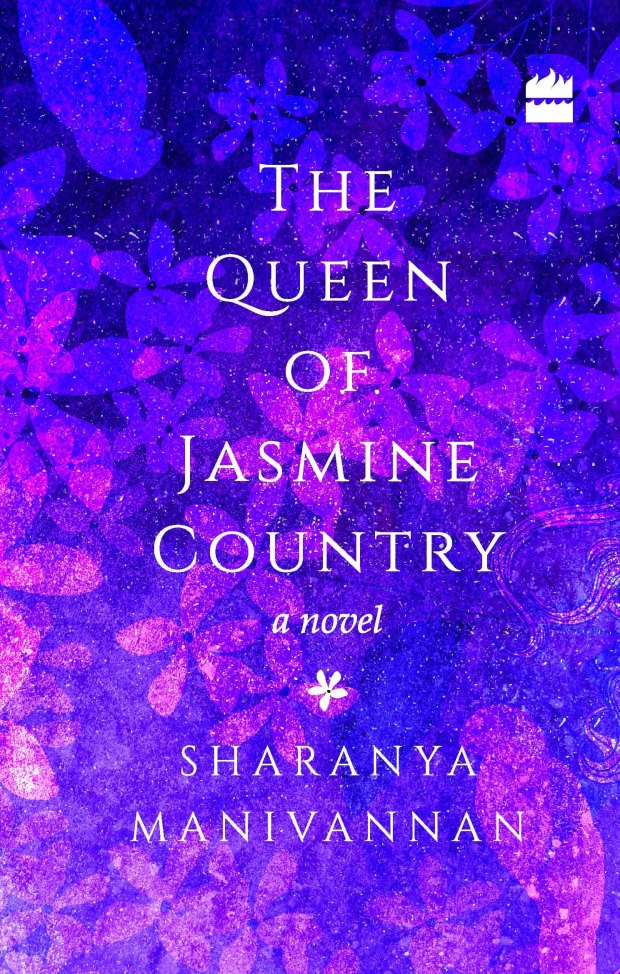
THE QUEEN OF JASMINE COUNTRY

The Queen of Jasmine Country_Cover Spread

Longlisted for The JCB Prize for Literature

Shortlisted for The Hindu Prize

Longlisted for the Mathrubhoomi Book Of The Year Award

“A rare and incandescent book”. – Trisha Gupta in India Today

 “Among contemporary Indian writers in English, there aren’t many who can write fiction as if it were poetry and do as good a job of it as Sharanya Manivannan.” – Tanuj Solanki in Scroll

“Manivannan’s writing is honest, beautiful and compassionate. Her recreation of 7th-century Tamil society is believable, and her storytelling, hypnotic. Her poetic prose serves as a delightful and sensual channel for Andal’s life, love and art. The poet-goddess could not have picked a better medium.” – Urmi Chanda-Vaz in The Hindu Business Line

“Manivannan weaves an impressive story that feels new while drawing from the familiar.” – Krupa Ge in Firstpost

“Kodhai’s every metaphor, every daydream is laced with the imagery of the earth, both local and distant. In Manivannan’s characteristically lyrical style, the prose is sensual and tactile. She mines the tropes within Andal’s own writing to create Kodhai’s unique voice which combines storytelling and poetry.” – Urvashi Bahuguna in Scroll

“The Queen of Jasmine Country celebrates both love and womanhood like never before.” – Soumyabrata Gupta in Deccan Chronicle / The Asian Age

“The quality of sensuality and earthiness in Manivannan’s writing goes right to the reader’s bones, and I have had to stop to breathe, to stay with and feel the feelings rather than rush on with the reading.” – Kiranjeet Chaturvedi, Birdsong & Beyond

“Remarkable… A torch song of both love, and freedom.” – Shreya Ila Anasuya in Verve

“Long after you have finished the little book, the warmth of Manivannan’s words and the intricately imagined world of Kodhai will continue to hum in your head.” – Devapriya Roy in ScoopWhoop

“There’s much lush lyricism here, born out of the natural beauty of Kodhai’s small world, and one wonders if this is indeed the poet-saint herself writing about her life.” – Pooja Pillai in The Indian Express

[A] lyrical fable seeped in strong, indigenous, sensual prose” – Resh Susan in Huffington Post 

“Exquisite prose and the journey of a sublimely emancipated girl whose ‘words will themselves become prayers’… [A] garland of a book.”– Lisa Rani Ray

“This book was just so beautiful! So, so damn beautiful!”  Booxoul 

“A compelling testament on art, beauty, poetry and magic in prose that is way out of the normal league. This is legend.” – Hey DJ – Spin That Wheel

“I’m in love with each and every page of this book.” – Ronak R. Shah

“I found myself immersed in the feel of the words: there is so much power and depth in the words strung together, like a garland, each word chosen with care and which are full of depth and rich meaning.” — Chitra Ahanthem in Books And Conversations

“[TheQueen of Jasmine Country shows you the power of language when poets pen down a novel, this is where the play of language and the elegance of poetry comes into play.” – Sahil Pradhan in A Hindu’s View

“These words that Sharanya uses to describe what Kodhai (who later goes on to become Andal) felt in the book, might as well describe Sharanya’s own relationship with words. She weaves them majestically like they weave silk threads, delicately soft, yet strong, firm and unbreakable.” – Anushree K in Women’s Web

“It was like a thunderstorm of a love affair that leaves no scar yet lingers forever in who you become because of it.” – from an interview by Soumyabrata Gupta in Deccan Chronicle

“So who was she really – this young woman from over a thousand years ago? What filled her nights and days, and led her to write such intense, vivid poetry? This is what my novel is about – going beyond her legend, and reading between her own lines.” – from an interview by Rochana Mohan in The New Indian Express

“If you strip the fancy alangaram, the gem-encrusted hagiography, and see what’s really there – a young woman so desperate for love that she fasts and prays for it – I think you’ll see her as she came to me, too.” – from an interview by Kiran Manral in SheThePeople

“So Kodhai dreaming of the mythical landscape of Ayarpadi gives birth to another rendition of herself within that dream, committed to permanence in her poetry; and then there was me here in the 21st century spending my nights and days imagining Puduvai, conjuring up a whole life. Dreaming of the dreamer, who dreamt within my dream of her.” – from an interview by Nidhi Verma in Platform Magazine

“It was not the goddess Andal who came to me as a muse but a teenager named Kodhai, who lived in the 9th century and wrote incandescent and anguished poems, never knowing what would eventually become of them.” – from an interview by Varsha Naik in Free Press Journal

“Kodhai certainly knew the vision of those peaks. It is easy to imagine her: walking deeper into the forest, lifting her hems as she crossed small streams, stopping for elephant traffic, while the magnolia she tucked into her ear wilts through the course of the day. I lift my eyes to the mountains and drink in the certainty that what I see is very close to what she too must have seen.” – a travelogue in The Punch Magazine

“I felt as though a peacock had suddenly swept in from a place of camouflage, tail unfolded, and rearranged the world with its resplendence.” – an excerpt in Scroll

“I grew along with the fence of sugarcane. My teeth, when they came in, grew strong on the flesh of those stalks.” – an excerpt in Harper Broadcast

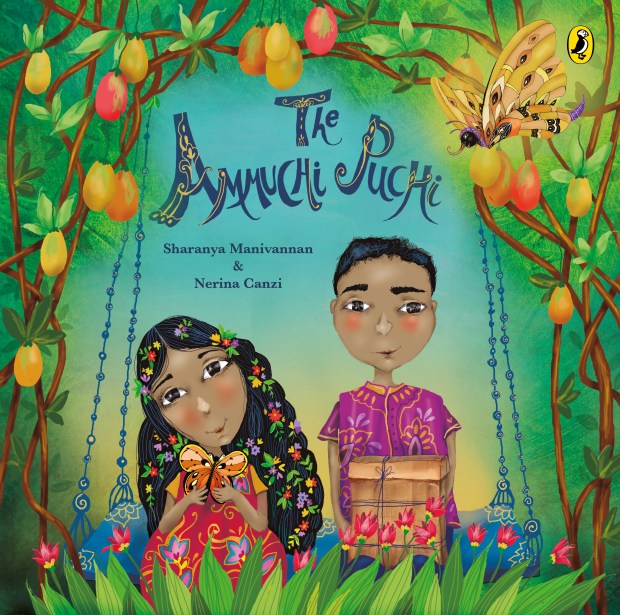
THE AMMUCHI PUCHI – Indian Subcontinental Edition

It was very, very special for me to have The Ammuchi Puchi – originally published in the UK by Lantana Publishing – be released in an Indian subcontinental edition in May 2018 by Puffin India. I’d always hoped that my book would be easily available to children here.

It is now in bookstores all over the Indian subcontinent, and online on Amazon India and other retailers.

Please see below the image for selected reviews and interviews.

Ammuchi Puchi.jpg

“”A powerful story about grief and loss…a wonderful reminder about the magic of imagination.” – Bijal Vachharajani in The Hindu

“”The language of grief and loss is universal. It can be as tender as you can make it. Or it can be lacerating. Both are heartwrenching. Manivannan chose tender.” – Shikhandin in Scroll

“The prose of the book is perfect for children, and will teach them the important lessons of: exploring their creativity, handling grief and the need for learning a variety of life skills from grandparents.” – Mithila Reviews

“I have seldom seen healing dealt with in such a sensitive and poetic manner.” – Ajinkya Shenava in Poetly

“Aa gorgeously illustrated tale of children dealing with the death of a beloved grandmother.” – The Hindu

“How to talk to your children about losing a grandparent” – Momspresso

Reviews, interviews and other press for the UK edition here.

The Venus Flytrap: Avni And Other Tigers

There is one particular detail of the killing of Avni, the tiger, in Maharashtra last week that I keep circling back to. She was lured using a trail of tiger urine mixed with a men’s perfume, Calvin Klein’s Obsession. The scent contains synthetics that mimic civetone, which is secreted in the perineal glands of civets, and has similar effects to musk, another animal-based perfumery ingredient. Tigers find civetone irresistible; it was deployed here because earlier experiments showed that they wanted to roll themselves all over where it was sprayed, rubbing their faces into it and sniffing with visible pleasure. Essentially, Avni was lured to her death through aphrodisiac pheromones.

Avni was a “man eater”, that archaic word so colonialist in its resonance, which keeps being used in reports about her killing. It’s a word from a worldview that’s clear in its division between animal and human, but specifically Man (colonial order wasn’t the only thing built into the language). As though women or water buffaloes don’t get eaten too (both equally inequal in the hierarchy of the Kingdom of Man). The dictionary suggests that it was first used for human cannibalism (more colonial inference), later becoming used to describe animals. “Man eater” is also still in common parlance as an innuendo, used to caricaturise women who are unapologetically desirous. The fear of the desirous woman is such that she is likened to a creature that kills to devour.

But for cultures that lived or live alongside the tiger, traditionally, fear is mixed not with bloodthirst but with reverence. In the Sundarbans, the tiger deity Dakshin Rai is appeased and asked for protection, while simultaneously expected to be mercurial and voracious. In Karnataka, the tiger god is Hulideva. Naga legend holds that the first tiger, first human and first spirit all shared the same mother. Among Warli and Koli people, Waghya (meaning “tiger”) is one of the principal deities, and Waghoba is the deity of the forest at large in Maharashtra.

It bears noting that it was at the behest of the people living in the Pandharkawada divisional forest, where an estimated 13 people were killed due to tiger attacks, that Avni was shot. While the lack of adequate tranquiliser usage, the decision to kill rather than capture, and the uncertain fate of her two cubs are all worthy of questioning, that she was a threat was something that we must accept. Otherwise, what difference is there between we who live in cities and have the luxury of choosing animal-friendly diets we don’t forage for ourselves, and those who colonised centuries ago and decided that the beasts of our lands were for sport hunting and that some human lives were less valuable than their own?

To return to man-eaters and musky pheromones, there’s another possibility as to why the scent attracted Avni. It’s heartbreaking to think that she died hoping that a mate was rambling in the vicinity. Perhaps what she thought she sensed was a competitor, another tiger on the prowl for the same prey. And so she died ferocious, protective – double-edged, just the way the tiger is understood by those who know it most.

An edited version appeared in The New Indian Express on November 8th 2018. “The Venus Flytrap” appears on Thursdays in Chennai’s City Express supplement.

The Venus Flytrap: How A #MeToo Story Is Told, Or Isn’t

Every woman has a #MeToo story. It just depends on how she tells it. On who asks her, on why they enquired, on what triggered the memory, on what she knows now that she didn’t at the time – on a hundred different variables, in short. No, scratch that – every woman has #MeToo stories. Two or twenty. The count varies, for the reasons already mentioned and more. It’s just that she may choose not to frame them all that way. Or that she would rather put some or all of them behind her. Or that this new vocabulary may later liberate her, but for right now it overpowers her in so volcanic a way that she would rather not feel the things it brings up. She’d rather put them away again – hopefully not in their old hiding-place of shame, but in some new site where light slants on them in a different way, and perhaps over time she’ll know what to do.

Harassment that’s cut short through a slap, as recounted by several women in viral-friendly videos and tweets, also constitutes a #MeToo story – not the avoidance of one. Because the weight of the story lies not in the response, but in the intended outcome that the perpetrator had (and always, always – an unwelcome advance is about power, and a non-consensual action is about power; desire is never the main factor). So, in some of our #MeToo stories we’ve slapped our way out of a situation. In others, we’ve sweet-talked our escapes – the screenshots will not reveal how we gritted our teeth as we said mollifying things because we’d been raised to be diplomatic, or because we were afraid. In still others, we kept sleeping with our oppressors because we’d been gaslit into thinking we were loved. And in so many more, we’d diminished our presences so we’d seem to be unthreatening (read: unattractive) wallflowers, nodded or smiled and said as little as possible, or cut our losses and quietly left. A slap and a clean getaway are only possible if you don’t have a salary on the line, are assured that you can leave both the location and the context easily, do not have other kinds of politics and dynamics in the environment that convolute it further, and most importantly, aren’t at risk of retaliatory physical or other violence.

Over the past few weeks, as the #MeToo movement experiences its second wave in India, I made space to reflect on why I’ve yet to publicly out anyone, even though I’m fully supportive of the courageous people who’ve done so. My reasons are partly circumstantial, partly circumspect, and entirely complicated. I know this to be true for many people, because beneath the public wave are countless, powerful small ripples – private conversations and reckonings. I wish those who claim they’ve never been harassed or abused would reflect too. Open declaration is only one way of parsing trauma. If it doesn’t suit, pure denial or abject shame are not the only options. Slowly, we must teach ourselves new ways of healing and standing in our truths. Slowly. Because we aren’t just recalibrating our stories, we’re remaking the world.

An edited version appeared in The New Indian Express on October 25th 2018. “The Venus Flytrap” appears on Thursdays in Chennai’s City Express supplement.

The Venus Flytrap: The Jealousy Of The Genius

The enigmatic Annapurna Devi died in Mumbai at 91 last week. Her gift with the subahar and as a singer were legendary; but almost no one ever heard either, except if very selectively allowed into her home as a disciple. In her youth, she was also the first wife of Pandit Ravi Shankar. In an attempt to quell his jealousy and salvage their marriage, she took a vow that she would cease to publicly perform, and continued to keep it even after their divorce.

The Malayalam author KR Meera has spoken often of women she met when she was a young journalist who were introduced to her as the wives of eminent men, but whose true talents had been suppressed. As she once told me in an interview, a particular incident illustrated this state of affairs. An elderly woman who was married to the great man she had come to meet seemed especially intrigued by Meera’s work. Out of politeness, Meera asked her if she had ever been a writer herself. As the author recounted to me, “The graceful woman who was the incarnation of love, care and compassion turned angry and ferocious, and said: Used to write? Who? Me? This man sitting here saw me for the first time on a stage while I was reciting poetry. The great poet Vallathol had blessed me, saying, ‘You are Saraswati, the goddess of learning’. And this fellow fell in love with me and married me and then what? My literary career ended then and there.And he was climbing up the ladder while I was toiling in the kitchen and giving birth to his kids.

Annapurna Devi, too, had been called the embodiment of Saraswati. By her father, the celebrated composer and musician Allauddin Khan. One could say he was possibly biased, except that he had first refused to teach her music. He had educated Annapurna’s older sister, and because this had caused problems in her marriage, he’d refused to teach the younger girl. She’d learned from simply listening to others’ lessons, and when her father eventually discovered her talent, he felt compelled to begin her formal studies in music. Eventually, it was an unfortunate marriage that thwarted her career too.

Some obituaries of Annapurna Devi romanticise her reclusiveness and praise what is perceived as her non-attachment to the material world. Doubtlessly, she found a way to sublimate her creativity into a spiritual life, of which teaching was an extension. But it’s dangerous to call that her choice. It’s, firstly, an erasure of her truth, which she shared in rare interviews in which she did not mince words about Ravi Shankar’s abusive and deceitful nature. But it’s also dangerous for all those out there whose passions are simply called hobbies, who rub the ink on their fingertips onto their aprons and watch as the words they wanted to inscribe evaporate like steam from a boiling pan, whose thoughts unfold in ragas they must wait for a secret hour to hum, who hide their illustrations inside plain notebooks that lie like obsolete currency in locked drawers. To call such sacrifice a choice is to abet their suppression.

An edited version appeared in The New Indian Express on October 18th 2018. “The Venus Flytrap” appears on Thursdays in Chennai’s City Express supplement.

The Venus Flytrap: Swords In The Hands Of Children

How does a sword end up in a lake or a river, and stay dredged in its bed for millennia until one day someone’s small hands or feet chance upon it when none had before? That it fell overboard, that it was offered ceremonially or amidst a sacrifice, that its weight helped drown the body that wore its scabbard – the possible stories of how it came to be there are myriad, limited only by the imagination. But its long and silent afterlife in those depths is sheer mystery. This week, 8-year old Saga Vanecek was playing in southern Sweden’s Lake Vidöstern, its waters in low season due to a drought, when she discovered a pre-Viking era sword, which archaeologists have since dated to around 1500 years old. The archaeologists are still wading in those waters. So far, they have found a fibula brooch, which dates to 3 or 4 CE. And a coin from as recently as 18CE, which seems almost mundane in comparison.

If anything can be mundane, that is. What if the actual history of that coin is stranger than that of the sword?

There are other stories of children finding ancient swords in water bodies. In 2014, 11-year old Yang Junxi found a 3000-year old bronze sword while washing his hands in China’s Laozhoulin river. Last year, when another little girl found another sword in a lake, the discovery was laughed off by the person who claimed he’d put it there. Legend has it that Dozmary Pool, England, was where the mystical Lady of the Lake bestowed on King Arthur the sword named Excalibur, and where it was returned to as he died. Legend also holds that only the rightful Queen of Britain would next be given the weapon. Imagine being Matilda Jones, then age 7, and pulling a huge sword out of this very lake. And then having a local man who said he bought a cinema prop in the ‘80s with which he would drunkenly “knight” people claim he had thrown it into the lake back then as a Celtic ritual. How disenchanting.

When Monty Python and the Holy Grail was written, the lines “Strange women lying in ponds distributing swords is no basis for a system of government. Supreme executive power derives from a mandate from the masses, not from some farcical aquatic ceremony” must have seemed both brilliant and accurate. And they were, and would be still – except that we’ve seen what both capitalism-driven democracy and “due process” enact in the world, and don’t do for us, and the alternates don’t seem so farcical at all. Would I rather put my trust in a thrilled child who chances on a relic than on a predator who moved up level after level of power through entitlement and intimidation? Yes, I would.

I’m reaching for these stories neither as metaphor nor as deflection. Though it’s true that some things must lie in wait for a long time, and that the fantastical is sometimes real. It’s just that some weeks need a story out of the ordinary, for they help us cope with what is staggeringly, unconscionably unjust – and common.

An edited version appeared in The New Indian Express on October 11th 2018. “The Venus Flytrap” appears on Thursdays in Chennai’s City Express supplement.

The Venus Flytrap: The Adultery Law

What could we have told the woman who took her own life this week in Chennai – after her cheating husband allegedly told her that adultery was no longer a crime – about how that law had never been meant to protect her? The now defunct Section 497 of the Indian Penal Code, which had read: “Adultery: Whoever has sexual intercourse with a person who is and whom he knows or has reason to believe to be the wife of another man, without the consent or connivance of that man, such sexual intercourse not amounting to the offense of rape, is guilty of the offense of adultery, and shall be punished with imprisonment of either description for a term which may extend to five years, or with fine, or with both. In such case the wife shall not be punishable as an abettor.”

Note that precise phrasing: “consent or connivance”. Conveniently, the law as well as those who upheld it understood consent, and applied it so alliteratively – to connivance! Unless a man participated willingly in his cuckolding, his wife’s lover could be charged with a crime.

Could we have explained to that deceased woman how she had never had any recourse to justice through this law? That it had been devised for one man to punish another, and that for any woman (as per the moral codes of our society), shame itself would have been the first among various insidious punishments. If wives, being chattel, were allowed to emote, anyway.

If we’d been ignorant of this archaic decree, that was also likely to have been because as a law that men could invoke against one another, it hadn’t received much exercise in public memory. Men don’t so often go after one another in quite that way. Not as often as women get the blame. Not as often as women are turned on each other, conditioned for example to hate the one who got caught in a deceitful husband’s web and not the husband himself who so dexterously spun it. Or even if she hates that husband, to possibly not love or know her selfhood without even him.

This law had no provision for women to lodge a case. Not for women whose husbands were having affairs, nor for women who had been fooled by married men. In fact, lawyers speaking to the press suggest that one of the rare usages of Section 497 was as an act of retaliation by men facing dowry harassment proceedings. It’s vaguely disquieting how when a law that was hardly ever used was repealed, the fact of its rare usage only reinforces many things about misogyny in our social fabric.

I wish the deceased Chennai woman whom that law was used against, at least in speech, this week will be the last one ever to suffer because of it. And I wish also that after the striking down of the sexist Section 497 and the homophobic Section 377, the next to go will be Section 375, which considers rape within marriage to be criminal only if the survivor is below 15 years old. Where is consent here? All that’s evident is connivance.

An edited version appeared in The New Indian Express on October 4th 2018. “The Venus Flytrap” appears on Thursdays in Chennai’s City Express supplement.