I’m the featured writer for the November/December 2010 issue of Anak Sastra, a new literary magazine with a South East Asian focus. You can read an interview with me (in the “featured writers” tab) and my slightly twee short story for young adults, “Spark”, here.
Monthly Archives: November 2010
Book Review: The Story That Must Not Be Told by Kavery Nambisan
When Simon Jesukumar misses his train back to Madras from Delhi, among his lost possessions are his deceased wife’s thick manuscript, which he has lugged from publisher to publisher over the years out of a sense of guilt and duty. Aging, curmudgeonly, and living alone in an apartment complex beside the city’s vast and thriving slum, Sitara, he is returning from a stay with his son – whose mother-in-law he has struck a slightly dubious friendship with. His only companion at home is his cat Thangu; when his formerly-estranged daughter Sandhya visits, he tolerates her with a mix of parental affection and genuine dismay. Kavery Nambisan’s The Story That Must Not Be Told opens with tremendous promise, introducing to the reader this complicated old man, one of the most interesting protagonists seen in recent Indian fiction.
Throughout the novel, similarly adroitly-sculpted characters make their appearances, only to fade in importance. Each of them – from the noble butcher Gaffur to the quack doctor Prince to the envious and dastardly Ponnu – come with a compelling backstory. The slum itself is drawn with a strong sense of the overbearing spirit pervasive through locations as complex and gritty as Sitara (or even Madras itself). The trouble is, cast and setting both arrive fully-formed and precisely executed in a novel that loses track of its own plot.
The Story That Must Not Be Told is essentially a story about the human condition as it plays out in urban India today, dichotomized by privilege and its lack, and juxtaposed by sheer proximity. Simon decides to buy a water cooler for the school in Sitara, and thus begins his involvement with the slum and its people. This is at odds with his neighbours at Vaibhav Apartments, who want to see to it that the slum is cleared. Questions of crime and hygiene have become issues; nonetheless, manual labour – from schoolboys running errands for the elderly to construction workers, and most especially, cleaners of toilets – comes directly from Sitara.
It’s a familiar scenario to any Indian: one may have people from lower classes cleaning their houses, may work for people of higher classes, or may take a conscientious approach and attempt or claim to eschew this system altogether, but ultimately all of us exist within it. This means that realistically, we already know how the story ends, and the onus on the element of surprise and originality rests with the author.
Still, Nambisan’s finesse at etching her characters is hugely admirable. Despite his cantankerousness and stubbornness, one finds it impossible not to side with Simon entirely. In a perfect echo of his sentiments, the slum dwellers are notably more nuanced than his own family and apartment neighbours – all of whom irritate the reader just as much as they do Simon. One roots for Simon and Sitara, and reads the book through in order to find out what happens.
That the book devolves into unresolved loose ends, a pat finish, and a bit of political commentary is thus all the more disappointing. There is a sense that the horse and the cart were switched at some point during the narrative; instead of being led by the natural pathos of its characters, the thematic and didactic aspects of the story gain precedence. Much is lost: the truth behind the misplaced manuscript is never resolved, the burgeoning friendship between Simon and his son’s mother-in-law is unexplored, and the eventual fate of Sitara is given an almost cursory conclusion. A much stronger and more stunning novel could have emerged if the focus had remained on the details, and not the pursuit of a bigger picture.
An edited version appeared in today’s The New Sunday Express.
The Venus Flytrap: Forbidden Fruit
This morning, I woke up humming, absolutely arbitrarily, the refrain “movin’ to the country, gonna eat a lot of peaches; movin’ to the country, gonna eat a lot of peaches”. It took a few moments to remember that this is the opening lyric of a song from the mid-90’s – and when I recalled that it was by a band named PUSA (Presidents of the USA) and made the obvious phonetic association, my day began in an auspiciously giggly mood.
If you miss my gist entirely, I can only direct you to T.S. Eliot, whose existentially-ailing J. Alfred Prufrock rued his lack of luck with women and pondered, “Do I dare eat a peach?” Though of course, peaches aren’t for all of us. This brings to mind the cat’s pyjamas of suburban legends I’ve heard about people who really, really love their fruits and veggies (and this is a genre in itself – let’s call it pulp fiction). This one’s set in one of those histrionically chauvinistic universities, in which male and female students are segregated to a degree that suggests that whatever’s in the water in those campuses must be so lushly virile that even the boys risk pregnancy.
That the young woman in this apocryphal tale took a liking to bananas will sound just like any hostel story you might already know involving carrots, cucumbers or – I wince at the thought – corn on the cob (of the venerable and trusty lady’s finger, one never hears). That a banana took too much of a liking to her, became stuck, and went rotten over the course of several days will also remind you of all the wickedly hilarious medical emergencies these stories always seem to end up in. But the really juicy part? It seems that ever since this unfortunate incident, bananas in the women’s canteen of this institution are only served chopped. The men’s canteen continues to serve them whole. Boys, apparently, don’t like bananas. No word, however, on how apple pies are served.
I mean, you’ve got to wonder: why are all these sex-crazed orchard-marauders always girls?
If these stories have any truth in them, I think it’s fantastic that these girls have sexual agency even within such repressed environments (though the effects on their physical and emotional health are a concern). I don’t see a cause for shame in the least. In fact, I feel a little sorry for the boys who are expected to be ripe with lust, and whose escapades lack the extra succulence that all fruit that is forbidden has.
And there isn’t that much that is forbidden to the heterosexual male in our society, or for which he is judged.
I hope this isn’t going to influence anyone impressionable into expressing his raw longing with pineapples, mingling seed with melons, or channeling his desperation into dates with dates. Though if it does, and a proctologist and an institutional policy change get involved, I’d hope it makes its way into the rich archive of similar rumoured romances.
Still, I’ll say this: if raiding (or raping) the grocery store is only a temporary means, there is one thing in particular one can practice on. It’s the straight man’s (and zigzaggy lady’s) only known permanent cure for desperation. The question is: do you dare eat a peach?
An edited version appeared in The New Indian Express. “The Venus Flytrap” is my column in the Zeitgeist supplement. Previous columns can be found here.
A Poem In carte blanche
I’m still juggling with the title, but I am certain about the poem, currently known as “Mouna Raga/Dawning”. You can read it here in carte blanche.
I know my readers are composed almost entirely of lurkers and stalkers (what? y’all are so silent — the editor of a distinguished magazine once told me that my poems were the most-visited webpage of that entire issue; typically, all was pin-droppable on this blog), but if you have a suggestion about the title (or if you think it works – I can be convinced either way), drop it in the comments, won’t you?
An Essay In Killing The Buddha
My essay, “The Aftermath, The Afterlife”, is in Killing The Buddha. You can read it here.
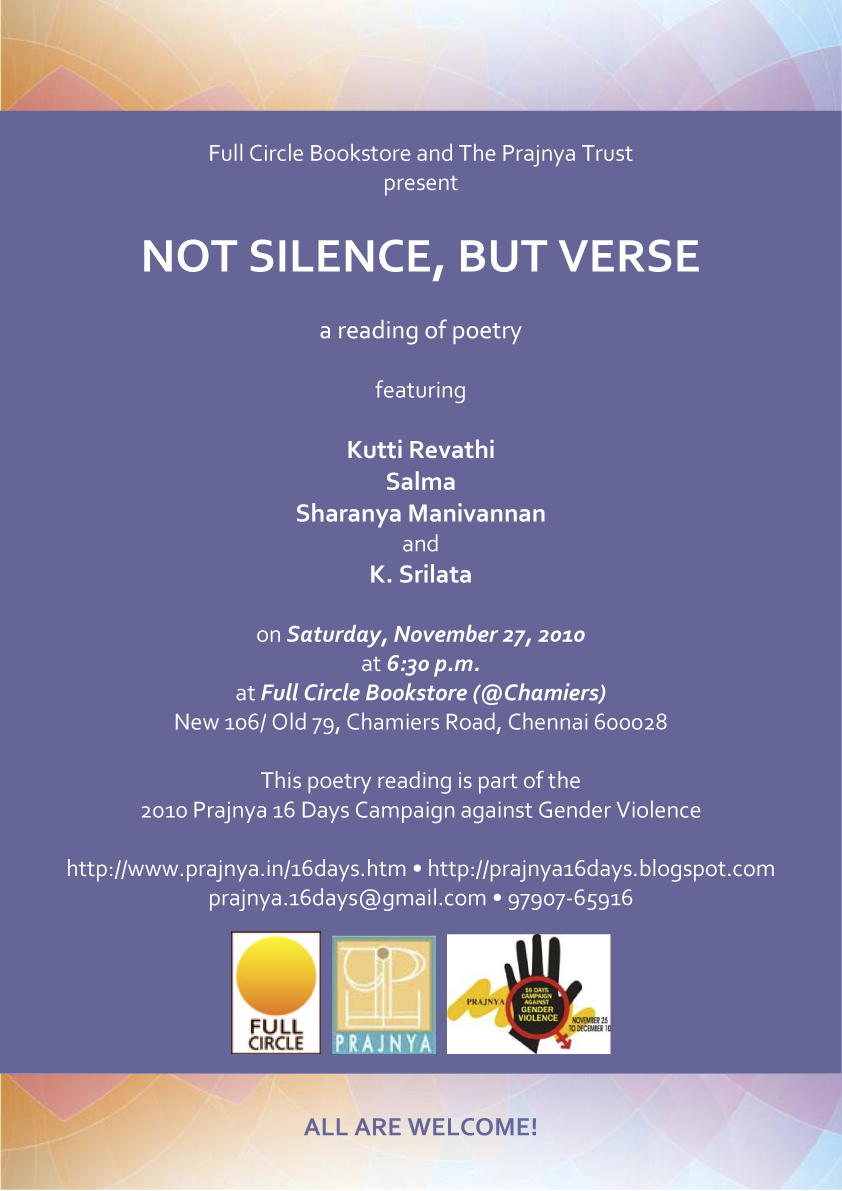
“Not Silence, But Verse” – Poetry Reading, Prajnya’s 16 Days Campaign
The Venus Flytrap: A Postcard, For You
When was the last time that the most urgent of my hopes was only that there will be bitter gourd for lunch? Because I am eating alone today, the meal is slow to come, and so I sit on the porch and look at the pepper-vined trees and ponder this until it does. There was no rain in the morning, and so the shrine visit – my most urgent hope otherwise – has been completed. It will be days before I have to think of anything else. It has been years since I have thought of nothing at all.
The food is ready. I’m disappointed – no batter-fried bitter gourd, my favourite, but there are long beans, to which I am allergic. Still, when I’m serving myself in the thatch-roofed hall, a downpour begins, and so I eat as slowly as I can, watching the earth become muddy, knowing that the sunken courtyard in the red house will fill a few inches, but dissipate by the time I return. I am here to fill my own well – but more than that, just to cleanse it, wash away all that was accumulated from everywhere but here.
So this is where I come to escape. At night, owls cry and a mad rooster from the poultry farm next door raises a ruckus. During the day, sunlight laces through leaves susurrous in the wind, and because the eight dogs know me well, I walk without fear. I find starfruit and mangosteen on the ground: echoes of my South East Asian childhood in the soil of South India. Corn grows nearby: a new experiment. There is a pool, another new thing, in which my friend threatens to skinnydip. I have a view from my window.
The memory of this place takes me a long way. I contain it the way some creatures contain water, subsisting on their interior resources long after their landscape has betrayed them.
Nearly everything I have written in the two years since I first began coming here has been a postcard – meant for one person, but sealed from no one’s eyes. But, dear reader, this is my week without letters. It is only for you that I reconnect to civilization at all. I intend to write nothing else, although tonight, in the town, I will read my poems to a few people. When I read them to my friend on the roof of this house a few evenings ago, I had looked up to see a faint rainbow in the west. I who have been led so wary by omens accepted it without suspicion.
And because it is you who is my intended now, I have wondered for days what to say to you. What can I tell you of the beauty of these present things, for which no description suffices? Snippets of conversation, an understated happiness that cannot really be imparted, of what use is all of this to you? Here, where I do not have to be who I am supposed to be, because I can be who I am, think of me today not as a witness but a well-wisher: wishing for you the same, a place so generous with its grace you can carry it back to wherever it is you must be, a deep source, a sweet scar.
An edited version appeared in The New Indian Express. “The Venus Flytrap” is my column in the Zeitgeist supplement. Previous columns can be found here.
A Poem in deuce coupe
A poem, “The Painted Boats“, in deuce coupe.
In other exciting news, two of my poems were shortlisted by Chad Sweeney for Asia Writes for Best of the Web 2010, and one was nominated. Read what Sweeney had to say here.
I know I have been silent; I surface slowly because I wouldn’t have it any other way.
Book Review: A Foreigner Carrying in the Crook of His Arm a Tiny Bomb by Amitava Kumar
The trouble with writing about war is that it’s almost impossible to do so without having to name an enemy, and some would argue, almost disingenuous not to. If taking the side of the terrorist, that vague yet absolutely damning term that has taken firm root in the world’s contemporary lexicon, is crude; then to take the side of any of the governments locking horns against this named but nebulous danger is equally reckless. In this lucid and well-researched enquiry into the American vendetta that in the decade since 9/11 has become a “global war on terror”, Amitava Kumar finds one way to approach this: from his position as an individual, he addresses the Other in the same way.
Two individuals in particular are at the centre of A Foreigner Carrying in the Crook of His Arm a Tiny Bomb. Both are men serving long-term prison sentences for the abetment of terrorist advances: Hemant Lakhani, a businessman and habitual braggart whose grandiose lies seal his fate, and Shahawar Matin Siraj, a dim-witted but almost sweetly devout young man. Both were coerced into planning terrorist attacks by paid informants. Neither, Kumar argues, would have gotten involved at all were it not for this coercion, not by radical factions but by the United States government itself. Not unlike the way in which funds that could have been used in the research and eradication of common diseases were diverted to tackle the spectral issue of biological warfare, the ordinary – if gullible – civilian becomes a target while the true progenitors of evil remain at large.
But sting operations are only the more dramatic manifestations of this: less dramatic, but pervasive, is the Islamophobia and general mistrust that had resulted in hundreds of people being taken into custody for transgressions no more serious than minor credit card fraud or having the wrong kind of name. One of the most terrifying examples enumerated in this book is that of Mohamed Yousry, a graduate student who had served as a translator in a court case, an act which later resulted in him being indicted on grounds of providing “material support to terrorists”. Neither his demonstrable lack of “suspicious” allegiance (a non-practicing Muslim with no ties to Islamic organisations, married to a Christian, raising his daughter in her mother’s faith) nor his outright condemnation of the accused he was translating for were enough to keep him from being scapegoated.
The most sinister layer to all of this is torture, as performed at Guantanamo Bay and Abu Ghraib. Here, again, the question of coercion arises: if not granted immunity (for operating under Presidential command) if not for having fallen in love with the wrong person (as Lynndie England, who emerged in shocking photographs holding a leash around a prisoner’s neck pleaded, citing her relationship with “the ringleader” of detainee abuse) – would those members of the military have committed those acts? One of the fundamental precepts this book posits is to consider power play and human psychology, difficult though it is to remain dispassionate.
The book’s most thought-provoking angle, however, deals not with the hapless but with those who make informed and conscious statements about the nature of anti-terrorism in the modern world: artists. Whether playing with shock or dealing with sentiment, the examples Kumar details are neither intellectual nor elitist responses, but a means of direct engagement. Conceptual artist Hasan Elahi’s daily web uploads detailing every aspect of his life becomes “a collaboration [with] the FBI” – by submitting himself willfully to the scrutiny of a surveillance state, he overwhelms it. Video art, installation and literature that deal with the reality of today’s world without necessarily fictionalising it are also explored: creativity as a feasible means of the reclamation of power, protest art in the age of advanced technology.
A Foreigner Carrying In The Crook of His Arm a Tiny Bomb is a valuable book, a nearly academic (and therefore highly meticulous) inquiry into anti-terrorism. In the past ten years, we have seen war through the eyes of artists and through the eyes of journalists, but Kumar’s middle ground brings something different to the discourse, and allows him to analyse both these responses as well.
Although Kumar also explores anti-terrorism in India, the book fares strongest when the focus in on America, and America’s effect on the world. His overarching argument is that the war in Iraq is “an elaborate and expensive distraction that hides from us the real crime” (of the war on terror). But while he presents this argument very successfully, the end of terrorism itself remains an open-ended question. This lack of didacticism, notable because it is quite rare in the work of political writers, is welcome. The question at the core of this text seems to be: if finger-pointing engenders and stokes conflict, where might we find ourselves if we stopped looking for easy answers?
An edited version appeared in this week’s The Sunday Guardian, New Delhi.
Book Review: Rock and Roll Jihad by Salman Ahmad
Salman Ahmad was born into a fairly charmed life: the son of a manager at Pakistan International Airlines, he travelled all over the world as a child, and migrated with his family to Tappan, New York, at the age of 12, where he discovered the world of concerts, liberal values, cross-cultural camaraderie and his own passion for music-making. So when he was sent back to Lahore in 1982 to pursue medical studies, the shock of dislocation was compounded by the shock of censorship and conservatism in an increasingly insular society. When the young Ahmad’s precious guitar is broken by a member of the self-proclaimed moral police, his destiny is sealed. He too becomes radicalized, but instead of retreating into bigotry and hatred, he accepts as his personal jihad the spreading of love and understanding, through the power of music.
Today, Salman Ahmad is known as Pakistan’s first real rock star, a musician who brought a message of hope to a politically complex part of the world with the bands Vital Signs and Junoon, and an ambassador for cultural relations whose work has dealt with repairing the divides between Islam and the West, and Pakistan and India. Rock and Roll Jihad, his memoir of his personal journey so far, is an inspiring account by a compassionate messenger of peace.
The book starts out a little awkwardly, peppered with too many parenthetical explanations – take this single line for an example, “Salman mian [young man], you want to become a mirasi [low-class musician]? Your parents have high expectations of you and you want to waste the rest of your life playing this tuntunna [gizmo]?” But as the greater ambition of this memoir – to be a reconciliatory and celebratory bridge between divides – becomes clear, this is forgiven for how helpful it might be for a young, international audience. Told in an easygoing style, brushes with glamour – like taking Mick Jagger to see dancing girls – and brushes with politics – like being banned by the government, and losing band members to ego clashes and religious fanaticism – sit comfortably with an abidingly deep spirituality.
Rock and Roll Jihad is recommended regardless of whether one is a fan of Salman Ahmad’s music – although the accompanying 12-track CD offers a bonus to anyone who is. Best suited for teenage readers, who might see in Ahmad a wonderful example of how rebellion and anger can be galvanized to heal, this simply-worded, tactfully passionate memoir is a stirring read.
Ahmad’s jihad is a beautiful one – inspired by the poets of the past and the peacemakers of the present, he sees himself and his work as a necessary voice in the greater struggle against forces of ignorance, prejudice and restriction. This book, peacefully narrated and with no hint of the ugly anger that colours the work of many activists, succeeds in spreading a message both in support of greater global harmony, and in encouraging the young to take heart as they pursue their dreams. Like all truly enlightened people, Ahmad leads by example.
An edited version appeared last week in EDEX, The New Indian Express.
Pondy Reading
I’m sorry for this being on such short notice, but I will be reading (possibly with percussion interludes) at Touchwood Studios/Bindaas Cafe, Needarajaprayar Street, Pondicherry, today at 6.30pm.
 Sharanya Manivannan
You must be logged in to post a comment.